 Arabic Grammar
| Key Takeaways |
| Sukoon (سُكُون) is a diacritical mark placed above an Arabic letter to indicate it carries no vowel sound. |
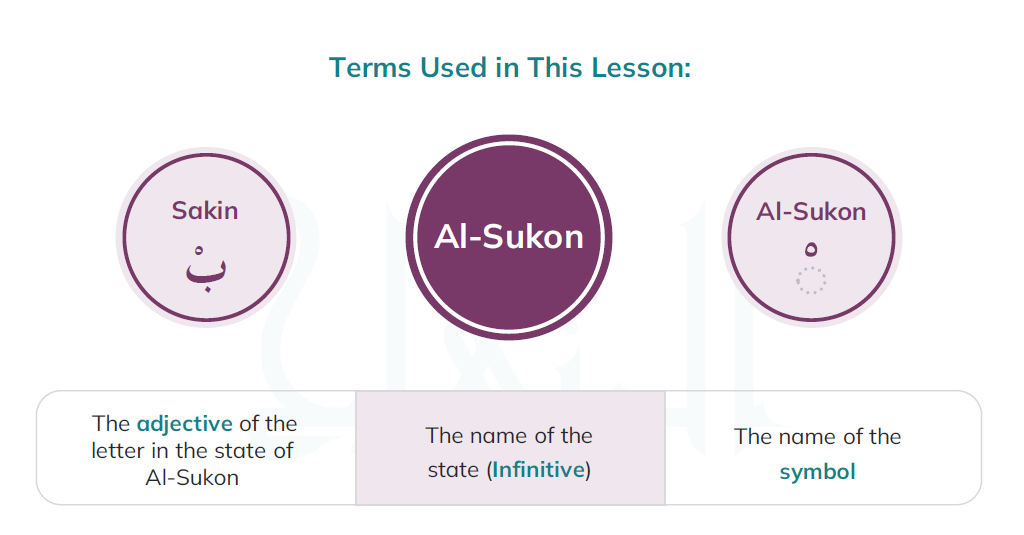
| The sukoon symbol (ْ) looks like a small open circle and is one of the essential tashkeel marks in Arabic. |
| Letters with sukoon are called sakin letters; they close a syllable and are never pronounced with a vowel. |
| In Quranic recitation, sukoon governs crucial rules of stopping, prolongation, and assimilation that affect meaning. |
| Mastering sukoon is foundational to reading Arabic correctly — errors here distort pronunciation at word level. |
Sukoon in Arabic refers to the diacritical mark (ْ) placed above a consonant to signal that the letter carries absolutely no vowel sound. A letter marked with sukoon is called ساكن (sākin) — meaning “still” or “resting.” When you see it, you pronounce the letter alone, with no following vowel. This single mark fundamentally shapes Arabic phonology and reading.
Without understanding sukoon, learners read Arabic text incorrectly from the very first word. It is not an advanced concept — it is a core literacy tool. Every properly voweled Arabic text, including the Quran, relies on sukoon to guide precise pronunciation and to mark where syllables close.
What Is the Meaning of Sukoon in Arabic?
Sukoon (سُكُون) comes from the Arabic root س-ك-ن, which carries meanings of stillness, calm, and rest. Grammatically, it signals exactly that: the letter “rests” with no vowel.
In classical Nahw scholarship, a letter bearing sukoon is described as being in a state of وقف (waqf) at that consonant — the voice does not continue into a vowel.
What Is the Symbol of Sukoon and How Is It Written?
The sukoon symbol is a small, hollow circle (ْ) written directly above the letter it modifies. It resembles a miniature version of the letter هـ or a small zero floating above the consonant. It appears exclusively in fully voweled (mushakkal) Arabic text, including Quranic script, children’s books, and language learning materials.
Here is how it appears on a common Arabic consonant:
بْ = the letter Baa with sukoon → pronounced simply as “b,” with no following vowel.
Compare this to:
| Mark | Symbol | Example | Pronunciation |
| Fatha | َ | بَ | “ba” |
| Kasra | ِ | بِ | “bi” |
| Damma | ُ | بُ | “bu” |
| Sukoon | ْ | بْ | “b” (no vowel) |
This table captures the essential distinction learners must internalize early.
Explore and Study Al-Menhaj Book for Free
What Are Sukoon Letters and How Do They Function?
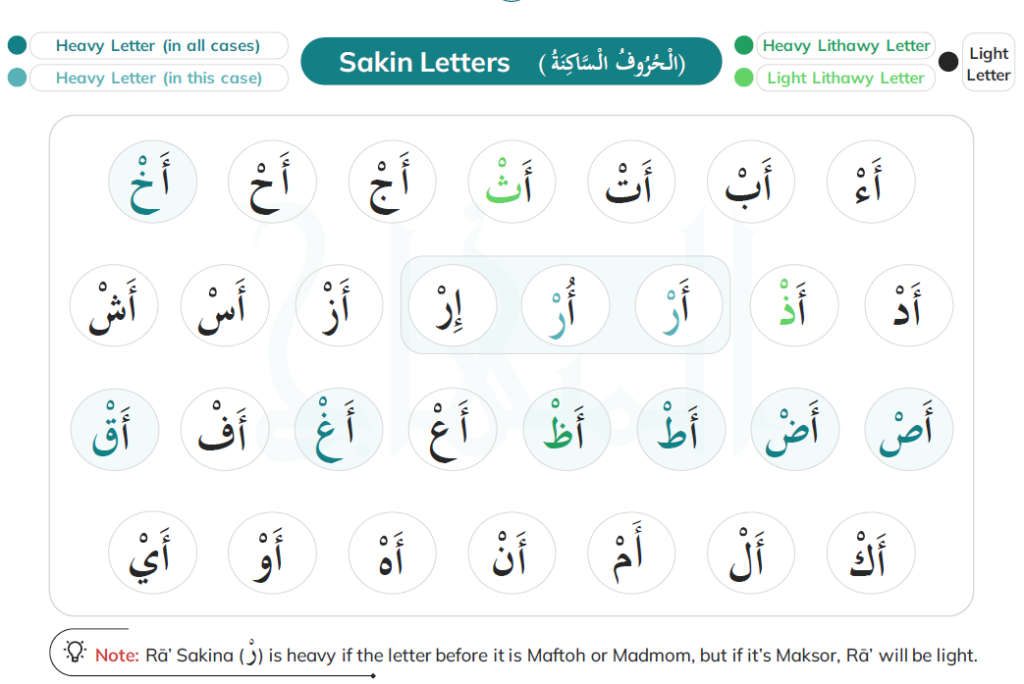
Sukoon letters — called حُرُوف سَاكِنَة (huruf sakinah) — are any Arabic consonants that carry the sukoon mark. They have no vowel of their own and must always follow a vowelled letter. In Arabic, a word can never begin with a sakin letter — this is a firm phonological rule in the language.
The rule governing sukoon letters: every sakin letter must be preceded by a vowelled letter. This is why Arabic uses the (hamzat al-wasl) — a connective hamza — to allow speech to flow across cluster boundaries.
In the word مَسْجِد (masjid) — “mosque”:
مَسْجِد Masjid “Mosque”
The س carries a sukoon. Notice it follows مَ, which bears a fatha. The syllable structure becomes: ma-SJID. The sukoon closes the first syllable.
Students at The Arabic Learning Centre working through our Learn to Read Arabic Course regularly encounter confusion in weeks two and three of study. The correction comes fastest when learners audibly elongate the vowel and feel the difference in breath duration.
Start Reading Arabic with a FREE Trial

Where Sukoon Appears in a Word?
Sukoon can appear in the middle or at the end of a word but never at the beginning, because a word must start with a vowel sound in Arabic.
Examples:
- أَبْ (ab)
- مِنْ (min)
- يَلْعَبُ (yal‘abu)
Exception – Long Vowels:
Arabic long vowels (ا، و، ي) sometimes appear with sukoon in certain scripts, especially for non-native learners, but they aren’t pronounced differently.
For instance:
- بُوْ and بُو are pronounced the same.
Shots Videos from Our Courses
Examples of Sukoon in Arabic Words
Sukoon symbol (ْ) on one of their letters. An example of this is:
مُسْلِمَتَانِ) – اَبُوْهُمَا – كَيْدُكُمْ – (منْزل
Here are more examples:
| Word | Breakdown | Meaning |
| أَبْ | alif + ba + sukoon | father |
| مِنْ | meem + kasra + noon suk. | from |
| شَرَبْ | sheen + fatha + Ba + sukoon | drink (noun) |
| يَكْتُبْ | ya + fatha + kaf sukoon + damma | he writes |
Sukoon in verbs
Sukoon is the original affirmative sign. Jazm is concerned with the present tense verb only, and the Sukoon replaces the deletion of the vowel and also the deletion of the letter Noon. Cases of Jazm the present verb with Sukoon can be illustrated in the following examples:
- يرسم = لم يرسمْ.
- يقبل = لم يقبلْ.
- ينظف = لم ينظفْ
Sukoon and Arabic Grammar
In Arabic, the word does not begin with a Sukoon at all. This means that the first letter of the word must be a vowel. If a word exceeds three letters, it must be followed by a consonant or more. That is: we do not find in the Arabic word four vowels, except for a reason, or as a matter of anomaly according to the rule of dividing the Arabic word into syllables.
In Arabic morphology, sukoon is essential for:
- Verb conjugation: many verb forms end with a sukoon (e.g., past tense)
- Syllable formation: Arabic often uses consonant-vowel-consonant patterns
- Reading fluency: mastering sukoon helps learners blend sounds naturally
Note: Words never begin with a sukoon, because Arabic phonotactics require an initial vowel.
For learners exploring these patterns in structured lessons, our Arabic Grammar Course at The Arabic Learning Centre introduces sukoon in context rather than isolation, which dramatically accelerates recognition.
Start Learning Arabic Grammar with a Free Trial

How Do You Pronounce Sukoon in Arabic Correctly?
To pronounce a letter with sukoon correctly, articulate it at its full makhraj (مَخْرَج) — point of articulation — and stop immediately, without releasing into any vowel sound. The letter is complete; no breath continues past it.
A common error: beginner learners add a faint “uh” sound after sakin letters — pronouncing كَلْب as “kal-ub” instead of “kalb.” This happens because English syllables rarely end in bare consonants without a following vowel, so the learner unconsciously adds one.
The correction is physical: press the tongue, lips, or throat firmly into the makhraj position, then close it. For لْ, the tongue tip touches the alveolar ridge — and stops. For بْ, both lips come together — and hold.
In our experience at The Arabic Learning Centre, this over-voweling habit resolves within two to three weeks of deliberate sukoon drills, especially when students shadow native recitation audio.
What Is the Importance of Sukoon in Understanding Arabic?
Sukoon is not a secondary mark — it is a structural element of Arabic phonology that determines syllable shape, word stress, and grammatical parsing. Without it, voweled Arabic text cannot be read accurately.
Arabic syllables follow strict patterns:
- Open syllable (CV): Consonant + vowel — e.g., مَ (ma)
- Closed syllable (CVC): Consonant + vowel + consonant-with-sukoon — e.g., مَن (man)
- Long vowel syllable (CVV): Consonant + long vowel — e.g., ما (maa)
Sukoon creates the closed syllable. Without understanding it, learners cannot identify where syllables begin and end — and word stress, which falls on specific syllable types in Arabic, becomes impossible to apply correctly.
Our Arabic Pronunciation Course at The Arabic Learning Centre dedicates early sessions specifically to syllable-type recognition because it underpins everything that follows in spoken fluency.
Begin Pronouncing Arabic Fluently with a Free Trial

What Is the Grammatical Role of Sukoon in the Arabic Language?
In Arabic grammar (Nahw), sukoon functions as a grammatical marker — specifically as the sign of جَزْم (jazm) on verbs and the sign of a مَجْزُوم (majzum) verb in certain grammatical constructions. This is where sukoon moves beyond phonology into syntax.
When a verb is put into the jussive mood — a specific grammatical state triggered by certain particles — its final letter receives a sukoon instead of a short vowel. This tells the reader the verb is in a dependent clause with a specific meaning.
لَمْ يَكْتُبْ
Lam yaktub
He did not write
Here, يَكْتُبْ ends in sukoon on the بْ — marking it as jussive (majzum). Compare this to يَكْتُبُ (yaktubu) in the indicative, where the بُ carries a damma.
This is the grammatical role of sukoon: a visible marker of mood and grammatical state, not just a phonological signal.
What Is the Difference Between Sukoon and Jazm?
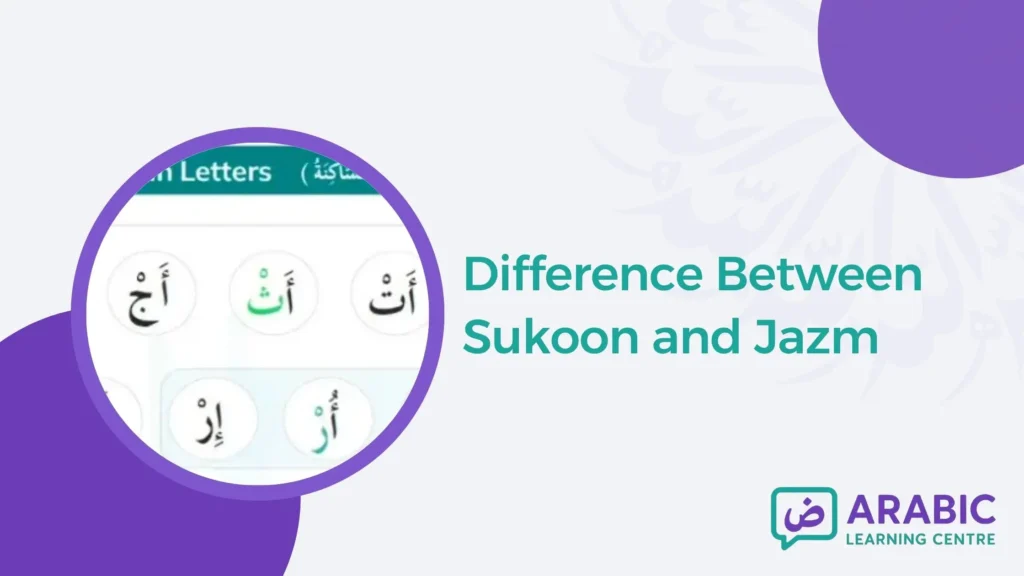
Sukoon and jazm are related but distinct: sukoon is the physical mark (ْ), while jazm is the grammatical state it represents on verbs. Learners frequently conflate them, but the distinction matters for proper grammatical analysis.
| Term | Arabic | Applies To | Function |
| Sukoon | سُكُون | Any letter | Phonological: no vowel on this letter |
| Jazm | جَزْم | Verbs only | Grammatical: verb is in jussive mood |
Think of it this way: sukoon is the sign; jazm is the grammatical state that sign can indicate in verbal contexts.
A letter at the end of a noun can also carry sukoon — but that is not called jazm. Jazm is reserved strictly for the grammatical analysis of verbs. Classical Nahw scholars are precise about this distinction, and learners of formal Arabic grammar must be equally precise.
How Does Sukoon Function in Arabic Calligraphy?
In Arabic calligraphy, the sukoon mark is considered one of the tashkeel elements that the calligrapher must place with precision and aesthetic balance above the letter it governs. Its circular form naturally complements the flowing curves of Arabic script styles.
In the Naskh script — the most commonly taught style for beginners — sukoon sits centered and proportional above the letter. In Thuluth calligraphy, it may be slightly stylized. In Quran manuscripts, sukoon placement is standardized according to recitation tradition.
For learners focused on reading rather than calligraphic art, the practical point is this: in handwritten Arabic, sukoon must be clearly distinguishable from the shadda (ّ) and from the tanwin marks. Unclear sukoon placement is a source of misreading.
Sukoon in Quranic Recitation
In Tajweed — the science of Quranic recitation — sukoon triggers several of the most important pronunciation rules, including idgham (assimilation), ikhfa (concealment), and qalqalah (echoing sound). Understanding sukoon is therefore foundational to correct Quran reading.
What Is Qalqalah and How Does Sukoon Activate It?
Qalqalah (قَلْقَلَة) — a slight echoing or bouncing quality — is produced specifically on five letters when they carry sukoon: ق، ط، ب، ج، د. When any of these five letters receives a sukoon, the reciter produces a brief resonant echo at the point of articulation.
قَلْب (Qalb) — “heart” — the لْ does not cause qalqalah, but if this word were recited with pause on a final قْ, qalqalah would apply.
For Muslims learning to read Quran correctly, our Quranic Arabic Course at The Arabic Learning Centre covers sukoon-based tajweed rules methodically, with native-speaker recitation modeling.
Join Our Quranic Arabic Course With a Free Trial

Read Also: The Difference Between Sukoon and Jazm in Arabic Grammar
How to Learn Sukoon in Arabic Effectively
The most effective method for learning sukoon is combining visual recognition drills with audio modeling — learning what it looks like and simultaneously internalizing what it sounds like from native recitation. Neither alone is sufficient.
A structured four-step approach used at The Arabic Learning Centre:
- Identify — Locate the sukoon symbol in fully voweled texts. Count sakin letters per word before attempting pronunciation.
- Contrast — Practice minimal pairs: words identical except one letter has a fatha and another has sukoon. Feel the difference in the mouth.
- Shadow — Listen to native recitation or speech and repeat immediately. The ear trains before the eye.
- Apply — Write short Arabic words from dictation with tashkeel, placing sukoon correctly.
Students who work through our Arabic Course for Beginners at The Arabic Learning Centre typically achieve consistent sukoon recognition within the first four weeks, provided they practice with voweled texts daily.
For those interested in the broader context of Arabic script and letter forms, our guide on mastering the Arabic alphabet is an excellent companion resource.
Read Also: How Many Harakat Are in Arabic?
Our Students Reviews
Start Learning Arabic with Certified Instructors at The Arabic Learning Centre
Sukoon is one of several foundational marks that separate accurate Arabic reading from guesswork — and mastering it requires structured, guided practice from the beginning.
The Arabic Learning Centre offers:
- 1-on-1 sessions with certified native Arabic instructors
- Flexible scheduling available 24/7
- Structured curricula covering tashkeel, tajweed, and grammar from day one
- A free trial lesson to experience the teaching approach firsthand
- Dedicated courses for beginners, kids, ladies, and Islamic studies learners
Whether your goal is conversational fluency, Quranic reading, or formal grammar mastery, the right course is waiting for you. Explore our Arabic Grammar Course or book your free trial today.
Check out our top courses in Arabic and choose the course you need to start learning Arabic today:
- Arabic Course for Beginners
- Arabic Script Writing Course
- Arabic Speaking Course
- Learn Arabic Letters for Tajweed
- Learning Arabic Grammar
- Arabic Vocabulary Course
- Fusha Arabic Course
- Classical Arabic Course
- Arabic Course for Islamic Studies
- Quranic Arabic Course
- Learn Arabic for New Muslims
Start with a FREE trial class and enhance your Arabic language skills

Conclusion
Sukoon is one of the lightest marks in Arabic script — a small open circle — but its impact on pronunciation, grammar, and meaning is substantial. Every Arabic word carries syllable structure shaped by where sukoon falls. Every verb in jussive mood announces its grammatical state through that same mark.
Learners who internalize sukoon early stop guessing at pronunciation and start reading with real accuracy. It becomes automatic within weeks of consistent practice with voweled texts.
The path forward is straightforward: read fully voweled Arabic daily, listen to native speakers actively, and work through sukoon rules with a qualified instructor who can correct errors in real time. The marks on the page exist precisely to guide you — sukoon included.
Read Also: Harakat in Arabic
Frequently Asked Questions About Sukoon in Arabic
What Is Sukoon in Arabic?
Sukoon (سُكُون) is a diacritical mark — a small hollow circle (ْ) placed above an Arabic consonant — indicating that the letter carries no vowel sound. The marked letter is called sakin, meaning “still.” Sukoon appears in fully voweled Arabic texts, including the Quran and Arabic learning materials for beginners.
What Is the Difference Between Sukoon and Jazm?
Sukoon is the physical mark (ْ) indicating no vowel on any letter. Jazm is the grammatical state — specifically the jussive mood of Arabic verbs — that sukoon represents when it appears on a final verb letter. All jussive verbs carry sukoon, but not all sukoon marks indicate jazm. Jazm applies only to verbs; sukoon applies to any letter.
How Do You Pronounce a Letter With Sukoon?
Pronounce the letter at its full point of articulation (makhraj) and stop without adding any vowel sound after it. The most common beginner error is inserting a faint “uh” after sakin letters. To correct this, articulate firmly at the makhraj and close immediately. Listening to native Arabic recitation and shadowing it closely is the fastest fix.
Why Is Sukoon Important in Quranic Recitation?
In Tajweed, sukoon activates several recitation rules that directly affect how letters are pronounced. The qalqalah rule — which produces a resonant echo — applies only when one of five specific letters carries sukoon. Correct sukoon recognition is therefore necessary to apply tajweed rules properly and recite the Quran with accuracy.
Can an Arabic Word Begin With a Sakin Letter?
No. Arabic phonology does not allow a word to begin with a letter bearing sukoon. When grammar would otherwise require this, Arabic uses the hamzat al-wasl (همزة الوصل) — a connective hamza — to introduce the word with a vowel sound, allowing the sakin letter to appear only after the preceding vowelled syllable in connected speech.