 Learn Arabic

| Key Takeaways |
| Arabic tracing worksheets use dotted letter outlines to build muscle memory for all 28 Arabic letters. |
| Each Arabic letter has four positional forms — isolated, initial, medial, and final — that quality worksheets cover. |
| Free printable Arabic tracing PDFs are available for both children and adult beginners from several verified sources. |
| Islamic-themed tracing worksheets pair each letter with a religious vocabulary word, making them ideal for Muslim learners. |
| Tracing practice works best when combined with structured reading and writing instruction from a qualified Arabic teacher. |
Arabic tracing worksheets are printable or downloadable practice sheets that display each of the 28 Arabic letters in a dotted or outlined font, allowing the learner to trace the correct stroke sequence directly on the page. They are one of the most reliable starting tools for building the fine motor memory needed to write Arabic script accurately.
What makes Arabic tracing practice genuinely different from English alphabet practice is the system of positional letter forms. Unlike Roman letters, each Arabic letter can look different depending on whether it appears at the beginning, middle, or end of a word — or stands alone. A good tracing worksheet accounts for all four of these forms.
1. Free Islamic Arabic Alphabet Colouring and Tracing Worksheets
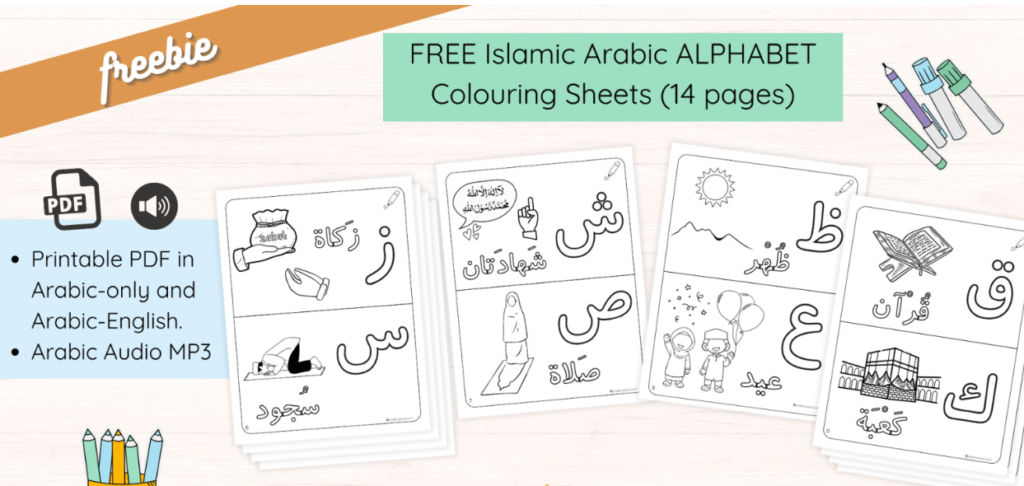
The Arabic Seeds Islamic Arabic Alphabet worksheets include an Islamic word for each letter of the Arabic alphabet, with colouring and tracing space for both the letter and its corresponding word and picture. The resource includes both Arabic-only and Arabic-English PDF files, alongside free Arabic audio MP3 files to support pronunciation and memorization.
This makes the Arabic Seeds set one of the most complete free packages available for Muslim families and beginners who want vocabulary exposure alongside handwriting practice.
What Makes This Worksheet Set Stand Out
Each page of the Arabic Seeds set focuses on a single letter and pairs it with an Islamic vocabulary word — for example, أ (Alif) is paired with أَمَانَة (amāna, “trustworthiness”). The learner traces both the isolated letter and the full word. This dual exposure is pedagogically sound because it teaches letters in context rather than in isolation.
The accompanying audio files are a notable addition. Hearing the correct pronunciation of each letter’s associated word while tracing helps embed both the written form and the spoken sound simultaneously. At The Arabic Learning Centre, our certified Arabic instructors consistently observe that students who combine auditory reinforcement with hand-tracing retain letter shapes significantly faster than those using silent worksheets alone.
Note for parents: The Arabic Seeds resource notes that some Islamic words carry deeper meaning than the simple illustrations can convey — so a brief explanation from a parent or teacher adds real value here.
2. Arabic Alphabet Tracing with Freehand Writing Lines
The My Resource Station worksheets include tracing for each Arabic letter followed by a dedicated space for writing without tracing. The writing area is lined to help learners correctly position each letter, making this resource well-suited for beginners who need structured practice and gradual progression from guided tracing to freehand writing.
This graduated approach — trace first, then write independently — is exactly the method The Arabic Learning Centre’s instructors use in our Arabic Course for Beginners. The transition from tracing to freehand is the critical step most self-study learners skip too quickly.
Join Our Arabic Course for Beginners With a Free Trial

Why the Writing Lines Matter
In Arabic script, letter baseline positioning determines legibility. Letters like ب (Ba) sit on the line, while others like و (Waw) and ي (Ya) drop below it with descending tails. A worksheet without ruled lines teaches letter shapes but not placement — which leads to inconsistent handwriting.
The My Resource Station sheets teach this baseline discipline from the very first practice session.
Access: myresourcestation.weebly.com
Read also: The Best Arabic Letter Worksheets
Shots Videos from Our Courses
3. Free Arabic Alphabet Tracing Worksheet PDF (Alif to Ya)
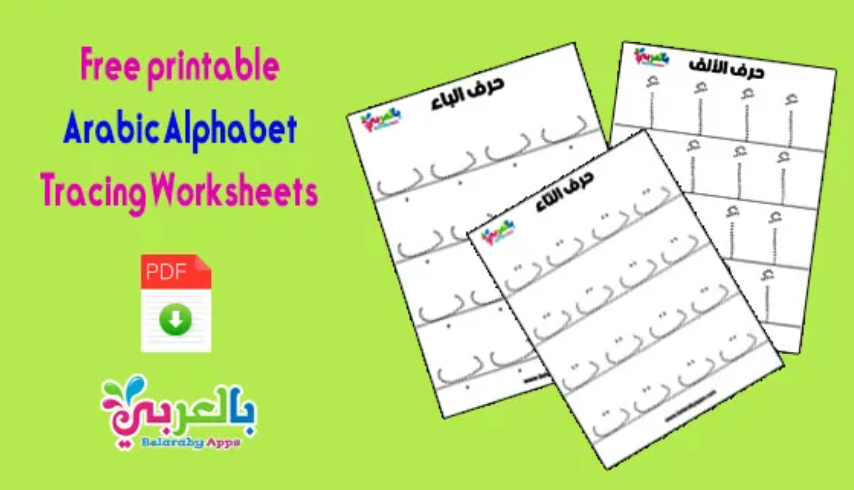
BelarabyApps offers a free printable Arabic Alphabet Tracing Worksheet PDF that covers each letter from Alif to Ya. The worksheets are designed to develop fine motor skills while giving learners practice in reading, tracing, and writing the Arabic alphabet.
The BelarabyApps resource is notable because it originates from a dedicated Arabic learning app ecosystem.
The worksheets show the correct formation of each letter and include the letter’s dots in their proper positions, making them particularly useful for distinguishing visually similar letters such as ب (Ba), ت (Ta), and ث (Tha), which share an identical base shape but differ only in the number and placement of dots.
Mastering the Dot-Distinction Problem
This is one of the most common errors our instructors see at The Arabic Learning Centre: adult beginners learning ب, ت, and ث recognize the base shape correctly but write the dots inconsistently. This happens because the hand traces the body of the letter fluently but then places the dots as an afterthought — rather than integrating them into the stroke sequence.
The BelarabyApps worksheet format helps correct this by treating each dotted letter as a single unified formation, not a base letter plus separate marks.
Read also: How to Learn Arabic as an English Speaker?
4. 28 Individual Arabic Letter Tracing PDFs (Alif to Ya)
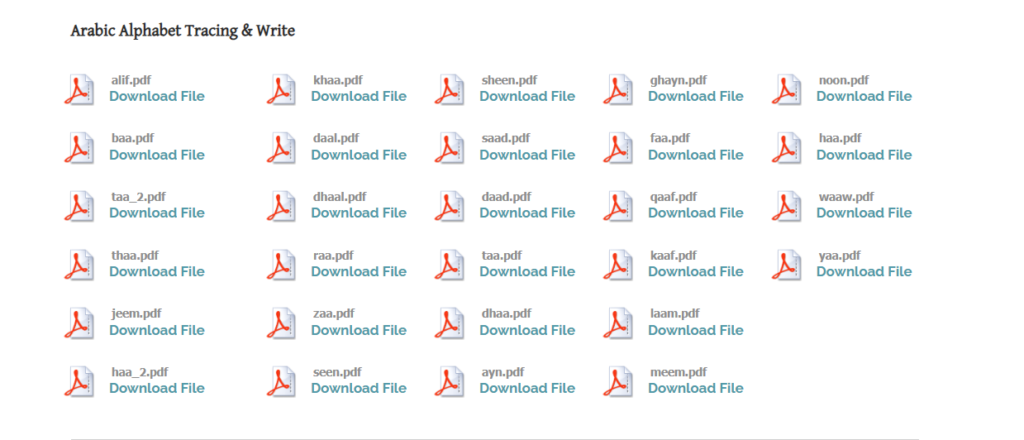
123Arabic offers a free downloadable set of 28 high-resolution PDF files, each featuring a different Arabic letter from Alif to Ya. The worksheets feature large, clear Arabic letters designed to be easy for learners to trace, and are described as ideal for pre-writing skill development.
Having one PDF per letter is a genuine structural advantage. It allows a learner — or teacher — to focus intensively on a single letter across an entire session before moving on. This approach aligns with what we know about letter acquisition sequencing in Arabic pedagogy: depth of practice per letter matters more than breadth at the early stage.
How to Use One-Letter-Per-Sheet Worksheets Effectively?
Our recommendation at The Arabic Learning Centre is to group the 28 letters by shape family rather than working alphabetically. For example:
| Shape Family | Letters |
| Tooth-base (one dot below) | ب (Ba) |
| Tooth-base (two dots above) | ت (Ta) |
| Tooth-base (three dots above) | ث (Tha) |
| Cup with two dots | ن (Nun) |
| Circular letters | د (Dal), ذ (Dhal), ر (Ra), ز (Zayn) |
Grouping by shape reduces confusion and builds faster recognition. A student who masters the tooth-base family together immediately understands that the dots — not the body — carry the phonetic distinction.
5. Arabic Letters Tracing Sheets (Print-Ready PDF)
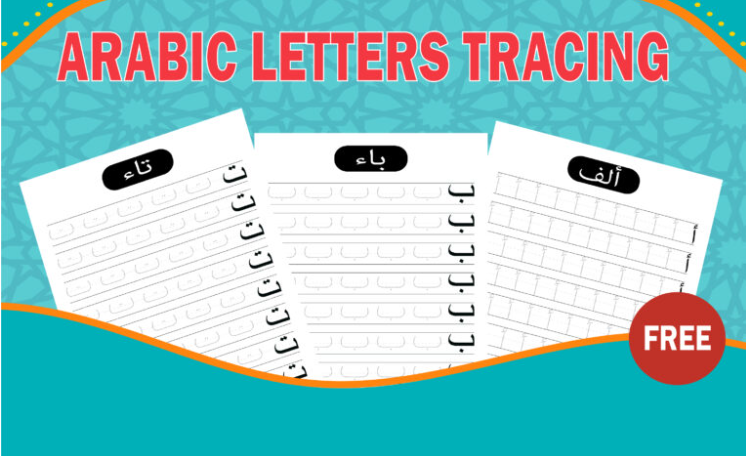
The Scribd Arabic Letters Tracing Sheets collection covers tracing rows for each Arabic letter, from Alif through to the end of the alphabet.
The document was created for repeated use — the creator recommends printing and laminating sheets to allow multiple practice rounds with a dry-erase marker rather than consuming printed copies.
The lamination suggestion here is practically sound and worth following. In our instructors’ experience, learners who laminate their tracing sheets and use a fine-tip dry-erase marker practice more frequently because there is no friction around “wasting paper.” The lower the barrier to picking up the sheet, the more repetitions accumulate — and repetition is the sole mechanism by which muscle memory for letter formation develops.
6. Teachers Pay Teachers (TPT) — Free Arabic Tracing Worksheets for Classroom Use
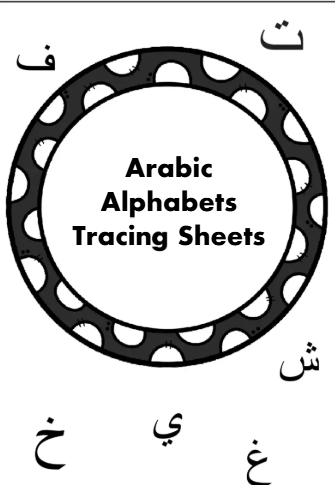
Teachers Pay Teachers hosts a large selection of free Arabic letter tracing resources uploaded by educators. These include worksheets with dotted letters for tracing, letter recognition activities, worksheets covering each letter’s four positional forms, and resources covering Arabic letter connection within words.
The TPT marketplace is particularly valuable because many resources are created by practising Arabic teachers rather than content publishers. This means the pedagogical sequencing tends to be more reliable — particularly for worksheets that address letter forms by word position.
What to Look for in a TPT Arabic Tracing Worksheet
Not all free TPT resources are equally useful. When selecting, prioritize worksheets that include:
- Directional stroke arrows — showing the correct starting point and direction of each stroke
- All four positional forms — isolated, initial, medial, and final — on the same page or in sequence
- Connection practice rows — showing how the letter joins to adjacent letters in a word
Worksheets that show only the isolated letter form are adequate for a first introduction but insufficient for developing real writing fluency. Arabic is a fully connected script — the letter ب in بسم (Bism) looks and connects differently than ب in كتب (kataba), and this distinction needs dedicated practice.
To support this next stage, our Learn to Read Arabic Course provides systematic training in letter connections within structured word-level reading practice.
How to Choose the Right Arabic Tracing Worksheet for Your Level?
Arabic tracing worksheets are not all equivalent in difficulty or scope. Matching the worksheet to the learner’s current stage prevents frustration and maximises time spent on genuine skill-building.
| Learner Stage | Recommended Worksheet Type | What to Look For |
| Absolute beginner (no letter knowledge) | Isolated letter tracing, one letter per page | Large dotted letters, directional arrows, minimal distraction |
| Early beginner (recognises some letters) | Letter forms by position (initial/medial/final) | Side-by-side form comparisons, stroke direction guides |
| Developing beginner (all letters recognised) | Word-level tracing and letter connection sheets | Connected letter rows, baseline-ruled writing space |
| Intermediate | Sentence-level copying and dictation practice | Tashkeel (vowel marks) included, short meaningful phrases |
For most adult learners starting from zero, realistic progress looks like this: approximately 3–4 weeks of daily 15-minute tracing sessions to gain confident recognition and rough production of all 28 letters in isolated form.
Adding the four positional forms typically requires another 2–3 weeks of targeted practice. This timeline assumes consistent daily practice — not occasional sessions.
If you are learning Arabic for Quran reading specifically, our Al-Menhaj Book at The Arabic Learning Centre provides a structured letter-to-reading pathway designed specifically for non-native adult learners, integrating letter recognition, form variation, and early Quranic word reading into a single progressive programme.
Working through worksheets alongside our online Arabic classes for kids or our adult reading programme accelerates progress significantly — because a certified instructor can immediately correct incorrect stroke habits that a worksheet alone cannot diagnose.
Our Students Reviews
Enroll your child in our Arabic Classes for KIDS with a free trial

Read Also: Free Arabic Practice Worksheets
Start Learning Arabic Script With Certified Instructors at The Arabic Learning Centre
Tracing worksheets build the foundation — but structured instruction builds the skill. The Arabic Learning Centre offers:
- Certified native Arabic instructors with extensive experience teaching non-Arabic speakers
- 1-on-1 personalised sessions available 24/7 to fit any schedule
- A structured Arabic Course for Beginners that takes learners from letter recognition through confident reading
- Dedicated online Arabic classes for kids with age-appropriate pacing
- A Learn to Read Arabic Course for learners focused on reading fluency
Book your free trial lesson today and let our certified instructors give you the personalised foundation that worksheets alone cannot provide. Insha’Allah, fluent Arabic reading is closer than you think.
Check out our top courses in Arabic and choose the course you need to start learning Arabic today:
- Arabic Course for Beginners
- Arabic Script Writing Course
- Arabic Speaking Course
- Learn Arabic Letters for Tajweed
- Learning Arabic Grammar
- Arabic Vocabulary Course
- Fusha Arabic Course
- Classical Arabic Course
- Arabic Course for Islamic Studies
- Quranic Arabic Course
- Learn Arabic for New Muslims
Start with a FREE trial class and enhance your Arabic language skills

Read Also: Downloadable Arabic Worksheets for Beginners
Frequently Asked Questions About Arabic Tracing Worksheets
What Are Arabic Tracing Worksheets and How Do They Work?
Arabic tracing worksheets are printable or digital practice sheets that display Arabic letters in a dotted or outlined format, allowing the learner to trace the correct stroke path directly on the page. They build fine motor memory for letter shapes and stroke direction, helping learners move toward independent freehand writing by internalising the correct formation sequence.
Are Arabic Tracing Worksheets Suitable for Adult Beginners?
Yes — Arabic tracing worksheets are equally effective for adults and children. Adults may progress through the isolated-letter stage faster than young children due to stronger existing fine motor control. However, adults benefit from worksheets that additionally cover positional forms and letter connection, since adult learners typically advance to word-level reading more quickly and need this skill sooner.
How Many Times Should a Learner Trace Each Arabic Letter?
A minimum of 10–15 repetitions of each letter per session is a practical starting point. More important than a fixed count is quality of attention: tracing the stroke in the correct direction with the correct starting point matters more than tracing quickly. Once a learner can produce the letter without looking at the dotted guide, that letter is ready to move to freehand practice.
What Is the Correct Stroke Direction for Arabic Letters?
Arabic is written right to left, and most letter strokes begin from the right side of the letter body and move left or downward. Directional stroke arrows on quality worksheets make this explicit. This right-to-left directionality is one of the most common early errors in English-speaking learners — defaulting to left-to-right stroke habits that produce malformed letters even when the overall shape appears superficially correct.
Should Children Learn All 28 Arabic Letters Before Practising Words?
Not necessarily. A more effective method — and the one The Arabic Learning Centre’s instructors use — is to introduce a small group of letters (typically 4–6 with distinct shapes), practise them to a confident level, and then immediately show how those letters form simple words. This accelerates motivation and makes the connection between letter knowledge and reading ability feel immediate and rewarding.
Related Articles
Learn Arabic