 Arabic Resources & Courses
| Key Takeaways |
| Structured online courses with certified instructors consistently produce faster Arabic progress than self-study apps alone. |
| Arabic learners need resources that address script, grammar, pronunciation, and conversation — no single tool covers all four effectively. |
| Apps like Duolingo build vocabulary habits but cannot replace grammatical explanation or pronunciation correction from a qualified teacher. |
| Beginners should prioritize Arabic script literacy first — reading confidence accelerates every other Arabic skill that follows. |
| The most effective Arabic learning strategy combines a primary structured course with one supplementary vocabulary or listening resource. |
The best Arabic language learning resources combine structured instruction with consistent daily practice — and the right combination depends on your goals, whether that is reading the Quran, holding a conversation, or mastering Modern Standard Arabic grammar. Not all resources are equal, and knowing which tools serve which purpose saves you months of wasted effort.
Most learners who struggle with Arabic are not lacking motivation — they are using the wrong resources in the wrong order. Script-first, grammar-second, and conversation-third is the progression that produces durable results. The resources below have been selected based on what genuinely works for non-Arabic speaking learners at every stage.
1. Structured Online Arabic Courses with Certified Instructors
Structured online courses with certified Arabic instructors remain the single most effective Arabic language learning resource for non-native speakers. They provide personalized error correction, sequenced grammar instruction, and accountability — none of which self-study tools can replicate.
Every other resource on this list works best as a supplement to a structured course, not a replacement for one.
At The Arabic Learning Centre, our Arabic Course for Beginners is designed specifically for non-Arabic speakers starting from zero. Students receive 1-on-1 sessions with certified native Arabic instructors, flexible scheduling available 24/7, and a structured curriculum that moves from Arabic script through grammar and into conversational use — in the correct sequence.
Join Our Arabic Course for Beginners With a Free Trial

Students at The Arabic Learning Centre regularly find that the first four weeks of structured instruction cover more ground than several months of app-based self-study — primarily because a certified instructor catches pronunciation and script errors before they become habits.
If your goal is Arabic grammar mastery, our dedicated Arabic Grammar Course builds classical Nahw (النَّحْو) competency systematically, covering concepts like the إضافة (idafa) genitive construction, فاعل (fa’il) subject-verb agreement, and case endings — with practical sentence application throughout.
2. Arabic Alphabet and Script Learning Guides
Arabic script literacy is the foundational resource every beginner needs before anything else. Non-Arabic speakers must internalize all 28 letters in their four positional forms — isolated (مُنْفَرِد), initial (أَوَّل), medial (وَسَط), and final (آخِر) — before reading or writing Arabic becomes functional. Attempting vocabulary or grammar without script fluency creates a ceiling that limits all further progress.
Our detailed guide on how to master the Arabic alphabet covers letter formation sequences, connection rules, and the exact errors most beginners make when learning to write Arabic for the first time.
| Letter | Isolated | Initial | Medial | Final |
| ب (Ba) | بـ — | بـ | ـبـ | ـب |
| ع (Ayn) | ع | عـ | ـعـ | ـع |
| م (Meem) | م | مـ | ـمـ | ـم |
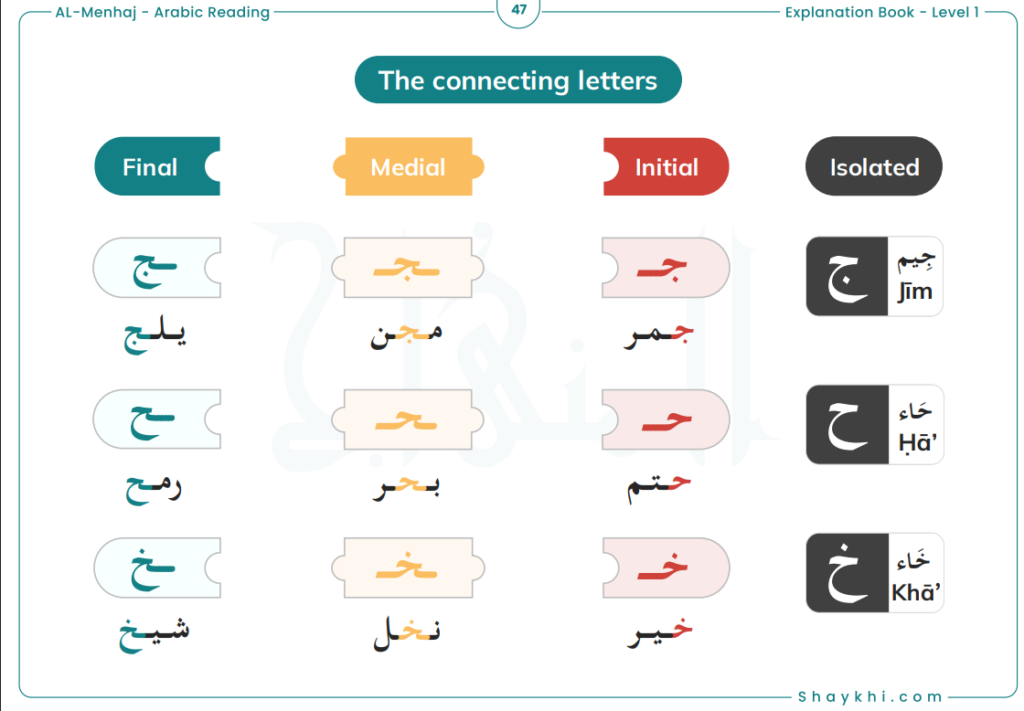
In our instructors’ experience, adult learners who practice letter formation for 15 minutes daily — focusing on one letter family per session — recognize all 28 letters within three to four weeks. The key is tracing each letter through all four positional forms before moving to connected words.
For younger learners, our Arabic alphabet guide for kids uses age-appropriate visual sequences proven to build letter recognition faster than adult-formatted textbooks.
3. Arabic Vocabulary Apps and Flashcard Systems
Vocabulary apps serve a specific and limited function as Arabic language learning resources — they are effective for building and reviewing word banks, but they cannot teach grammar, script formation, or pronunciation accuracy. Used correctly, spaced repetition apps like Anki accelerate vocabulary retention significantly when paired with a structured course.
The most practical approach is building thematic vocabulary sets: household items, body parts, common verbs, and basic adjectives first — then moving to topic-specific sets as your Arabic progresses.
Our Arabic Vocabulary Course at The Arabic Learning Centre takes a structured approach to vocabulary acquisition, organizing words within grammatical patterns so that learners absorb vocabulary and sentence structure simultaneously — a method that outperforms isolated word memorization in retention tests.
Enroll in Our Arabic Vocabulary Course to Get Your Free Trial

| Resource Type | Best For | Limitation |
| Anki (spaced repetition) | Long-term vocabulary retention | No grammar or pronunciation |
| Duolingo Arabic | Daily habit formation | Minimal grammar depth |
| Arabic vocabulary course | Structured acquisition with context | Requires scheduling commitment |
One practical note: when using flashcard apps for Arabic, always include the Arabic script version of each word — not just transliteration.
Learners who build vocabulary exclusively through romanized transliteration develop a dependency that slows reading progress significantly.
4. Arabic Pronunciation Resources and Audio Tools
Arabic pronunciation cannot be self-taught to an accurate standard through text resources alone — the language contains sounds with no English equivalent, and incorrect pronunciation habits form within the first weeks of learning if not corrected early. Dedicated audio resources and a certified Arabic pronunciation instructor are both essential for this skill.
The makhraj (مَخْرَج — articulation point) of each Arabic letter determines its correct pronunciation. Letters like ع (Ayn), غ (Ghayn), ح (Ha), خ (Kha), and ق (Qaf) require specific throat and mouth placements that English speakers have never used in their native language. These cannot be corrected through reading alone.
Beginners consistently mispronounce ع as a plain open vowel — producing an “a” sound — because the throat-contracted articulation has no English equivalent. In our instructors’ experience, this error is almost always present in self-taught learners and requires targeted correction before it becomes a permanent habit.
For a structured approach to Arabic pronunciation, our full guide on how to pronounce Arabic correctly covers the most common mispronunciation patterns and their corrections in detail.
Shots Videos from Our Courses
Read also: Arabic Alphabet Practice
5. Arabic Grammar Textbooks and Reference Guides
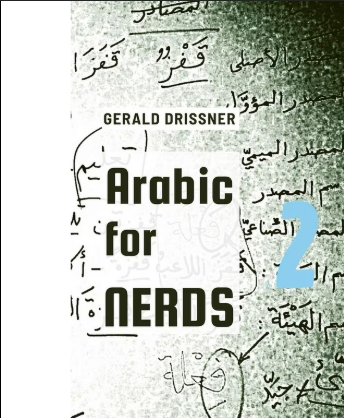
Arabic grammar textbooks remain valuable reference resources for serious learners — particularly those studying Modern Standard Arabic or Classical Arabic (الفُصْحَى — Fusha). The most reliable foundational grammar references for non-native speakers include Arabic for Nerds by Gerald Drißner, the Al-Kitaab series by Georgetown University Press, and Haywood and Nahmad’s A New Arabic Grammar — all of which are verifiable and widely used in academic Arabic programs.
Textbooks work best alongside live instruction, not instead of it. Grammar rules in Arabic are interdependent — understanding إعراب (i’rab, grammatical case marking) requires prior understanding of الاسم (al-ism, noun categories), and that cannot be absorbed from a textbook page alone without someone explaining the logic behind it.
Our Arabic Grammar Course pairs these grammatical principles with practical application, ensuring students understand why rules operate as they do — not just memorizing forms in isolation.
Start Learning Arabic Grammar with a Free Trial

6. Arabic Conversation Practice Resources and Speaking Partners
Conversational Arabic resources — including language exchange platforms, speaking practice sessions, and structured conversation courses — address the production skill that most Arabic learners neglect longest. Reading and grammar study without spoken output creates a passive competency that does not transfer to real conversation.
Platforms like Tandem and HelloTalk connect learners with native Arabic speakers for informal exchange. However, informal exchange partners cannot diagnose grammatical errors or teach correct sentence structure — they can only model natural speech.
The Arabic Learning Centre’s Arabic Conversation Course provides the structured speaking practice that language exchange cannot — with certified instructors guiding pronunciation, correcting grammatical errors in real time, and building conversational frameworks systematically.
For learners asking how to speak Arabic effectively, the critical distinction is between exposure to Arabic conversation and guided production of it. Both matter — but guided production with correction produces fluency faster.
Read also: How to Learn the Arabic Alphabet?
7. Arabic Learning Resources for Children
Online Arabic classes for children require age-specific resources that balance visual engagement with genuine language instruction — not just games with Arabic labels. The most effective children’s Arabic resources combine structured letter recognition, audio pronunciation modeling, and short, repeated vocabulary exposure in child-appropriate thematic contexts.
At The Arabic Learning Centre, our Online Arabic Classes for Kids are designed by certified Arabic instructors experienced in child language acquisition. Sessions are structured around short attention spans, with visual reinforcement of letter forms and vocabulary built into interactive lessons.
Children learning Arabic script benefit from physical letter tracing alongside on-screen instruction — a combination that builds both recognition and formation memory simultaneously.
Enroll your child in our Arabic Classes for KIDS with a free trial

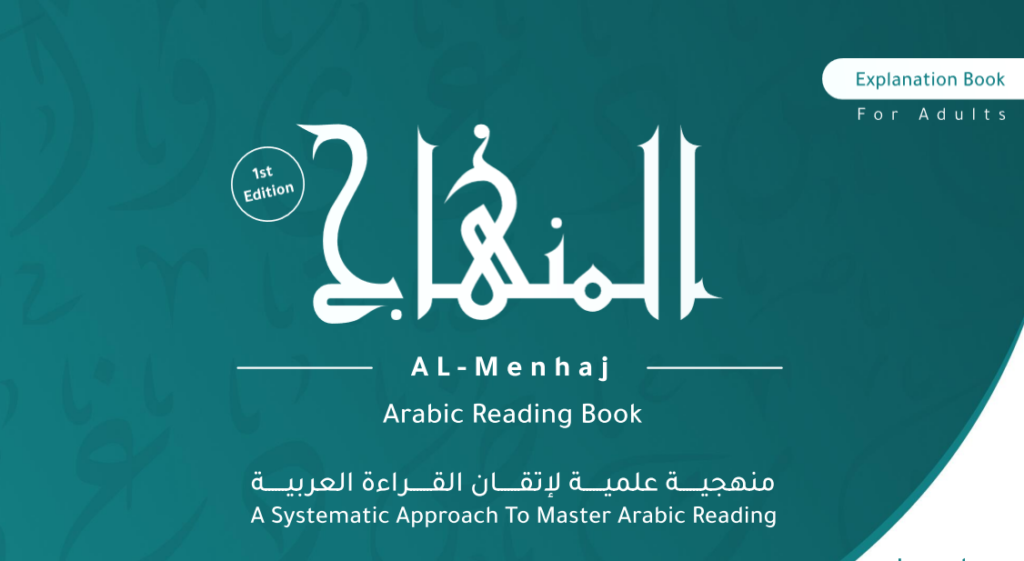
8. Al-Menhaj Book — FREE Arabic Reading Resource for Quran Learners
For Muslim learners whose primary goal is reading the Quran in Arabic, The Arabic Learning Centre offers Al-Menhaj Book — a structured learn-to-read Quran resource designed by experienced Arabic instructors with over 25 years of teaching expertise. It covers Arabic alphabet fundamentals, vowel recognition (حَرَكَات — harakat), and reading mechanics tailored specifically for non-native speakers approaching Quranic text.
Al-Menhaj Book is particularly effective for adult learners who have no prior Arabic reading background. It sequences letter introduction carefully — building from single letter recognition through joined letter reading and then to full Quranic word reading — without assuming any prior Arabic knowledge.
Paired with our learn to read Arabic course, Al-Menhaj Book provides the printed resource base that structured online sessions build upon.
Our Students Reviews
Explore Al-Menhaj Book for Free
Start Learning Arabic with Certified Instructors at The Arabic Learning Centre
The right Arabic language learning resources — in the right order — make the difference between slow, frustrating progress and genuine, measurable fluency. Script first. Grammar second. Conversation built on both.
The Arabic Learning Centre offers:
- 1-on-1 sessions with certified native Arabic instructors
- Flexible scheduling available 24/7
- Structured courses from beginner through advanced levels
- Specialized tracks for kids, adults, ladies, new Muslims, and business learners
- A free trial lesson to experience the teaching method before committing
Explore the course that matches your goal — and begin with a free trial session today.
Check out our top courses in Arabic and choose the course you need to start learning Arabic today:
- Arabic Course for Beginners
- Arabic Script Writing Course
- Arabic Speaking Course
- Learn Arabic Letters for Tajweed
- Learning Arabic Grammar
- Arabic Vocabulary Course
- Fusha Arabic Course
- Classical Arabic Course
- Arabic Course for Islamic Studies
- Quranic Arabic Course
- Learn Arabic for New Muslims
Frequently Asked Questions About Arabic Language Learning Resources
What Is the Most Effective Arabic Language Learning Resource for Complete Beginners?
The most effective Arabic language learning resource for complete beginners is a structured course with a certified Arabic instructor, supplemented by a daily script practice tool. Beginners need corrective feedback in the early weeks — apps and textbooks alone cannot provide this. Starting with the Arabic alphabet and building to grammar, then conversation, produces the most durable results.
Can I Learn Arabic Effectively Using Only Free Online Resources?
Free resources — apps, YouTube channels, and online dictionaries — can supplement Arabic learning effectively, but they cannot replace structured instruction. Free tools lack the error correction, sequencing, and accountability that produce real fluency. Most learners using only free resources plateau within a few months and develop uncorrected pronunciation and grammar habits that become harder to fix later.
How Long Does It Take to Learn Arabic with the Right Resources?
With consistent daily study and a structured course, most adult beginners reach functional reading confidence within six to eight weeks and basic conversational ability within six to twelve months, as estimated from instructional experience at The Arabic Learning Centre. For a detailed breakdown by skill level, our guide on how long it takes to learn Arabic covers realistic timelines by learning intensity.
Are Arabic Learning Apps Like Duolingo Worth Using?
Arabic learning apps like Duolingo are worth using for one specific purpose: building a daily study habit and basic vocabulary exposure. They are not effective for Arabic script mastery, grammar instruction, or pronunciation correction. Treat them as a habit-formation supplement — not a primary learning resource — and pair them with structured instruction for meaningful progress.
What Arabic Resources Are Best for Learning Business Arabic?
Business Arabic requires MSA (Modern Standard Arabic) grammatical competency combined with professional vocabulary and formal register awareness. Our Business Arabic Course at The Arabic Learning Centre is designed for professionals needing Arabic for workplace communication, combining formal grammar instruction with domain-specific vocabulary in business, law, and media contexts.
Related Articles
Arabic Resources & Courses