 Arabic Alphabet & Writing
The Arabic alphabet consists of 28 letters, all representing consonants, written from right to left in a connected cursive script. Short vowel sounds are indicated separately through diacritical marks called tashkeel, rather than standalone letters. This system is consistent, rule-governed, and — with the right method — far more learnable than most beginners expect.
What makes Arabic literacy genuinely achievable is that the script follows predictable patterns. Once you understand how letters connect, how positional forms work, and where each sound is produced in the mouth, reading Arabic becomes a systematic skill rather than a memorisation challenge. The sections ahead give you exactly that foundation.
What Is the Arabic Alphabet? Definition and Core Structure
You can define Arabic alphabet — known in Arabic as الأبجدية العربية (al-abjadiyyah al-ʿarabiyyah) — as a writing system where letters represent consonants only. It contains 28 letters arranged in a fixed traditional order.
Vowels are not letters in the standard script; they appear as optional diacritical marks above or below letters, primarily used in the Quran, children’s texts, and language-learning materials.
This structure surprises many beginners expecting an alphabet similar to English. The key distinction is that fluent Arabic readers infer short vowels from context and word familiarity — a skill that develops naturally with structured reading practice.
The Arabic script is written right to left, and almost all letters connect to adjacent letters within a word, creating a flowing cursive appearance. This connectivity is not decorative — it is the standard, functional form of the script.
At The Arabic Learning Centre, our Arabic Course for Beginners introduces this structure systematically, ensuring students build accurate script recognition before attempting full words or sentences.
Join Our Arabic Course for Beginners With a Free Trial

How Many Letters Are in the Arabic Alphabet?
The Arabic alphabet contains exactly 28 letters. This number is fixed in Modern Standard Arabic (MSA) and Classical Arabic (Fusha). Some extended forms — used for writing non-Arabic sounds in languages like Urdu or Persian — add letters with modified dots, but the core Arabic alphabet remains 28.
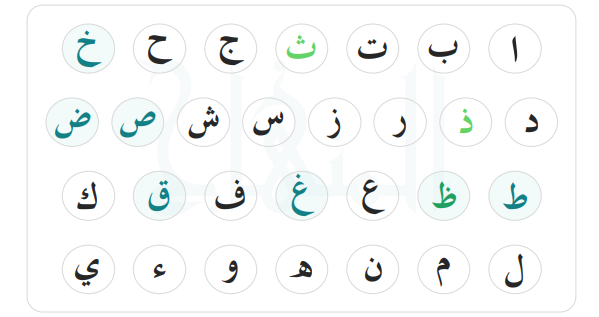
Here is the complete alphabet in traditional order:
| # | Letter | Name | Isolated Form |
| 1 | ا | Alif | ا |
| 2 | ب | Baa | ب |
| 3 | ت | Taa | ت |
| 4 | ث | Thaa | ث |
| 5 | ج | Jeem | ج |
| 6 | ح | Haa | ح |
| 7 | خ | Khaa | خ |
| 8 | د | Daal | د |
| 9 | ذ | Dhaal | ذ |
| 10 | ر | Raa | ر |
| 11 | ز | Zayn | ز |
| 12 | س | Seen | س |
| 13 | ش | Sheen | ش |
| 14 | ص | Saad | ص |
| 15 | ض | Daad | ض |
| 16 | ط | Taa (emphatic) | ط |
| 17 | ظ | Dhaa (emphatic) | ظ |
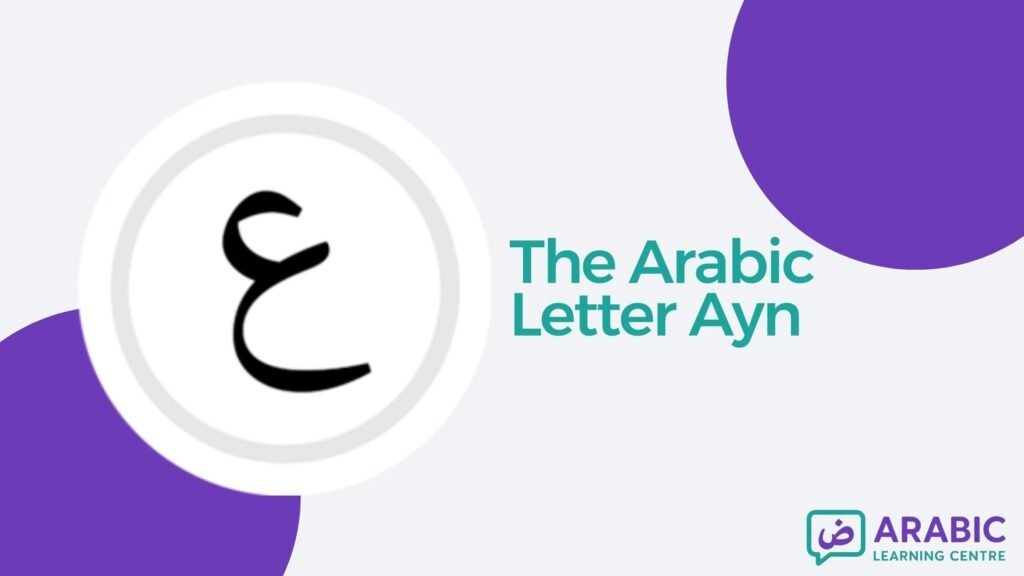
| 18 | ع | ʿAyn | ع |
| 19 | غ | Ghayn | غ |
| 20 | ف | Faa | ف |
| 21 | ق | Qaaf | ق |
| 22 | ك | Kaaf | ك |
| 23 | ل | Laam | ل |
| 24 | م | Meem | م |
| 25 | ن | Noon | ن |
| 26 | ه | Haa | ه |
| 27 | و | Waaw | و |
| 28 | ي | Yaa | ي |
Shots Videos from Our Courses
Read also: The Best Arabic Language Learning Resources
How to Say the Arabic Alphabet?
Pronouncing the Arabic alphabet correctly requires understanding makhraj (مَخْرَج) — the precise point of articulation in the mouth or throat where each sound originates. Arabic has sounds with no English equivalent, and learning their correct physical production from the start prevents deeply ingrained mispronunciation that takes months to correct later.
Letters That Commonly Challenge English Speakers
ع (ʿAyn): Produced deep in the throat with a constriction of the pharynx. Beginners almost universally produce it as a plain vowel sound. The correct articulation requires squeezing the throat — not the mouth — while voicing.
Explore Al-Menhaj Book for Free
ح (Haa): A voiceless pharyngeal fricative. The airflow comes from the back of the throat, not the lips. It sounds similar to a whispered, breathy “h” produced from deep in the throat.
ق (Qaaf): Articulated at the very back of the tongue against the uvula — noticeably further back than the English “k.” Students who substitute English “k” for ق produce a recognisably non-native sound.
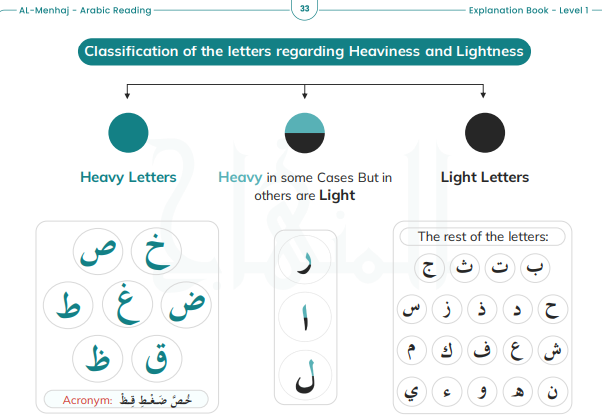
ص, ض, ط, ظ: These are emphatic consonants — their articulation involves pharyngealisation, a simultaneous retraction of the tongue root that creates a “heavier” resonance. They contrast directly with their non-emphatic counterparts (س, د, ت, ذ).
At The Arabic Learning Centre, our Online Arabic Pronunciation Course addresses makhraj systematically, letter by letter, so students build accurate sound production from the foundation rather than correcting habits later.
Begin Pronouncing Arabic Fluently with a Free Trial

Read also: Arabic Alphabet Practice
Arabic Alphabet for Beginners
Every Arabic letter has four positional forms: isolated, initial (beginning of a word), medial (middle of a word), and final (end of a word). This is one of the first structural rules beginners must internalise — and it is far more consistent than it initially appears.
| Letter Name | Isolated | Initial | Medial | Final |
| Baa (ب) | ب | بـ | ـبـ | ـب |
| Seen (س) | س | سـ | ـسـ | ـس |
| ʿAyn (ع) | ع | عـ | ـعـ | ـع |
| Meem (م) | م | مـ | ـمـ | ـم |
Six letters — ا, د, ذ, ر, ز, و — are non-connecting: they connect to the letter before them but not to the letter after. This breaks the word visually and is a consistent rule with no exceptions in standard Arabic.
Students at The Arabic Learning Centre regularly find that grouping letters by shape family — rather than memorising all 28 in sequence — accelerates recognition dramatically. Letters like ب, ت, ث share the same base form and differ only in dot placement, which reduces the memory load considerably.
For a deeper look at script formation techniques, explore our guide on mastering Arabic alphabet learning.
Read also: How to Learn Classical Arabic?
Arabic Alphabet with Words: Connecting Letters in Real Examples
Seeing individual letters is one step — seeing them function inside real Arabic words consolidates recognition into reading ability. Below are beginner-accessible Arabic words demonstrating letter connectivity:
بَيْت Bayt “House” — Notice how ب, ي, and ت connect in a single flowing unit.
كِتَاب Kitāb “Book” — The ا (Alif) here functions as a long vowel carrier, extending the “aa” sound.
مَدْرَسَة Madrasah “School” — A five-letter word showing medial forms of د (non-connecting, note the break) and ر (also non-connecting).
These examples illustrate why learning letter forms in context — rather than in isolation only — produces faster reading fluency. Our guide on how to learn Arabic expands on this principle with a broader learning framework.
Enroll in Our Arabic Vocabulary Course to Get Your Free Trial

Does Arabic Have an Alphabet, or Is It Something Different?
Technically, Arabic uses an abjad rather than a true alphabet. In a full alphabet, both consonants and vowels have dedicated letters. In Arabic, the 28 letters represent consonants only — vowels are added as optional diacritical marks (tashkeel) rather than core letters.
This distinction matters practically. When reading standard Arabic text — newspapers, books, websites — short vowels are almost never written. Learners must develop the ability to recognise words by their consonantal root structure, a skill that comes with vocabulary exposure and reading practice.
For beginners, most structured courses and children’s texts include full tashkeel to support accurate reading from the start. The Quran also carries complete diacritical marking, which is part of why Quranic Arabic reading is often the entry point for Muslim learners.
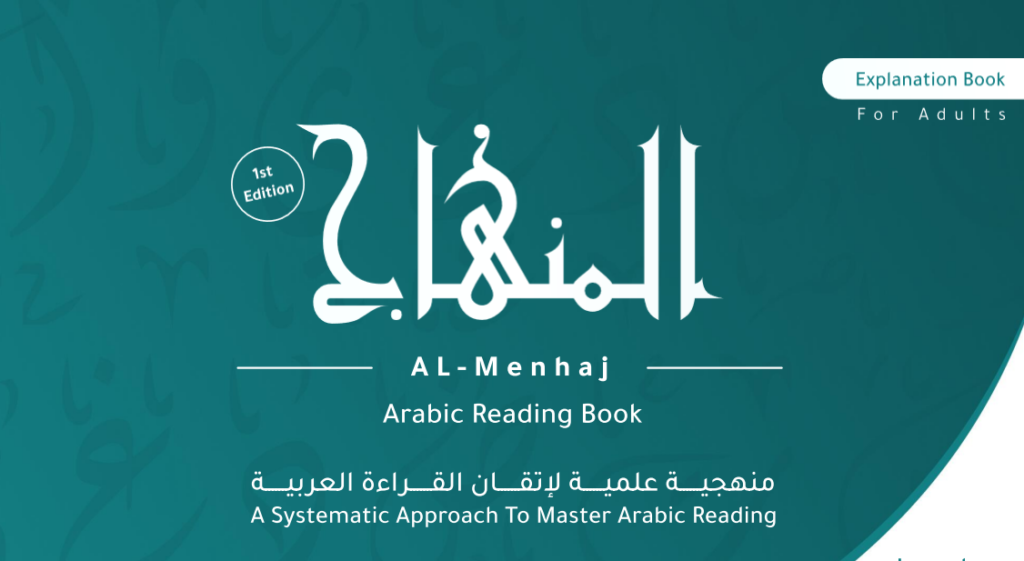
Our Al-Menhaj Book is specifically designed for this purpose — covering Arabic alphabet fundamentals and reading mechanics for non-native speakers pursuing Quran literacy.
Explore Al-Menhaj Book for Free
What Languages Use the Arabic Alphabet?
The Arabic alphabet is used — in adapted forms — by several major world languages beyond Arabic itself. This reflects centuries of Islamic scholarship, trade, and cultural exchange across Asia, the Middle East, and Africa.
| Language | Region | Notable Adaptation |
| Urdu | South Asia | Naskh/Nastaliq script, additional letters |
| Persian (Farsi) | Iran | 4 additional letters added |
| Pashto | Afghanistan/Pakistan | Additional emphatic letters |
| Kurdish (Sorani) | Iraq/Iran | Modified vowel representation |
| Uyghur | Central Asia | Extended letter set for Turkic sounds |
| Sindhi | Pakistan | Significant additional letters |
This shared script means that learners who master Arabic letter recognition gain partial literacy access to written Urdu, Persian, and several other languages — a practical benefit rarely mentioned at the beginner stage.
Is the Arabic Alphabet Hard to Learn?
The Arabic alphabet is not inherently hard to learn — it is unfamiliar, which is different. The script contains 28 letters (fewer than some languages), follows consistent positional rules, and has a direct sound-to-symbol correspondence once diacritical marks are present.
Most adult learners with no prior Arabic exposure achieve confident letter recognition within three to four weeks of structured daily practice.
The genuine challenges are specific and addressable: the unfamiliar letter forms, the right-to-left directionality, the absence of written short vowels in standard text, and several sounds not found in European languages.
None of these require exceptional aptitude — they require correct instruction and consistent practice.
What makes the difference, in our instructors’ experience at The Arabic Learning Centre, is the sequence of teaching. Students who learn letter shapes grouped by visual family — then immediately apply them in short words — progress to reading sentences significantly faster than those who attempt rote memorisation of all 28 letters before seeing them in use.
For a detailed breakdown of what to expect, read our article on how long it takes to learn Arabic.
How to Teach Arabic Alphabets to Kids?
Teaching the Arabic alphabet to children requires a different approach than adult instruction — one that prioritises sound familiarity before script, uses visual anchors for each letter, and introduces writing through large motor movements before fine pen control.
Sequence That Works for Young Learners
Start with listening and speaking the letter names and sounds before introducing written forms. Children absorb phonology rapidly; connecting familiar sounds to new symbols is easier than learning both simultaneously.
Introduce letters using visual mnemonics — for example, connecting the shape of ع to an eye (it resembles one), or ب to a boat with a dot beneath. These anchors are not linguistically technical, but they dramatically improve retention for ages 4–10.
Use tracing activities with large letter forms before standard writing practice. Fine motor skills for Arabic script — particularly the flowing connections — develop with repetition on large surfaces first.
Our dedicated guide on teaching the Arabic alphabet to kids covers age-appropriate methods in full detail. The Arabic Learning Centre also offers Arabic Words for Kids courses specifically designed around child learning psychology.
Enroll your child in our Arabic Words for Kids course with a free trial
Our Students Reviews
Begin Learning Arabic with Certified Instructors at The Arabic Learning Centre
The Arabic alphabet is your entry point to one of the world’s most widely spoken languages — and it is learnable with the right structured approach.
The Arabic Learning Centre offers:
- 1-on-1 sessions with certified native Arabic instructors
- Flexible scheduling available 24/7 to fit any timezone or routine
- Structured Arabic Course for Beginners covering script, pronunciation, and reading from the foundation
- Arabic Script Writing Course for learners focused on letter formation and handwriting fluency
- Learn Arabic Letters for Tajweed for those pursuing Quranic recitation accuracy
- A free trial lesson — no commitment required
Start with a free trial and experience structured Arabic instruction from day one.
Check out our top courses in Arabic and choose what is the most course you need to start learning Arabic today:
- Arabic Course for Beginners
- Arabic Script Writing Course
- Arabic Speaking Course
- Learn Arabic Letters for Tajweed
- Learning Arabic Grammar
- Arabic Vocabulary Course
- Fusha Arabic Course
- Classical Arabic Course
- Arabic Course for Islamic Studies
- Quranic Arabic Course
- Learn Arabic for New Muslims
Start with a FREE trial class and enhance your Arabic language skills

Frequently Asked Questions About the Arabic Alphabet
How to Learn the Arabic Alphabet as a Beginner?
Start by grouping letters visually by shared base shapes — ب, ت, ث share one form; ج, ح, خ share another. Learn each group’s positional forms (isolated, initial, medial, final), then practise recognising them in short real words immediately. Daily 15-minute focused sessions outperform longer infrequent study sessions for script acquisition.
How Long Does It Take to Learn the Arabic Alphabet?
Most adult learners with no prior Arabic exposure recognise all 28 letters consistently within three to four weeks of daily structured practice. Confident reading of fully vowelled text typically follows within six to eight weeks. Reading unvowelled standard Arabic text requires vocabulary and context familiarity built over months of continued study.
Is the Arabic Alphabet Hard to Learn?
The Arabic alphabet is unfamiliar to English speakers, not inherently difficult. Its 28 letters follow consistent positional and connection rules, and the script has a direct sound-to-symbol correspondence. The main challenges — letter directionality, positional forms, and unfamiliar sounds — are specific skills, each teachable through structured instruction.
Does Arabic Have an Alphabet or a Different Writing System?
Arabic technically uses an abjad — a consonantal writing system where letters represent consonants only and short vowels are marked optionally with diacritical signs. It functions like an alphabet for practical learning purposes, but differs from true alphabets like English in that vowel letters are absent from standard unvowelled text.
What Is the Classical Arabic Alphabet?
The classical Arabic alphabet is the same 28-letter system used in Modern Standard Arabic. The script itself has not changed significantly since early Islamic manuscripts. What differs in Classical Arabic (Fusha) is vocabulary, grammatical structures, and rhetorical register — not the letters. Classical texts use the same alphabet, often with full tashkeel for precision.
Related Articles
Arabic Alphabet & Writing