 Arabic Alphabet & Writing
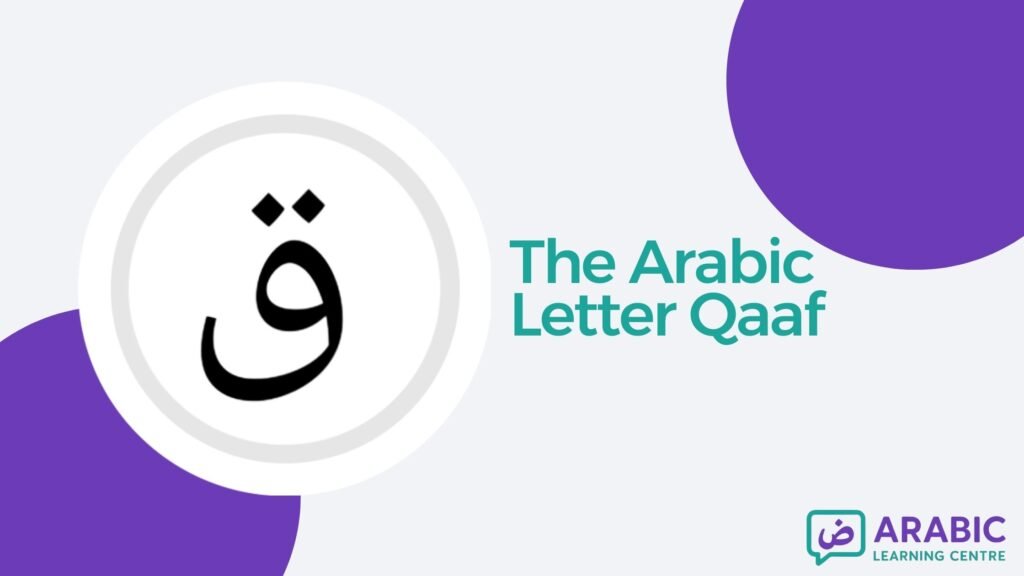
Learning the Arabic alphabet is an essential step for anyone who wants to read, write, and communicate effectively in Arabic. Among the 28 letters, the letter Qaaf (ق) holds a unique place due to its distinct sound and shape. Mastering this letter helps learners improve pronunciation, reading fluency, and writing skills, making it a fundamental part of Arabic literacy.
In this guide, we will explore the letter Qaaf (ق) in detail. You will learn how to recognize it in different positions within words, understand its pronunciation with various vowel marks, and practice through examples, exercises, and downloadable worksheets. Whether you are a parent teaching your child or a beginner learner, this comprehensive approach will make learning the Arabic letter Qaaf (ق) engaging and effective.
Letter Qaaf – ق

The Arabic letter Qaaf (ق) is the twenty-first letter in the Arabic alphabet. It has a deep and emphatic sound produced from the back of the tongue near the soft palate, which makes it distinct from other Arabic letters. This unique pronunciation can be challenging for beginners and non-native speakers, but mastering it is essential for accurate reading and speaking in Arabic.
In terms of shape, Qaaf (ق) has a rounded form with two dots above it in its isolated form. Like all Arabic letters, its shape changes depending on its position in a word—whether at the beginning, middle, or end. Learning how to recognize and write Qaaf (ق) in all its forms is the first step toward becoming proficient in Arabic writing and reading.
How to Identify The letter Qaaf – ق
Recognizing the Arabic letter Qaaf (ق) is essential for learners, especially because it can be confused with the letter Fa (ف) due to their similar shapes. The key feature that distinguishes Qaaf is the two dots placed above the letter in its isolated form.
Here are some tips to help identify the letter Qaaf (ق):
1- Look for the two dots above – without them, the letter could be mistaken for Fa (ف).
2- Notice its rounded shape – the body of Qaaf has a distinct curved form that sets it apart from other letters.
3- Check its position in a word – like all Arabic letters, Qaaf changes shape depending on whether it appears at the beginning, middle, or end of a word.
Letter Qaaf and ق Forms: At the Beginning, Middle, and End of the word
Like most Arabic letters, Qaaf (ق) changes its shape depending on where it appears in a word. Understanding these forms is essential for reading and writing correctly.
1- At the Beginning (قـ)
Example: قلم (Pen)
Here, the letter connects to the next letter while keeping its curved body and the two dots above.
2- In the Middle (ـقـ)
Example: مفتاح (Key)
When Qaaf comes in the middle, it connects smoothly from both sides, maintaining its curved shape and the two dots above.
3- At the End (ـق)
Example: بق (Cow)
At the end of a word, the letter has a more closed form but still retains the two dots above.

Master Arabic at Arabic Learning Centre
Arabic Learning Centre provides comprehensive online Arabic courses designed for learners of all levels. Our experienced native teachers guide you through the Arabic alphabet, including challenging letters like Qaaf (ق), using fun exercises, interactive lessons, and practical examples. Join us to make learning Arabic both effective and enjoyable!
Letter Qaaf/ ق With Fatha ( َ )

When the letter Qaaf (ق) carries a Fatha ( َ ), it is pronounced as “Qa” (قَ) with a short “a” sound. The fatha is a small diagonal stroke placed above the letter.
Examples:
– قَلم (Qalam – Pen) → Qaaf comes at the beginning.
– مقال (Maqal – Article) → Qaaf appears in the middle.
– بقَرة (Baqara – Cow) → Qaaf is in the middle.
To practice, repeat the sound “Qa” several times, paying attention to the deep pronunciation of Qaaf compared to other letters.
Letter Qaaf / ق With Dammah ( ُ )

When the letter Qaaf (ق) carries a Dammah ( ُ ), it is pronounced as “Qu” (قُ) with a short “u” sound. The dammah is a small curl-like diacritical mark placed above the letter.
Examples:
– قُرآن (Quran – Quran) → Qaaf comes at the beginning.
– مقُولة (Maqula – A talk) → Qaaf appears in the middle.
– نقانقُ (Naqanqu – Sausage) → Qaaf is at the end.
To practice, repeat the sound “Qu” several times, focusing on the deep articulation of Qaaf from the back of the tongue.
Letter Qaaf/ ق With Kasrah ( ِ )

When the letter Qaaf (ق) carries a Kasrah ( ِ ), it is pronounced as “Qi” (قِ) with a short “i” sound. The kasrah is a small diagonal stroke placed below the letter.
Examples:
– قِط (Qiṭ – Cat) → Qaaf comes at the beginning.
– يقِيس (Yaqies – Measures) → Qaaf appears in the middle.
– يُبقِ (Yubiqi – Keeps) → Qaaf is at the end.
To practice, repeat the sound “Qi” several times, paying attention to the correct articulation of Qaaf and its connection to the following letters.
Letter Qaaf/ ق With sukoon ( ْ )

When the letter Qaaf (ق) carries a Sukoon ( ْ ), it is pronounced as “Q” (قْ) without any vowel sound following it. The sukoon is a small circular mark placed above the letter, indicating that it should be pronounced in a “silent” or non-vowel form.
Examples:
– مقْلمة (Maqlama – Pencil case) → Qaaf appears in the middle.
– حقْ (Ḥaq – Right/Truth) → Qaaf is at the end.
To practice, repeat the sound “Q” with a sharp stop at the end of the letter, paying attention to its deep articulation from the back of the throat.
Examples of letter Qaaf/ ق in Words
The letter Qaaf (ق) appears in many Arabic words and can occur at the beginning, middle, or end. Its distinct curved shape with two dots above makes it easy to identify. Recognizing Qaaf in different positions helps learners improve their reading fluency and accuracy.
| Position | Arabic Word | Pronunciation | English Word |
| At the beginning | قلم / قمر / قراءة | Qalam / Qumar / Qirā’ah | Pen / Moon / Reading |
| In the middle | مقلمة / بَقشيش / دراسة | Maqlama / Baqshīsh / Dirāsah | Pencil case/ Tip / Study |
| At the end | بقرة / حق / صادق | Baqara / Ḥaq / Ṣādiq | Cow / Right / Honest |
When practicing, learners should highlight the letter ق in words to train their eyes to spot it quickly, no matter where it appears.

Examples of letter Qaaf/ ق in Phrases and Sentences
The letter Qaaf (ق) also appears frequently in Arabic phrases and sentences. Recognizing it in context helps learners understand how it connects with other letters and improves reading comprehension. Here are some examples with Qaaf in different positions:
| Position | Arabic Phrase / Sentence | English Translation |
| At the beginning | قراءة الكتب ممتعة | Reading books is enjoyable |
| In the middle | أحب مقلمتي | I love my pencil case |
| At the end | أخذت بقرة | She took a cow |
Practice Tip: Highlight Qaaf (ق) in each sentence and try reading aloud. Repeating phrases with different vowel marks or sukoon will strengthen pronunciation and fluency.
How to write the Qaaf Letter?
Writing the Arabic letter Qaaf (ق) requires practice, as its shape changes depending on its position in a word. However, the basic structure is always a rounded curve with two dots above.
Steps to Write Qaaf (ق):
1- Start with the main curve – a semi-circle shape that opens to the left.
2- Connect it smoothly – at the beginning or middle, it connects to the next letter without lifting the pen.
3- Add the two dots above – this distinguishes Qaaf from Fa (ف).
4- Practice in all positions – beginning (قـ), middle (ـقـ), and end (ـق).

Examples in handwriting practice:
– قـ → قلم (Pen)
– ـقـ → مقلمة (Pencil case)
– ـق → عمق (Deepth)
How to Pronounce the Letter Qaaf?
The pronunciation of the Arabic letter Qaaf (ق) is unique and distinct in the Arabic language. It is produced from the back of the tongue near the soft palate, creating a deep and emphatic sound that differs from other letters like Kaf (ك). Mastering this sound requires careful practice, especially for non-native speakers.

Basic pronunciation rules of Qaaf with short vowels (ḥarakāt):
1- Qaaf with Fatha (قَ)
Pronounced as “Qa” with a short “a” sound.
Example: قلم (Qalam – Pen)
2- Qaaf with Dammah (قُ)
Pronounced as “Qu” with a short “u” sound.
Example: قمر (Qumar – Moon)
3- Qaaf with Kasrah (قِ)
Pronounced as “Qi” with a short “i” sound.
Example: قِط (Qiṭ – Cat)
4- Qaaf with Sukoon (قْ)
Pronounced as a plain “Q” sound without any vowel.
Example: حقْ (Ḥaq – Right/Truth)
Tips for correct pronunciation:
– Keep the back of the tongue raised toward the soft palate while producing the sound.
– Open your mouth slightly for “Qa”, round your lips for “Qu”, and smile lightly for “Qi”.
– Practice in front of a mirror to ensure the tongue and mouth positions are correct.
– Repeat words and short phrases containing Qaaf in different positions to reinforce the sound.
Learn Qaaf through videos
Learning the Arabic letter Qaaf (ق) becomes much more effective when you use educational videos. Seeing the shape, hearing the pronunciation, and watching the writing process step-by-step will help you remember the letter better. The following videos explain Qaaf in a clear and engaging way:
Recommended Videos to Learn Qaaf (ق)
1- The secret to pronounce the /q/ ق in Arabic – Lesson 3
This video guides young learners through the pronunciation of the letter Qaaf (ق) in the Arabic alphabet.
2- learn the difference ق VS.
ك – The most common mistake in Arabic pronunciation – Lesson 5 Arabic 101
Learn how to differentiate between two unique sounds in the Arabic language: Qaaf (ق) and Kaaf (ك).
3- Arabic Alphabet: How to Write Qaaf “قاف”
A short video demonstrating how to write the letter Qaaf (ق) in Arabic.
How to Make the Most of These Videos
1- Listen and Repeat: Carefully listen to the pronunciation at the start of each video, then repeat the examples out loud.
2- Follow Writing Demonstrations: Observe the writing demonstrations step-by-step, and practice writing Qaaf alongside the video.
3- Combine with Other Resources: Use these videos in conjunction with worksheets, images, and pronunciation drills for maximum learning.
Exercises for letter Qaaf in Arabic
Practicing is the best way to master the Arabic letter Qaaf (ق). These exercises will help you recognize, write, and pronounce Qaaf correctly in different positions of a word.
1. Identify the Letter Qaaf
Circle the letter Qaaf (ق) in the words below:
– قلم
– مقلمة
– قراءة
– بقرة
2. Write Qaaf in Different Positions
Write the letter Qaaf (ق) in:
– Beginning position: قـ
– Middle position: ـقـ
– End position: ـق
3. Match the Word to Its Picture
Draw a line between each word and the correct picture:
– قلم 
– مقلمة 
– قمر 
4. Fill in the Missing Letter
Complete the words by adding the missing Qaaf (ق):
1- __لم (Pen)
2- __مر (Moon)
3- __راءة (Reading)
5. Read Aloud
Read these words slowly, paying attention to Qaaf pronunciation:
– قلم (Qalam – Pen)
– قمر (Qumar – Moon)
– قراءة (Qirā’ah – Reading)
– بقرة (Baqara – Cow)
Tip: Repeat these exercises daily until you can spot Qaaf instantly and write it from memory.
Downloadable Worksheets for the Arabic letter Qaaf
To make learning engaging and effective, we’ve created printable worksheets for the Arabic letter Qaaf (ق). These worksheets help students practice recognizing, writing, and using Qaaf in words and sentences through fun, interactive activities. They are perfect for both classroom use and home learning.
Download the worksheets here:
– My Resourse Station: Qaaf Worksheet – Colour, Trace, and Write a printable PDF to practice writing and recognizing Qaaf.
– Arabic Seeds (Islamic-themed): Provides coloring and tracing worksheets for each letter, including Qaaf, along with pronunciation audio files for memorization and enhanced learning.
Common Mistakes related to the letter Qaaf
Even though the Arabic letter Qaaf (ق) is one of the most important and unique letters in Arabic, many beginners make common mistakes when learning it. Understanding these mistakes will help you avoid them and improve your Arabic skills faster.
1. Confusing Qaaf (ق) with Kaf (ك)
Mistake: Learners often mistake Qaaf (ق) for Kaf (ك) due to their similar curved shapes.
Correction: Qaaf has two dots above, while Kaf has no dots.
| Feature | Qaaf (ق) | Kaf (ك) |
| Shape | Curved with two dots above | Curved with no dots |
| Sound | Deep “Q” sound from the back of the tongue | Light “K” sound from the front of the tongue |
| Example | قلم (Qalam – Pen) | كلب (Kalb – Dog) |
Read Also: The Letter Noon ن In Arabic With Examples, Exercises, and Worksheets
2. Misplacing or Forgetting the Dots
Mistake: Some learners forget to write the two dots above Qaaf, or place them incorrectly.
Correction: Always place the two dots above. Without them, the letter could be mistaken for Fa (ف), which changes the meaning of the word.
3. Incorrect Pronunciation
Mistake: Qaaf is sometimes pronounced like Kaf (ك) or Qaf softened.
Correction: Pronounce Qaaf from the back of the tongue near the soft palate for a deep, emphatic sound. Practice tongue placement carefully.
Read Also: The Letter Meem م In Arabic With Examples, Exercises, and Worksheets
4. Wrong Connections in Words
Mistake: Learners connect Qaaf incorrectly, either from both sides or leave it isolated when it should connect.
Correction:
– At the beginning: قـ (قلم)
– In the middle: ـقـ (مفتاح)
– At the end: ـق (بق)
Read Also: The Letter Laam ل In Arabic With Examples, Exercises, and Worksheets
5. Mixing Qaaf (ق) with Other Letters
Mistake: Confusing Qaaf (ق) with Kaf (ك) or other similar-sounding letters when listening or speaking.
Correction: Focus on articulation:
– Qaaf (ق): Back of the tongue, deep “Q” sound. Example: قمر (Qumar – Moon)
– Kaf (ك): Front of the tongue, light “K” sound. Example: كلب (Kalb – Dog)
By focusing on these common mistakes and practicing consistently, learners can master Qaaf (ق) and understand its unique place in Arabic pronunciation and writing.
Read Also: The Letter Zhaa ظ In Arabic With Examples, Exercises, and Worksheets
Start Your Arabic Learning Journey with Expert Teachers Today
Ready to truly understand Arabic and use it with confidence? At The Arabic Learning Centre, you’ll learn with expert Arabic language teachers, including qualified female Arabic teachers, in a supportive and professional environment designed for real progress. Whether you’re learning Arabic for the Quran, studies, career, or daily conversation, we have the right course for you.
Take the next step today and join thousands of students learning Arabic the right way.
Courses We Offer:
- Business Arabic Course
- Learn Arabic from Zero
- Medical Arabic Course
- Learning Arabic for Non Arabic Speakers
- Learn Arabic in Saudi Arabia
Conclusion
Learning the Arabic letter Qaaf (ق) is a crucial step toward mastering the Arabic language. Its unique sound, produced from the back of the tongue, and its distinctive shape with two dots above, set it apart from other letters. By practicing Qaaf in different positions within words, using vowel marks, and engaging with exercises and worksheets, learners can improve both reading fluency and writing accuracy. Recognizing Qaaf in context also strengthens comprehension and confidence in reading Arabic texts.
Consistent practice is key to mastering Qaaf (ق). Understanding common mistakes, such as confusing it with Kaf (ك) or misplacing the dots, helps learners avoid errors and solidify correct pronunciation. By writing, reading, and pronouncing Qaaf repeatedly, learners develop a strong foundation in Arabic literacy. This systematic approach ensures that Qaaf becomes second nature, supporting further progress in learning the Arabic alphabet and the language as a whole.
Related Articles
Arabic Alphabet & Writing

Leave a Reply