 Learn Arabic
| Key Takeaways |
| Gulf Arabic and Modern Standard Arabic serve different purposes in the UAE — learners benefit from studying both simultaneously. |
| The Arabic script has 28 letters, each with up to four positional forms — mastering these forms is the essential first step for UAE learners. |
| Most adult learners in the UAE achieve functional conversational Arabic within 3–6 months of structured daily practice with a qualified instructor. |
| Emirati Arabic uses specific Gulf vocabulary and pronunciation patterns that differ noticeably from Egyptian or Levantine dialect forms. |
| Structured online learning with certified instructors consistently outperforms self-study apps for learners targeting real-world Arabic use in the UAE. |
UAE Arabic language learning works best when you approach both spoken Gulf Arabic and Modern Standard Arabic (MSA) together — not as separate subjects. The UAE’s linguistic environment is formal settings, government signage, and written media use MSA (الفصحى al-Fuṣḥā), while social settings draw from Gulf dialect (اللهجة الخليجية al-lahja al-khalījiyya).
For expats, professionals, and language learners based in or connected to the UAE, this dual-register reality is actually an advantage. Learning Arabic here gives you immediate, daily opportunities to practise what you study — and the motivation that comes from real-world application accelerates progress faster than any classroom setting alone can achieve.
What Varieties Do You Need for the UAE Arabic Language Learning?
Learning Arabic for the UAE means understanding two overlapping registers: Modern Standard Arabic for formal and written contexts, and Gulf Arabic for everyday spoken interaction. Together, they give learners genuine communicative range across professional and social settings.
MSA governs written Arabic throughout the UAE — newspapers, official documents, road signs, and formal broadcasts. Gulf Arabic (Khaleeji) governs the social settings.
The good news is that the grammar foundations of MSA transfer directly into understanding Gulf dialect structures, so learning them together is more efficient than treating them as unrelated systems.
Students at The Arabic Learning Centre who begin with MSA grammar foundations consistently find Gulf vocabulary acquisition faster — the grammatical scaffolding is already in place.
| Feature | Modern Standard Arabic (MSA) | Gulf Arabic (Khaleeji) |
| “What?” | ماذا mādhā | وش wesh / إيش ēsh |
| “Now” | الآن al-ān | الحين al-ḥīn |
| “How are you?” | كيف حالك kayfa ḥāluk | كيف الحال kēf al-ḥāl / شلونك shlōnak |
| Verb “to want” | يريد yurīd | يبغى yibgha |
| “Good/okay” | جيد jayyid | زين zēn / كويس kuwayyes |
How to Learn the Arabic Script as a UAE-Based Learner?
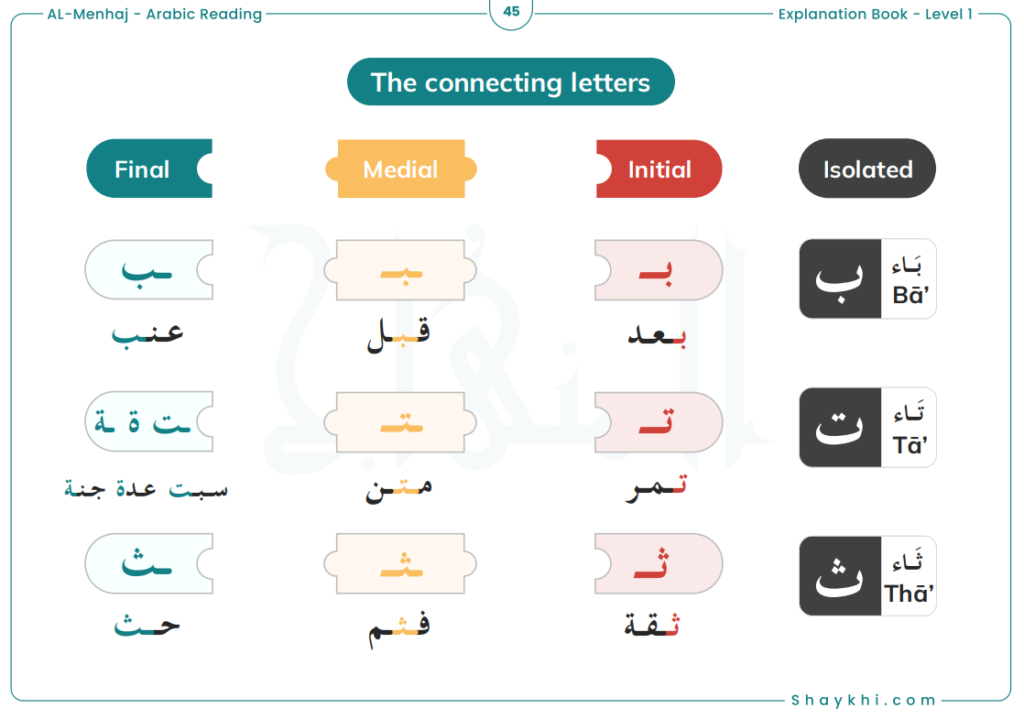
Arabic script mastery is the non-negotiable foundation for any serious UAE Arabic learner. The Arabic alphabet contains 28 letters, each appearing in up to four distinct forms depending on position: isolated, initial, medial, and final. Recognising all four forms for each letter typically takes adult learners 3–4 weeks of consistent daily practice.
Explore Al-Menhaj Book for Free
Starting with script — rather than romanised transliteration — positions you to read UAE signs, menus, WhatsApp messages from Emirati colleagues, and official documents. Transliteration is a temporary aid, never a destination.
Step 1: Learn Letters in Phonetic Families, Not Alphabetical Order
Grouping Arabic letters by shared skeleton shapes accelerates recognition dramatically. Letters like ب bā’, ت tā’, and ث thā’ share the same base form — only their dot placement differs. Learning these families together builds pattern recognition faster than sequential memorisation.
| Letter Family | Letters | Shared Base Form |
| Dot-below family | ب ت ث | One horizontal base |
| Curve family | ج ح خ | Hooked curve |
| Loop family | س ش | Zigzag baseline |
| Circle family | ع غ | Open loop |
Our guide on mastering the Arabic alphabet walks through each family in structured sequence — highly recommended as a parallel resource during this stage.
Step 2: Practise Letter Connection Rules Daily
Arabic is a cursive script — most letters connect to their neighbours. Six letters (و، ز، ر، ذ، د، ا) only connect from the right and force a break in the word. Understanding which letters break the flow — and which do not — is essential for both reading and writing.
The Arabic Learning Centre’s learn to read Arabic course covers letter connection rules systematically, with visual drills designed specifically for adult non-native learners.
Start Reading Arabic with a FREE Trial

What Are the Essential Arabic Phrases for Daily Life in the UAE?
The 15 phrases below are drawn directly from UAE Gulf dialect. Each includes Arabic script, transliteration, and English meaning.
1. Greeting someone warmly in the UAE
هلا والله Hala wallah “Welcome / Hey there!” — the most natural Emirati greeting between acquaintances; warmer and more colloquial than the formal marhaba
2. Asking how someone is
شلونك؟ Shlōnak? (to a man) / Shlōnich? (to a woman) “How are you?” — the standard Gulf check-in; expect the reply بخير، الحمد لله (bi-khayr, al-ḥamdu lillāh — “Fine, praise be to God”)
3. Saying everything is good
زين، شكراً Zēn, shukran “Good, thank you” — زين zēn is the quintessential Gulf word for “good” or “okay”; you will hear it dozens of times daily in the UAE
4. Asking the price
بكم هذا؟ Bi-kam hādha? “How much is this?” — the natural Gulf phrasing for price enquiries in any shop or market setting
5. Asking where something is
وين…؟ Wēn…? “Where is…?” — Gulf dialect replaces MSA أين ayna with وين wēn; universally understood across all seven Emirates
6. Saying you want something
أبغى… Abgha… “I want…” — Gulf Arabic uses يبغى yibgha for “to want” rather than MSA يريد yurīd; mastering this verb immediately marks your speech as locally grounded
7. Saying you don’t understand
ما فهمت Mā fahamt “I didn’t understand” — the Gulf past-tense phrasing, used more naturally in conversation than the MSA present-tense form; Emiratis will slow down and rephrase when they hear this
8. Asking someone to repeat themselves
عيد، لو سمحت ‘Īd, law samaḥt “Repeat, please” — عيد is the Gulf dialect verb for “repeat/say again”; paired with the polite لو سمحت law samaḥt (“if you please”), it is a respectful and natural request
9. Announcing you are learning Arabic
أتعلم عربي at’allam ‘arabī “I am learning Arabic” — dropping the definite article (versus formal العربية) is natural in Gulf speech; this phrase earns immediate goodwill and informal practice opportunities from Emirati speakers
In our instructors’ experience at The Arabic Learning Centre, students who use this phrase regularly with UAE colleagues receive spontaneous vocabulary coaching that accelerates progress more than many formal lesson hours.
10. Saying goodbye
مع السلامة Ma’a as-salāma “Goodbye” (literally: “with safety/peace”) — the standard farewell across the Gulf; the typical reply is الله يسلمك (allāh yisallimak — “May God keep you safe”)
11. Expressing agreement or approval
إي، والله Ī, wallāh “Yes, by God / Absolutely” — إي is the Gulf dialect word for “yes” (replacing MSA نعم na’am); adding والله wallāh intensifies the agreement and sounds completely natural in Emirati conversation
12. Saying “now” or “right away”
الحين Al-ḥīn “Now / Right now” — Gulf Arabic uses الحين where MSA uses الآن al-ān; you will hear this constantly in service contexts, meetings, and everyday instructions across the UAE
13. Asking for the bill or receipt
الحساب، لو سمحت Al-ḥisāb, law samaḥt “The bill, please” — used identically across MSA and Gulf contexts; knowing it cold for restaurants, petrol stations, and service counters saves confusion in busy UAE settings
14. Giving or receiving a compliment
ما شاء الله Māshā’allāh “What God has willed” — used in the UAE to express admiration, appreciation, or approval; saying this when a colleague shows you something they are proud of is culturally natural and warmly received
15. Expressing that something is easy or no problem
ولا يهمك Walā yuhimmak “Don’t worry about it / No problem at all” — a distinctly Gulf expression of reassurance; more natural in UAE conversation than the pan-Arabic لا بأس lā ba’s; learning this phrase signals genuine cultural engagement beyond textbook Arabic
| Phrase | Transliteration | Meaning |
| هلا والله | Hala wallah | Welcome / Hey there |
| شلونك؟ | Shlōnak? | How are you? |
| زين، شكراً | Zēn, shukran | Good, thank you |
| بكم هذا؟ | Bi-kam hādha? | How much is this? |
| وين…؟ | Wēn…? | Where is…? |
| أبغى… | Abgha… | I want… |
| ما فهمت | Mā fahamt | I didn’t understand |
| عيد، لو سمحت | ‘Īd, law samaḥt | Repeat, please |
| أنا أتعلم عربي | Anā at’allam ‘arabī | I am learning Arabic |
| مع السلامة | Ma’a as-salāma | Goodbye |
| إي، والله | Ī, wallāh | Yes, absolutely |
| الحين | Al-ḥīn | Now / Right away |
| الحساب، لو سمحت | Al-ḥisāb, law samaḥt | The bill, please |
| ما شاء الله | Māshā’allāh | What God has willed |
| ولا يهمك | Walā yuhimmak | No problem at all |
For learners who want to build beyond these 15 phrases into full spoken fluency, The Arabic Learning Centre’s Arabic Conversation Course teaches Gulf-context dialogue through structured 1-on-1 sessions with certified native instructors — with flexible scheduling available 24/7.
Enroll in Our Arabic Speaking Course Today With a Free Trial

How to Build Arabic Grammar Foundations for UAE Communication
Arabic grammar for UAE learners should begin with three core structures: noun-adjective agreement, the إضافة idāfa (possessive construct), and basic verb conjugation. These three patterns cover the majority of what you will hear, read, and need to produce in UAE daily life.
1. Understanding Arabic Noun-Adjective Agreement
In Arabic, adjectives follow the noun and must agree in gender, number, and definiteness. This is the single most common error pattern among English-speaking learners in the UAE.
بيت كبير
bayt kabīr
“a big house” (masculine, indefinite)
بيت كبير versus البيت الكبير (al-bayt al-kabīr — “the big house”) shows definiteness agreement in action. Both the noun and the adjective carry the definite article ال al-.
Our Arabic grammar for beginners guide covers agreement rules in full, including the irregular broken plural patterns that trip up most intermediate learners.
2. Using the إضافة Idāfa Construction in Context
The إضافة idāfa (possessive construct) is the Arabic equivalent of “of” or the English possessive apostrophe. It requires the first noun to be indefinite and the second to be definite — a rule that becomes intuitive with practice but confuses learners who memorise it abstractly without visual or spoken examples.
مكتب المدير
maktab al-mudīr
“The director’s office” (literally: office of the director)
At The Arabic Learning Centre, our Arabic Grammar Course teaches idāfa through real-world UAE workplace and social scenarios, so the rule clicks through context rather than rote memorisation. Explore the Arabic Grammar Course for structured progression from foundational to intermediate grammar.
Start Learning Arabic Grammar with a Free Trial

Practical Exercises for UAE Arabic Learners
These exercises are sequenced by skill level. Complete them in order for maximum benefit.
Exercise 1: Script Recognition (Beginner — Week 1–2)
Write each of the following UAE place names in Arabic script from memory after studying the letters:
| English | Arabic | Transliteration |
| Dubai | دبي | Dubayy |
| Abu Dhabi | أبو ظبي | Abū Ẓaby |
| Sharjah | الشارقة | Ash-Shāriqa |
| Ajman | عجمان | ‘Ajmān |
Recognition of familiar place names accelerates letter retention because the learner already has strong mental associations with the word meaning.
Exercise 2: Phrase Substitution (Beginner-Intermediate — Week 3–6)
Take the sentence
أنا في…
(Anā fī… — “I am in…”) and substitute UAE locations:
أنا في دبي — Anā fī Dubayy — “I am in Dubai” أنا في السوق — Anā fī as-sūq — “I am in the souk” أنا في المكتب — Anā fī al-maktab — “I am in the office”
This substitution method builds sentence confidence without requiring full grammar knowledge. It also mirrors the communicative approach used in The Arabic Learning Centre’s Arabic Course for Beginners.
Exercise 3: Gulf Vocabulary Mapping (Intermediate — Week 6–12)
Take ten MSA words you already know and find their Gulf Arabic equivalents. Start with this set:
| MSA Word | MSA Meaning | Gulf Equivalent |
| الآن al-ān | Now | الحين al-ḥīn |
| يريد yurīd | He wants | يبغى yibgha |
| جيد jayyid | Good | زين zēn |
| ماذا mādhā | What? | وش wesh |
Mapping vocabulary this way reinforces MSA learning while building Gulf comprehension — two skills in a single exercise session.
Start Learning Arabic for the UAE with Certified Instructors at The Arabic Learning Centre
Living or working in the UAE gives you daily Arabic immersion — the missing ingredient for most language learners worldwide. Structured study with a qualified instructor converts that immersion into measurable progress.
The Arabic Learning Centre offers:
- 1-on-1 sessions with certified native Arabic instructors
- Flexible 24/7 scheduling designed for UAE working patterns
- Courses for every level — from absolute beginners through advanced Gulf Arabic
- A free trial lesson to experience the method before committing
Whether you are starting from zero or building on existing knowledge, our Arabic Course for Beginners is the structured, expert-guided starting point UAE-based learners need. Book your free trial today and begin speaking Arabic with confidence — Insha’Allah.
Check out our top courses in Arabic and choose the course you need to start learning Arabic today:
- Arabic Course for Beginners
- Arabic Script Writing Course
- Arabic Speaking Course
- Learn Arabic Letters for Tajweed
- Learning Arabic Grammar
- Arabic Vocabulary Course
- Fusha Arabic Course
- Classical Arabic Course
- Arabic Course for Islamic Studies
- Quranic Arabic Course
- Learn Arabic for New Muslims
Start with a FREE trial class and enhance your Arabic language skills

Frequently Asked Questions About UAE Arabic Language Learning
Is It Worth Learning Arabic If Most UAE Residents Speak English?
Learning Arabic in the UAE is worth the effort even in an English-dominant environment. Emirati colleagues, government officials, and older community members respond differently — more openly and respectfully — to anyone who engages in Arabic. Professional advancement, visa processes, and community integration are all meaningfully improved by Arabic ability, even at a conversational beginner level.
How Long Does It Take to Learn Conversational Arabic in the UAE?
Most adult learners achieve functional conversational Arabic within 3–6 months when studying consistently with a qualified instructor. Script literacy typically arrives first — within 4–6 weeks of structured study. Conversational fluency in Gulf Arabic follows, with vocabulary acquisition accelerating once daily immersion opportunities in the UAE are actively used alongside formal lessons.
Should UAE Learners Study Gulf Arabic or Modern Standard Arabic First?
UAE learners benefit most from beginning with Modern Standard Arabic grammar fundamentals and learning Gulf Arabic vocabulary simultaneously. MSA provides the grammatical framework — verb patterns, noun declension, agreement rules — while Gulf vocabulary gives immediate communicative utility. Starting with Gulf dialect only, without MSA foundations, creates gaps that limit long-term progress and reading ability.
Are Online Arabic Classes Effective for UAE-Based Learners?
Online Arabic classes with certified native instructors are highly effective for UAE-based learners — particularly because flexible scheduling accommodates shift patterns, variable working hours, and the multicultural time-zone reality of UAE professional life. Learners who combine structured online lessons with daily informal Arabic exposure in the UAE environment typically progress faster than either approach alone.
Related Articles
Learn Arabic
Leave a Reply