 Learn Arabic
Learning Arabic as an English speaker is absolutely possible, and thousands of non-Arabic speakers reach genuine fluency every year. The process requires a strategic sequence: script first, then pronunciation mechanics, then grammar structure — not the reverse. English and Arabic differ fundamentally in script, sound system, and sentence structure, but none of these gaps are insurmountable with the right method.
What separates learners who progress from those who plateau is almost never intelligence or talent. It is sequencing. Arabic rewards learners who build each layer correctly before adding the next. The steps below reflect exactly what that sequence looks like in structured, instructor-led practice — and why each stage matters before moving forward.
1. Choose the Right Arabic Variety Before You Begin
To learn Arabic as an English speaker, the first decision is choosing between Modern Standard Arabic (MSA / Fusha) and a regional dialect such as Egyptian or Levantine Arabic.
This choice should happen before any other study begins. MSA is used in formal writing, news media, literature, and Quranic study. It is universally understood across the Arab world, making it the most transferable investment for most learners.
If your goal is reading the Quran, understanding Islamic texts, or communicating across multiple Arab countries, MSA is the correct starting point. If your sole goal is informal conversation in one specific country, a dialect may serve you faster in the short term — but at the cost of limited transferability.
| Goal | Recommended Variety |
| Quranic Arabic / Islamic study | Classical Arabic (Fusha) |
| Formal communication, news, literature | Modern Standard Arabic (MSA) |
| Conversational use in one region | Regional dialect (e.g., Egyptian) |
| Academic or professional Arabic | MSA first, dialect alongside |
At The Arabic Learning Centre, our Arabic Course for Beginners guides students through this decision in the first session — ensuring every learner builds on the right foundation from day one, with certified native instructors available 24/7.
Join Our Arabic Course for Beginners With a Free Trial

2. Learn the Arabic Alphabet
The Arabic alphabet is the non-negotiable first step for any English speaker learning Arabic. Arabic has 28 letters, all consonants, written from right to left. Vowels are represented by small diacritical marks called harakat (حَرَكَات) placed above or below letters.
Most beginners underestimate how quickly the script becomes readable with focused daily practice.
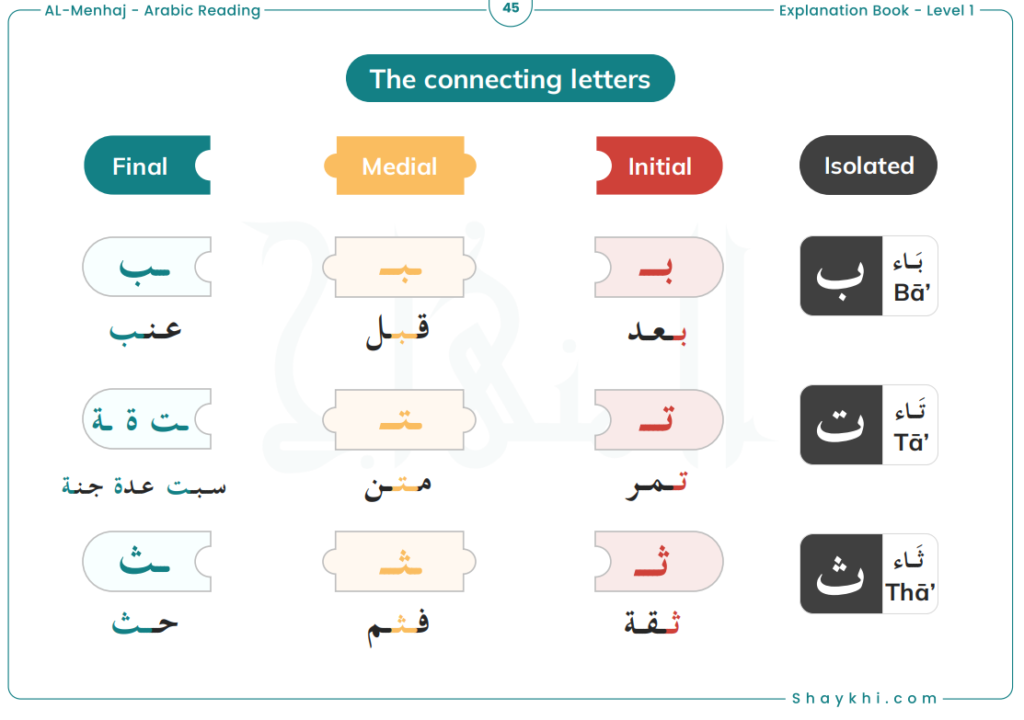
Each Arabic letter has up to four positional forms: isolated, initial (word-beginning), medial (word-middle), and final (word-end). Learning these forms is essential before attempting to read any text.
How Arabic Letter Forms Change by Position
Take the letter ب (ba) as a practical example:
| Position | Form | Example |
| Isolated | بَ | ب |
| Initial | بَيْت | بَـ (at start of بَيْت — “house”) |
| Medial | حبل | ـبـ (connected both sides) |
| Final | كَتَبَ | ـبَ (connected on right only) |
Explore Al-Menhaj Book for Free
In our instructors’ experience at The Arabic Learning Centre, adult learners who study letter forms in this positional sequence — isolated first, then initial, medial, and final — recognize all 28 letters within 3–4 weeks of 15-minute daily sessions.
Those who skip positional training and jump to full words often spend months struggling with basic reading fluency.
For a structured approach to the script, explore our detailed guide on mastering the Arabic alphabet.
3. Learn Arabic Pronunciation Mechanics From Day One
Arabic pronunciation must be addressed from the very first lesson — not after the alphabet is memorized. English speakers encounter sounds in Arabic that simply do not exist in English, and leaving pronunciation unfixed early creates fossilized errors that take years to correct.
The two most problematic sounds for English speakers are ع (‘ayn) and غ (ghayn). The ع is a voiced pharyngeal fricative — produced deep in the throat with a constriction that English has no equivalent for. Beginners consistently produce it as a plain open vowel (“a” or “ah”), which fundamentally distorts word meaning.
The Arabic Sounds English Speakers Struggle With Most
| Arabic Sound | Makhraj (Articulation Point) | Common English Speaker Error |
| ع (‘ayn) | Pharynx (deep throat) | Replaced with plain vowel “a” |
| غ (ghayn) | Uvula (back of throat) | Replaced with “g” or “r” |
| خ (kha) | Uvular fricative | Replaced with “k” or “h” |
| ق (qaf) | Deep back of mouth | Replaced with “k” |
| ص (sad) | Emphatic “s” (pharyngealized) | Replaced with plain “s” |
The concept of makhraj (مَخْرَج) — the precise physical articulation point of each sound — is central to classical Arabic phonology.
Students who learn where each sound originates in the vocal tract correct their pronunciation faster and more permanently than those who imitate sound alone.
Our Arabic pronunciation course addresses each of these sounds systematically, with certified instructors providing real-time correction in 1-on-1 sessions.
Begin Pronouncing Arabic Fluently with a Free Trial

4. Understand How Arabic Grammar Works Differently From English
Arabic grammar for English speakers requires a genuine mental shift — not because it is illogical, but because its logic is organized on entirely different principles. Arabic is a root-based language, meaning most words derive from a three-letter root (called the جذر jidhr). Once you recognize a root, you can often deduce the meaning of dozens of related words.
For example, the root ك-ت-ب (k-t-b) relates to writing:
كَتَبَ (kataba) — “he wrote” كِتَاب (kitāb) — “book” مَكْتَبَة (maktaba) — “library” كَاتِب (kātib) — “writer”
This root system is one of Arabic’s most powerful learning advantages — once it clicks, vocabulary acquisition accelerates significantly.
What English Speakers Must Unlearn First
Arabic sentences frequently follow a Verb-Subject-Object (VSO) pattern, which is the reverse of English’s Subject-Verb-Object order. Arabic also marks grammatical case on nouns through vowel endings (i’rab — الإعراب), a concept absent from modern English entirely.
Our detailed guide on Arabic grammar for beginners explains these structures with practical examples that connect Arabic rules to what English speakers already understand intuitively.
For structured grammar study, The Arabic Learning Centre’s Arabic Grammar Course provides step-by-step instruction in classical Nahw (نَحْو) grammar with certified teachers and flexible 24/7 scheduling.
Start Learning Arabic Grammar with a Free Trial

Read also: The Best Way to Learn Arabic Vocabulary
5. Build Arabic Vocabulary Through the Root System, Not Memorization Lists
Vocabulary acquisition in Arabic works most efficiently through the root-based system — not through isolated word lists. English speakers who try to memorize Arabic vocabulary word-by-word, as they might in Spanish or French, progress slowly and retain poorly. The root system fundamentally changes this.
When a learner understands the root د-ر-س (d-r-s), meaning study or lesson, they immediately gain access to:
دَرَسَ (darasa) — “he studied” دَرْس (dars) — “lesson” مَدْرَسَة (madrasa) — “school” مُدَرِّس (mudarris) — “teacher”
Students at The Arabic Learning Centre who begin vocabulary study through roots rather than lists consistently report that their vocabulary retention improves markedly after the first month — the words start feeling connected rather than arbitrary.
Our Arabic vocabulary course is structured entirely around this root-based methodology for exactly this reason.
6. Develop Arabic Conversation Skills With Real Speaking Practice
Conversational Arabic fluency for English speakers requires dedicated speaking practice — reading and grammar study alone will not produce spoken fluency. Arabic conversation introduces the additional challenge of choosing the right register: MSA is formal and written; dialectal Arabic is the spoken daily norm in most Arab communities.
The most effective approach for English speakers is building an MSA foundation first, then layering in conversational patterns specific to your target dialect or region.
This sequence ensures you can read, write, and communicate formally — while also developing the spoken confidence to hold real conversations.
Early in spoken practice, the key is removing the fear of imperfect production. Errors in verb conjugation or case endings rarely prevent communication in conversation — but pronunciation errors in core sounds like ع and ق frequently do. Prioritize sound accuracy over grammatical perfection in early speaking sessions.
The Arabic Learning Centre’s Arabic Conversation Course pairs learners with certified native speakers for structured conversational practice, with sessions tailored to your specific level and goals.
Enroll in Our Arabic Speaking Course Today With a Free Trial

7. Immerse Consistently — Arabic Requires Daily Contact
Daily contact with Arabic is non-negotiable for English speakers seeking real progress. Arabic is classified by the U.S. Foreign Service Institute as a Category IV language — the most time-intensive category for English speakers — requiring an estimated 2,200 class hours for professional working proficiency. That figure drops significantly with structured daily immersion rather than sporadic weekly study.
Effective daily immersion does not require hours of study. It requires consistent, focused exposure:
- 15–20 minutes of Arabic script reading daily
- Arabic audio (Quran recitation, news broadcasts, or podcasts) as passive background input
- Flashcard review of root-based vocabulary sets for 10 minutes
- Weekly 1-on-1 sessions with a certified instructor for speaking practice and feedback
For a realistic breakdown of how long different proficiency levels take to reach, our article on how long it takes to learn Arabic provides honest, experience-based timelines — not inflated marketing claims.
Begin Learning Arabic with Certified Instructors at The Arabic Learning Centre
Arabic is learnable. Every step in this guide reflects what structured instruction actually produces — not theoretical timelines. At The Arabic Learning Centre, we offer:
- 1-on-1 personalized sessions with certified native Arabic instructors
- Flexible scheduling available 24/7 to fit any time zone
- Structured curricula from absolute beginner through advanced classical Arabic
- A free trial lesson — no commitment required
Whether you are starting with the Arabic alphabet, developing conversational fluency, or deepening your understanding of Quranic Arabic, our courses — including our Arabic Course for Beginners, Arabic Grammar Course, and Arabic Conversation Course — are built around your specific goals. Book your free trial today.
Check out our top courses in Arabic and choose the course you need to start learning Arabic today:
- Arabic Course for Beginners
- Arabic Script Writing Course
- Arabic Speaking Course
- Learn Arabic Letters for Tajweed
- Learning Arabic Grammar
- Arabic Vocabulary Course
- Fusha Arabic Course
- Classical Arabic Course
- Arabic Course for Islamic Studies
- Quranic Arabic Course
- Learn Arabic for New Muslims
Start with a FREE trial class and enhance your Arabic language skills

Frequently Asked Questions About Learning Arabic as an English Speaker
Is It Possible to Learn Arabic as an English Speaker?
Learning Arabic as an English speaker is entirely possible and well-documented across thousands of successful learners globally. English and Arabic differ in script, sound system, and grammar structure — but each of these gaps is bridgeable with correct sequencing and consistent practice. The alphabet typically becomes readable within 3–6 weeks, and basic conversational ability develops within 6–12 months of structured daily study.
How Long Does It Take for an English Speaker to Learn Arabic?
For English speakers, reaching conversational Arabic fluency typically requires 1–2 years of consistent structured study — roughly 600–1,000 hours. Professional-level proficiency requires closer to 2,200 hours, per U.S. Foreign Service Institute estimates. Learners focusing specifically on reading the Quran or basic functional literacy often reach their goals considerably faster, within 6–12 months of focused effort.
Is Arabic Hard to Learn for English Speakers?
Arabic is genuinely more challenging for English speakers than Spanish or French, due to its non-Latin script, unfamiliar sounds, and root-based grammatical system. However, “hard” is not the same as “slow.” Arabic’s internal logic — especially its root system — makes vocabulary acquisition accelerate significantly once the foundation is established. With the right method and daily practice, progress is consistent and measurable from the earliest weeks.
Is Arabic Fun to Learn?
Arabic is genuinely engaging for most learners, particularly once the script becomes readable — which typically happens faster than beginners expect. The root system creates satisfying “aha” moments when learners realize one root unlocks five or ten related words simultaneously. For Muslim learners, the added dimension of understanding Quranic words in their original language adds a layer of motivation that our instructors at The Arabic Learning Centre observe regularly among students.
Is Arabic Fun to Learn in English?
Learning Arabic through English as the medium of instruction is effective and accessible — most structured Arabic courses for non-native speakers use English explanations for grammar rules, transliteration, and vocabulary building. The richness of Arabic — its sounds, its calligraphic script, and the depth of its classical literature — tends to surprise English-speaking learners who expected only difficulty. Many students report that Arabic becomes one of the most satisfying languages they have studied.



Leave a Reply