 Learn Arabic

| Key Takeaways |
| Consistent daily practice of 20–30 minutes accelerates Arabic learning faster than occasional long sessions. |
| Mastering the Arabic alphabet first is non-negotiable — script recognition unlocks every subsequent learning stage. |
| Focusing on Modern Standard Arabic (MSA) before dialect gives learners a transferable foundation across all Arabic-speaking countries. |
| Immersive listening and speaking practice from week one dramatically shortens the time to conversational confidence. |
| Structured instruction from a certified Arabic teacher reduces common beginner errors and compresses the learning curve significantly. |
You can learn Arabic fast — realistically fast — if you follow a structured, sequential method rather than scattered self-study. Most adult learners who commit to 20–30 minutes of focused daily practice begin reading Arabic script within 4–6 weeks and hold basic conversations within three to four months.
The difference between learners who plateau and those who accelerate almost always comes down to method, not talent. The steps below reflect what genuinely moves the needle — drawn from years of teaching non-Arabic speakers at The Arabic Learning Centre, where we have seen exactly where learners get stuck and what breaks them through.
1. Master the Arabic Alphabet Before Anything Else
To learn Arabic fast, begin with the Arabic alphabet — all 28 letters, their four positional forms, and their core sounds. Attempting vocabulary or conversation before script mastery forces you to rely on transliteration, which actively slows long-term progress. Most adult learners recognise all 28 letters within three to four weeks of fifteen-minute daily practice.
The Arabic alphabet is not as difficult as it first appears. Letters share family shapes — ب (bā’), ت (tā’), and ث (thā’) all share the same base form, differentiated only by dot count and position. Learning by shape families, rather than alphabetical sequence, cuts memorisation time noticeably.
How Does Letter Position Affect Arabic Script Reading?
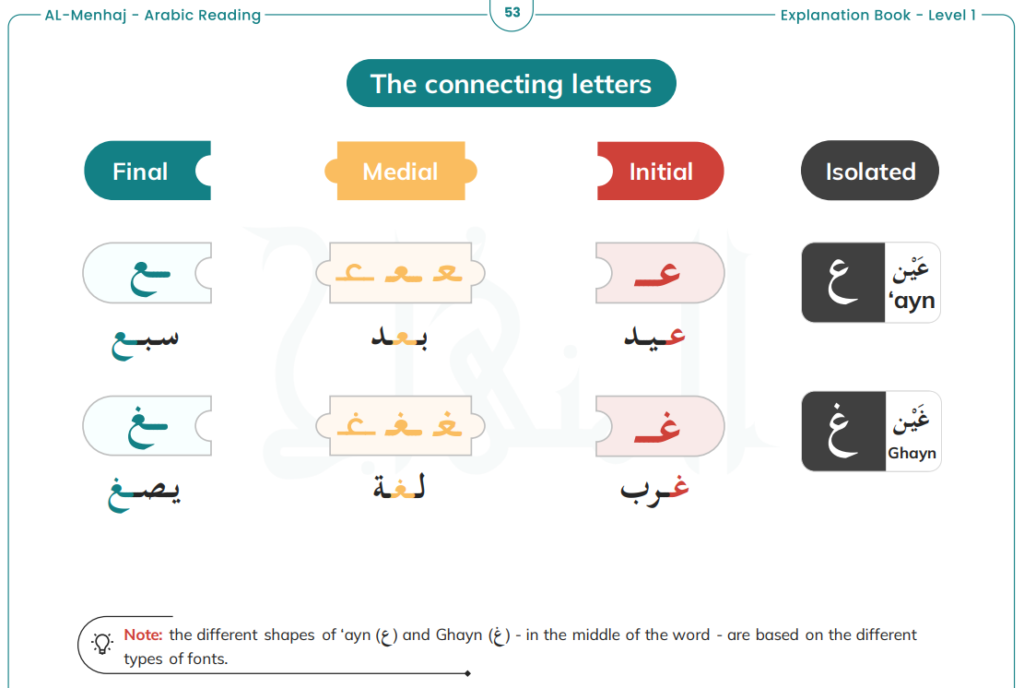
Each Arabic letter has up to four written forms depending on where it appears in a word: isolated, initial (word-beginning), medial (word-middle), and final (word-end). For example:
ع — isolated | عَـ — initial | ـعَـ — medial | ـع — final
Explore Al-Menhaj Book for Free
Learners who understand positional forms early read connected script far more fluently than those who only memorise isolated letters. Our blog on mastering the Arabic alphabet walks through this in full practical detail.
At The Arabic Learning Centre, our Arabic course for beginners covers alphabet mastery systematically in the opening weeks — giving students the right foundation before moving forward.
Join Our Arabic Course for Beginners With a Free Trial

2. Learn Arabic Pronunciation From Day One
Arabic pronunciation must be addressed at the very start of learning — not treated as something to fix later. Arabic contains sounds absent from English, including ع (ʿayn), خ (khā’), غ (ghayn), and ح (ħā’). Mispronouncing these from the beginning creates habits that require significant effort to correct.
The science of Arabic sound production is called makhraj (مَخْرَج) — the physical point of articulation in the mouth, throat, or chest where each sound originates.
For instance, ح is produced deep in the throat with a constricted, breathy release — beginners consistently confuse it with the English letter “h” because they articulate it at the lips rather than the pharynx.
Our dedicated Arabic pronunciation course addresses these exact articulation points, helping learners build accurate sound production from week one — before errors become ingrained.
Begin Pronouncing Arabic Fluently with a Free Trial

You can also read our guide on how to pronounce Arabic for an overview of the most common pronunciation challenges.
3. Build a High-Frequency Vocabulary Core First
To speak and understand Arabic quickly, prioritise the 500–800 most frequently used Arabic words before expanding your vocabulary broadly. These high-frequency words form the backbone of everyday conversation and Quranic reading alike.
Rather than learning words in isolation, learn them inside short phrases — this builds both vocabulary and natural sentence structure simultaneously. For example:
أُرِيدُ أَنْ أَتَعَلَّمَ الْعَرَبِيَّةَ
Urīdu an atʿallama al-ʿarabiyyah
“I want to learn Arabic.”
A single sentence like this introduces a verb, an infinitive construction, and the word for “Arabic” — three vocabulary items in one natural unit.
Our Arabic vocabulary course is structured precisely around this high-frequency approach, sequencing words by practical utility rather than thematic grouping alone.
4. Understand Basic Arabic Grammar Patterns Early
Arabic grammar may appear complex, but its logic is highly systematic. Learning three foundational structures early gives you a generative framework — meaning you can build new sentences rather than memorising every phrase individually.
The three patterns every beginner should prioritise are:
| Grammar Pattern | Arabic Name | Example |
| Noun-Adjective Agreement | النَّعْتُ وَالْمَنْعُوتُ | كِتَابٌ كَبِيرٌ — “a big book” |
| Possession Construction | الْإِضَافَةُ (Idāfa) | كِتَابُ الطَّالِبِ — “the student’s book” |
| Verb-Subject-Object Order | الْجُمْلَةُ الْفِعْلِيَّةُ | كَتَبَ الطَّالِبُ الدَّرْسَ — “The student wrote the lesson” |
The إضافة (idāfa) construction is particularly important early on — it governs possession, attribution, and compound noun phrases throughout the language.
Students at The Arabic Learning Centre who learn idāfa with visual diagrams in the first month consistently apply it correctly, whereas those who memorise the rule as an abstract formula often make gender and case errors for weeks afterward.
Our Arabic grammar course covers these foundational patterns with structured exercises — and ourArabic grammar for beginners blog post is an excellent starting companion.
5. Choose Modern Standard Arabic as Your Starting Foundation
Modern Standard Arabic (MSA), known as الفُصْحَى (al-fuṣḥā), is the correct starting point for most learners who want to learn Arabic fast. MSA is understood across all twenty-two Arabic-speaking countries, used in media, education, literature, and formal speech, and forms the grammatical backbone of every regional dialect.
Learners who begin with a dialect often reach a ceiling — fluent in one regional variety but unable to read, write, or communicate formally across Arabic contexts. MSA removes that ceiling entirely.
This is a point our instructors emphasise consistently: dialect knowledge is valuable, but it is a branch — MSA is the root. Build the root first, and dialects become dramatically easier to acquire afterward.
For a structured comparison of learning paths, our article on how to learn Arabic covers this decision in detail.
6. Practise Speaking Arabic From the Very First Week
Arabic conversation should begin in week one — not after you feel “ready.” Waiting for readiness before speaking is the single most common mistake among self-taught learners, and it reliably produces learners who read well but cannot produce speech under real-time pressure.
Start with ten to fifteen minutes of daily spoken practice, even using simple phrases:
كَيْفَ حَالُكَ؟
Kayfa ḥāluk?
“How are you?”
أَنَا بِخَيْرٍ، شُكْرًا
Anā bikhayrin, shukran
“I am well, thank you.”
Early speaking practice builds phonological memory — your brain begins to associate sounds with meaning under production pressure, which deepens retention significantly compared to passive reading alone.
The Arabic Learning Centre’s Arabic conversation course pairs learners with certified native-speaking instructors for live spoken sessions from the very first class. Read our guide on how to speak the Arabic language for specific techniques to get started.
Enroll in Our Arabic Speaking Course Today With a Free Trial

7. Use Spaced Repetition to Lock in Vocabulary Fast
Spaced repetition is the most evidence-supported method for fast vocabulary retention. It works by presenting items you know well less frequently and items you struggle with more frequently — optimising review time so nothing is wasted.
For Arabic specifically, spaced repetition is most effective when applied to:
- Root-word families: Arabic words cluster around three-letter roots. Learning one root unlocks multiple related words simultaneously.
- High-frequency verb conjugations in past, present, and imperative forms.
- Common مُفْرَدَاتٌ (mufradāt) — vocabulary — organised by communicative function, not theme.
At The Arabic Learning Centre, we consistently observe that students who review vocabulary in fifteen-minute daily sessions retain over 70% of new words after one week — compared to students who study in one long weekly session and retain far less.
Read also: The Best Arabic Letter Worksheets
8. Immerse Yourself in Arabic Audio and Reading Daily
Arabic immersion — even partial, even thirty minutes per day — dramatically accelerates acquisition by training your ear to Arabic rhythm, intonation, and connected speech. This is how native speakers internalise language, and it works for adult learners too when used alongside structured study.
Effective daily immersion practices include:
- Listening to Arabic news broadcasts (MSA) while following a written transcript
- Reading short Arabic texts aloud — even texts slightly above your current level
- Watching Arabic content with Arabic subtitles, not English subtitles
The key distinction is active immersion — engaging with meaning — versus passive exposure, which produces minimal acquisition. Listen with intent.
Read also: The Best Arabic Tracing Worksheets
9. Set Weekly Learning Milestones, Not Vague Goals
Learners who set specific weekly milestones progress measurably faster than those with open-ended goals like “get better at Arabic.” Milestones create accountability, reveal gaps early, and produce the motivational effect of consistent small wins.
A realistic milestone framework for early Arabic learning:
| Week | Milestone |
| Week 1 | Recognise and write all 28 Arabic letters in isolated form |
| Week 2 | Read connected Arabic script slowly with diacritical marks (tashkeel) |
| Week 3 | Produce 30 correct Arabic sentences from memory |
| Week 4-5 | Hold a two-minute spoken exchange on a familiar topic |
| Week 6-9 | Read an unvocalised Arabic paragraph with 70%+ comprehension |
These milestones are realistic for learners who practise consistently for twenty to thirty minutes daily. They are estimates drawn from instructional experience — your pace may vary, but having a timeline keeps momentum strong.
10. Work With a Certified Arabic Instructor, Not Just Apps
Structured instruction from a certified Arabic teacher compresses your learning curve more than any app or self-study method available. Apps cannot diagnose your specific pronunciation errors, correct your written Arabic in real time, or adjust pacing to your actual gaps. A qualified instructor does all three.
Self-study with apps is useful for vocabulary drilling and listening practice. But for accurate grammar, correct script formation, and genuine conversational fluency — live instruction with a human expert is irreplaceable.
At The Arabic Learning Centre, our certified Arabic instructors offer fully personalised 1-on-1 online sessions with flexible 24/7 scheduling, structured curriculum, and continuous progress tracking. Whether you are a complete beginner or building toward advanced Fusha reading, you will learn with a method tailored precisely to you.
To understand how long it realistically takes to learn Arabic with structured instruction, our blog post on that topic gives honest, experience-based timelines.
How Can I Learn Arabic by Myself?
You can learn Arabic independently using a structured self-study plan — but self-study alone has clear limits. Begin with the alphabet using a quality learning resource, then build vocabulary through spaced repetition tools, and supplement with Arabic audio content daily.
Self-study works best when combined with at least occasional sessions with a certified Arabic teacher to correct errors before they become permanent habits. Most successful self-taught Arabic learners integrate some form of live instruction, even informally.
Start Learning Arabic Fast with Certified Instructors at The Arabic Learning Centre
The steps above work — when followed consistently and in sequence. The learners who progress fastest are those who begin with the alphabet, build vocabulary systematically, and get accurate spoken practice early.
The Arabic Learning Centre offers:
- Personalised 1-on-1 online sessions with certified native Arabic instructors
- Flexible 24/7 scheduling — study at your pace, on your timetable
- Structured curriculum from beginner through advanced levels
- Courses covering grammar, conversation, pronunciation, vocabulary, and more
- Free trial lesson — no commitment required
Explore our Arabic course for beginners or discover the full range of courses available. Your first lesson is waiting — Insha’Allah, fluency is closer than you think.
Check out our top courses in Arabic and choose the course you need to start learning Arabic today:
- Arabic Course for Beginners
- Arabic Script Writing Course
- Arabic Speaking Course
- Learn Arabic Letters for Tajweed
- Learning Arabic Grammar
- Arabic Vocabulary Course
- Fusha Arabic Course
- Classical Arabic Course
- Arabic Course for Islamic Studies
- Quranic Arabic Course
- Learn Arabic for New Muslims
Start with a FREE trial class and enhance your Arabic language skills

Frequently Asked Questions About How to Learn Arabic Fast and Quickly
How Long Does It Realistically Take to Learn Arabic Fast?
With consistent daily practice of 20–30 minutes and structured instruction, most adult learners achieve functional reading confidence within six to eight weeks and basic conversational ability within three to four months. Reaching professional-level Arabic fluency typically requires two to three years of dedicated study, depending on prior language learning experience and native language background.
What Is the Fastest Way to Learn Arabic Script?
The fastest way to learn Arabic script is to group letters by shared base shapes, learn all four positional forms of each letter from day one, and practise writing each letter daily by hand. Most learners recognise all 28 letters within three to four weeks using this method. Reading connected script fluently typically follows within two to three additional weeks of consistent practice.
Should I Learn Spoken Arabic or Modern Standard Arabic First?
For most learners, Modern Standard Arabic (MSA) should come first. MSA is understood across all Arabic-speaking countries, enables reading and writing, and provides a grammar foundation that makes every dialect easier to learn afterward. Learners who start with a single dialect often struggle with formal Arabic and written texts later, while MSA learners can adapt to dialects relatively quickly.
Is Arabic Hard to Learn for English Speakers?
Arabic is classified as a Category IV language by the US Foreign Service Institute — one of the most challenging for English speakers — primarily due to its script, root-based morphology, and sounds absent from English. However, difficulty is not fixed. With the right sequential method, a qualified instructor, and consistent daily practice, English-speaking adults make strong progress far faster than these classifications suggest.
Can I Learn Arabic Without a Teacher?
You can make meaningful progress independently using quality resources — but self-study without any teacher-guided correction carries a significant risk of ingraining pronunciation and grammar errors that become harder to fix over time. The most efficient path is structured self-study combined with regular sessions with a certified Arabic instructor, particularly in the early stages when foundational habits are formed.
Related Articles
Learn Arabic


Leave a Reply