 Learn Arabic
How To Learn Arabic Vocabulary? Learning Arabic vocabulary can be challenging due to the complexity of the language, including its root system and extensive synonyms. Effective strategies to master vocabulary include understanding the Arabic root system, using flashcards, engaging with Arabic media, and reading a variety of texts. Labeling everyday objects, creating personalized vocabulary lists, and utilizing Arabic dictionaries are also beneficial.
Expanding your vocabulary while learning any new language can be a challenging task. This is especially true when talking about the Arabic language; where each single word may have a ton of synonyms making it even more challenging to get the hang of it. But there is no need to worry!
In this article, I will provide you with the best way to learn Arabic vocabulary. So, let’s begin.
Shortly: Learning Arabic vocabulary is a rewarding journey. Though it might seem challenging at the beginning, it can be easily tackled by applying effective learning strategies. These strategies include: learning the Arabic Root system, using flashcards, watching Arabic media, reading Arabic books, learning how to use Arabic dictionaries, creating your own vocabulary lists as well as seeking the help of native Arab tutors by joining online Arabic classes.
What Is Arabic Vocabulary and How Is It Structured?
Arabic vocabulary is organized around a system of trilateral roots (الجذور الثلاثية, al-judhūr al-thulāthiyya) — three-consonant combinations that carry a core meaning. From each root, dozens of words are formed by applying fixed patterns (أوزان, awzān). This root-and-pattern architecture is what makes Arabic vocabulary simultaneously challenging and highly learnable for non-native speakers.
Understanding this structure is the foundation of every effective vocabulary-building strategy. Without it, Arabic words feel random and disconnected. With it, every new root you learn potentially gives you access to a cluster of related words at once.
How Many Words Does Arabic Vocabulary Contain?
The Arabic language is estimated to contain around 12.3 million words in its classical and modern forms combined — making it one of the largest vocabularies of any language. However, Modern Standard Arabic (MSA / الفصحى, al-fuṣḥā) in active daily use draws on a far smaller working set.
For practical fluency, learners need approximately 1,500–2,000 high-frequency words to hold meaningful conversations and read standard texts. Most basic Quranic comprehension is accessible with around 300 high-frequency Quranic vocabulary items — a realistic short-term goal for dedicated learners.
At The Arabic Learning Centre, our Arabic Vocabulary Course is structured precisely around this frequency-based approach, ensuring students invest their time in words that deliver the highest communicative return.
Enroll in Our Arabic Vocabulary Course to Get Your Free Trial

How To Learn Arabic Vocabulary?
If you are wondering what is the Arabic vocabulary? How to learn Arabic vocabulary and how to memorize new words in Arabic? Then, listen closely!
Learning Arabic vocabulary is a commutative process, which means that you will need to gradually build-up your vocabulary by employing different learning strategies in order to be able to confidently express yourself in Arabic later on. Now let us explore some of the most efficient strategies that can help you master Arabic vocabulary without effort.
1. Learn the Arabic root system
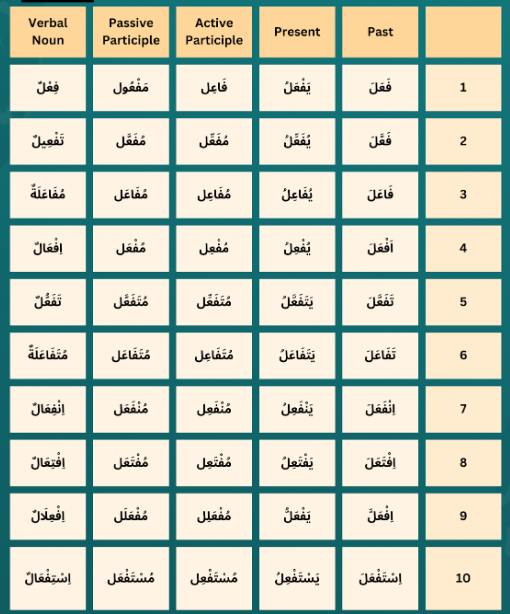
Unlike English, the Arabic language depends on a root system where most of the Arabic words are actually derived from a three-consonant root that has a fixed meaning; however, 10 different word patterns are derived from this root providing different variations of the same meaning (these patterns are called Awzan).
Guessing the meaning of Arabic words could be easy if you study the 10 Arabic verb forms chart. I recommend that you watch this YouTube video for further understanding of this important concept.
2. Use flashcards
Write down a set of the most commonly used Arabic vocabulary on flashcards and test yourself every day until you master this set of words then move on to a new set of words and so on.
This will help you remember the words as well as enhance your Arabic Writing as well since you will be more familiar with the spelling of a large number of Arabic words.
3. Watch Arabic media
Following the Arabic media is a good way to expand your Arabic vocabulary. If you are interested in learning modern standard Arabic vocabulary then your best way is to watch Arabic broadcasts and documentaries.
However, if you are more interested in learning slang Arabic expressions then you can watch talk shows and other informal programs.
Moreover if you intend to get familiar with the Quranic language and expressions you can listen to Quran broadcasts and programs presented by Muslim scholars.
4. Read, read, and read!
No need to say that reading is indispensable for anyone who is seeking to acquire a new language and the best way to learn a large number of Arabic words. A good advice if you find it challenging to read Arabic books is to start with children’s books where you can find less complex sentences and more basic vocabulary that can help you in the beginning of your Arabic learning journey.
After you gain a good deal of Arabic language knowledge you can move to more advanced Arabic books, newspapers and magazines. Reading on varied topics will allow you to cover a wider range of Arabic vocabulary including the words used in different professional fields, Academic subjects as well as abstract concepts.
5. Use Active Recall to Retain Arabic Words Long-Term
Active recall — deliberately retrieving a word from memory rather than passively re-reading it — is the mechanism that converts short-term vocabulary exposure into durable long-term knowledge. Passive review (reading a word list, highlighting) produces an illusion of familiarity. Active recall produces actual retention.
For Arabic vocabulary specifically, active recall should work in both directions: Arabic script to English meaning, and English concept to Arabic word. One-directional drilling produces recognition — the ability to understand Arabic when you hear or read it. Bidirectional drilling produces production — the ability to use vocabulary in speech and writing.
Building Active Recall Into Daily Arabic Practice
A 20-minute daily Arabic vocabulary session structured for active recall might look like this:
- 5 minutes: SRS card review (recognition direction)
- 5 minutes: SRS card review (production direction — cover Arabic, recall it)
- 5 minutes: Write three sentences using today’s new words
- 5 minutes: Say today’s words aloud, checking pronunciation against a reference
Speaking the words aloud matters more than many learners realize. Arabic pronunciation engages the makhārij al-ḥurūf (مَخَارِج الحُرُوف) — the specific articulation points for each letter — and linking pronunciation to vocabulary from the beginning prevents the deeply ingrained mispronunciation habits that are notoriously difficult to correct later. For foundational pronunciation guidance, our Arabic pronunciation guide is a recommended companion resource.
Begin Pronouncing Arabic Fluently with a Free Trial

6. Use Arabic Labels
Stick labels with the names of the objects that That’s around you or those that you commonly use in your everyday life such as the clock, the doors, the windows, the curtains, etc. By doing this you are most likely to remember the names of these objects readily.
7. Create your own cheat sheet!
As I mentioned before, reading is key to expanding your Arabic vocabulary. A very good idea to remember Arabic words and phrases that you have already memorized is to create your own cheat sheet. A notebook where you can write down new Arabic vocabulary, idioms, and phrases so that you can easily come back to it whenever you need to.
8. Use an Arabic Dictionary
One of the efficient ways that can help you learn Arabic vocabulary is to learn how to use an Arabic dictionary. This makes it easier for you to understand the root word, singular, plural, meaning, tense, and all other word attributes. Especially if you are learning Arabic on your own, the Arabic dictionary will be of great help to you in this regard.
9. Join Arabic language classes
Seeking the help of a professional native Arab tutor is an easy and fast way to achieve your goals. This can be done through traditional Arabic courses or more convenient online Arabic teaching platforms.
The Arabic Learning Centre is one of the leading platforms that deliver high quality online Arabic classes that are specially designed to meet your learning needs. With our well structured curriculum and abundant Arabic teaching resources, we ensure that you will master the language with the least effort insha’Allah.
Join Our Arabic Course for Beginners With a Free Trial

Read also: How To Learn Arabic For The Quran?
Does Arabic have more words than English?
The answer to this question is yes. One example of this is the Arabic word “Asad” ,or “Lion” in English. This word has an extended list of synonyms. For instance;
| Synonyms of the Arabic word “Asad- lion” | Transliteration |
| ليث | Laiyth |
| أسامة | Usama |
| غضنفر | Ghadanfar |
| قسورة | Quaswara |
| ضرغام | Dergham |
On the other hand, one Arabic word can refer to the same meaning of a whole English sentence. For instance, a word in the Quran gives the meaning of a complete question:
This word is “Anolzemkomoha” or “ أنُلْزِمُكُمُوهَا”. And its meaning in English is: “Shall we compel you to accept it?”
Why does Arabic have a large number of words?
Simply, because the Arabic language has what is known as “Awzan – أَوْزَان”, which are patterns or scales of words. Each pattern indicates a specific meaning.
By putting word roots into different patterns, you can get dozens of words that are related in meaning to the root.
This means, you can make a set of new words with varied, yet related meanings from just a single root word. Let me give you an example;
The root word “kataba- كَتَبَ” can be used to create several other words by following different patterns as follows;
| Word Pattern | Arabic Word | Transliteration | Translation |
| Fa’el- فَاعِل | كَاتِب | kateb | Writer (doer) |
| Maf’oul | مَكْتُوب | Maktoub | letter, message (object) |
| Maf’ala | مَكْتَبَة | Maktaba | library (place) |
Additionally, you can form many verbs with the meaning “to write” in different tenses and with different doers and numbers: for example:
| Arabic Verb | Transliteration | Translation |
| كَتبتُ | katabtu | I wrote |
| كَتبتَ | katabta | You wrote (past, single, masculine) |
| كَتَبَتِ | katabty | You wrote (past, single, feminine) |
| كتبتم | katabtom | You wrote (past, plural, masculine) |
| كتبتما | Katabtoma | You wrote (past, dual) |
| كتبتن | Katabtonna | You wrote (past, plural, feminine) |
| يكتبون | Yaktoboona | They write (present, plural, masculine) |
| تكتبن | Taktobna | They write (present, plural, feminine) |
What makes the Arabic vocabulary unique?
Arabic vocabulary is unique because it is a figurative, poetic, Semitic language, usually written with long sentences and filled with metaphors, allegories, figures of speech,, and similes.
Arabic words can have numerous meanings, or in many cases, Arabic words and phrases have no equivalent in the English language.
The Arabic alphabet itself includes some sounds that do not have a direct equivalent in the English language. For example, the letter “ض” is one of the unique Arabic letters.
Moreover, the Arabic language has many varieties, including Quranic Arabic, and Modern Standard Arabic, in addition to the different local Arabic dialects that emerged over the years with a lot of them having unique words that differ from standard Arabic.
Join Our Quranic Arabic Course With a Free Trial

Begin Building Your Arabic Vocabulary with Certified Instructors at The Arabic Learning Centre
Vocabulary growth accelerates dramatically with structured guidance. Self-study builds knowledge — expert instruction builds it faster and correctly from the start.
The Arabic Learning Centre offers:
- Arabic Vocabulary Course — frequency-based, root-organized curriculum
- Certified native Arabic instructors with proven experience teaching non-native speakers
- Flexible 1-on-1 personalized sessions scheduled 24/7
- Free trial lesson — no commitment required
- Structured progress tracking from beginner to advanced level
Book your free trial lesson today and begin building real, lasting Arabic vocabulary with a certified Arabic instructor by your side.
Check out our top courses in Arabic and choose what is the most course you need to start learning Arabic today:
- Arabic Course for Beginners
- Arabic Script Writing Course
- Arabic Speaking Course
- Learn Arabic Letters for Tajweed
- Learning Arabic Grammar
- Arabic Vocabulary Course
- Fusha Arabic Course
- Classical Arabic Course
- Arabic Course for Islamic Studies
- Quranic Arabic Course
- Learn Arabic for New Muslims
Start with a FREE trial class and enhance your Arabic language skills

To Sum Up!
Arabic is a rich and highly expressive Semitic language. In this article, we focused on teaching you how to Build Your Arabic Vocabulary.
The Arabic Vocabulary is unique because of the presence of many variants of the language. In addition to letters, words and phrases that have no direct equivalent in any other language.
The best way to learn Arabic vocabulary is to learn the Arabic root system, use flashcards, watch Arabic media, label your surroundings, and create your own vocabulary list, in addition to joining Arabic classes for professional guidance.
The Arabic Learning Centre is always there to help Arabic language learners to expand their Arabic vocabulary by providing comprehensive Arabic Online courses tailored to meet their individual needs. Navigate our website for more details on our courses or claim your free trial session before you decide!
Related Articles
Learn Arabic


Leave a Reply