 Quran
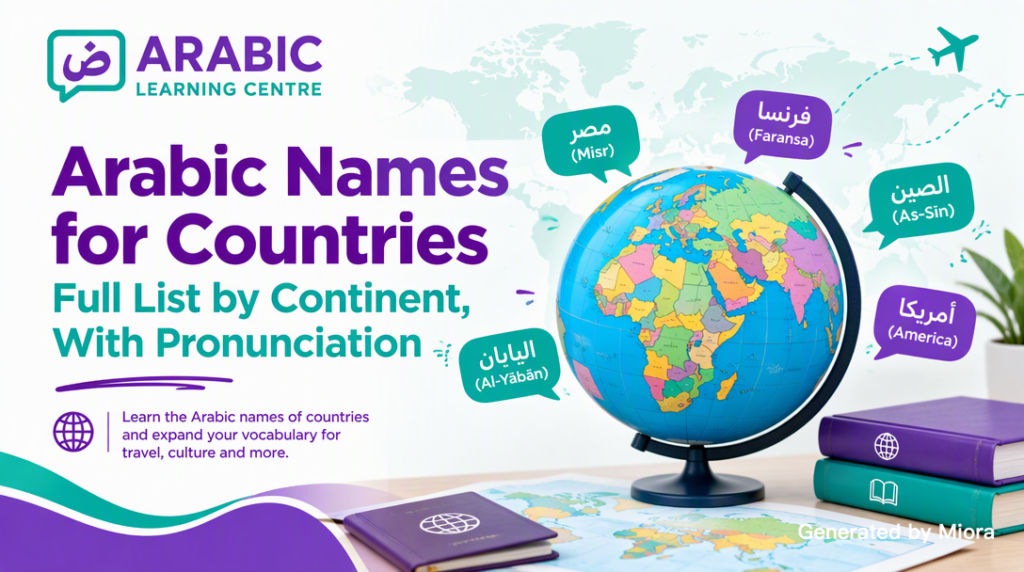
Learning the Arabic names for countries is an essential step for anyone building their Arabic vocabulary, especially beginners who want to talk about geography, travel, cultures, and nationalities.
But country names offer more than a list of words to memorize. They introduce learners to important features of Arabic pronunciation, spelling, and grammar, helping them understand how the language works in everyday contexts.
Some country names begin with the definite article (الـ), while others do not. Some contain long vowels that require careful pronunciation, and many have related nationality forms that change depending on gender. Recognizing these patterns makes it easier to read unfamiliar place names, introduce where you come from, and describe other people’s nationalities correctly.
This guide provides a comprehensive list of country names in Arabic, organized by continent, with English names and easy-to-follow transliterations. It also explains common pronunciation and grammar patterns, giving beginners practical tools to remember the vocabulary and use it confidently in real conversations.
Arabic names for countries by continent
Most countries outside the Arab world have names adapted from other languages, reshaped to fit Arabic sounds and syllable rhythm. The tables below group them by continent, starting with Europe, so you can study one region at a time.
Some Asian and African entries repeat Arab League membersso that each continent list stands on its own. Countries in the same region often share sounds and endings, so once one name sticks, the nearby ones come easier.
1. European countries in Arabic
European country names in Arabic include a mix of names that closely resemble their English forms and others that use traditional Arabic names. The table below lists common European countries alongside their Arabic spelling and transliteration to help you recognize, pronounce, and memorize each name.
| English | Arabic | Transliteration |
| United Kingdom | المملكة المتحدة | al-Mamlaka al-Muttaḥida |
| Spain | إسبانيا | Isbāniyā |
| Italy | إيطاليا | Īṭāliyā |
| France | فرنسا | Faransā |
| Germany | ألمانيا | Almāniyā |
| Switzerland | سويسرا | Swīsrā |
| Finland | فنلندا | Finlandā |
| Austria | النمسا | an-Namsā |
| Greece | اليونان | al-Yūnān |
| Netherlands | هولندا | Hūlandā |
| Norway | النرويج | an-Nurwīj |
| Poland | بولندا | Būlandā |
| Sweden | السويد | as-Suwīd |
| Turkey | تركيا | Turkiyā |
| Ukraine | أوكرانيا | Ukrāniyā |
| Hungary | المجر | al-Majar |
2. Asian countries in Arabic
Asian country names in Arabic vary between traditional names and modern transliterations of their English equivalents. Learning these names alongside their Arabic spelling and transliteration helps learners build geography vocabulary, improve pronunciation, and recognize common Arabic naming patterns. The following table covers countries from different parts of Asia.
| English | Arabic | Transliteration |
| China | الصين | aṣ-Ṣīn |
| Russia | روسيا | Rūsiyā |
| India | الهند | al-Hind |
| Singapore | سنغافورة | Singhāfūra |
| Japan | اليابان | al-Yābān |
| South Korea | كوريا الجنوبية | Kūriyā al-Janūbiyya |
| Afghanistan | أفغانستان | Afghānistān |
| Azerbaijan | أذربيجان | Adhrbayjān |
| Bangladesh | بنغلاديش | Banghlādish |
| Indonesia | إندونيسيا | Indūnīsiyā |
| Iraq | العراق | al-ʿIrāq |
| Iran | إيران | Īrān |
| Qatar | قطر | Qaṭar |
| Malaysia | ماليزيا | Māliziyā |
| Philippines | الفلبين | al-Filibbīn |
| Saudi Arabia | السعودية | as-Suʿūdiyya |
| Thailand | تايلاند | Taylānd |
| United Arab Emirates | الإمارات العربية المتحدة | al-Imārāt al-ʿArabiyya al-Muttaḥida |
| Vietnam | فيتنام | Fiytnām |
3. Countries in the Americas in Arabic
The names of countries in North, Central, and South America have different forms in Arabic. Some use the definite article (الـ), while others are written as direct transliterations of their English names.
The table below brings together common American countries with their Arabic spellings and transliterations to make learning and pronunciation easier.
| English | Arabic | Transliteration |
| United States of America | الولايات المتحدة الأمريكية | al-Wilāyāt al-Muttaḥida al-Amrīkiyya |
| Mexico | المكسيك | al-Miksīk |
| Canada | كندا | Kanadā |
| Brazil | البرازيل | al-Barāzīl |
| Argentina | الأرجنتين | al-Arjantīn |
| Chile | تشيلي | Tshīlī |
| The Bahamas | جزر البهاما | Juzur al-Bahāma |
| Bolivia | بوليفيا | Būlīfiyā |
| Ecuador | الإكوادور | al-Ikwādūr |
| Jamaica | جامايكا | Jāmāyka |
| Colombia | كولومبيا | Kūlūmbiyā |
| Cuba | كوبا | Kūbā |
| Panama | بنما | Banama |
| Peru | بيرو | Bīrū |
| Uruguay | أوروغواي | Urūghwāy |
| Venezuela | فنزويلا | Finizwīlā |
Arabic has little tolerance for clipped names where formal writing is expected. News and official documents use الولايات المتحدة الأمريكية in full rather than a short form.
Best Arabic Academy and School builds vocabulary like this into structured lessons, so you move from reading a country table to saying “I am from Brazil” without a pause. Learners also get feedback on sounds Arabic doesn’t share with English, such as the “ch” in تشيلي.
4. African countries in Arabic
African country names in Arabic include both traditional geographical names and transliterations adapted from other languages. Some names, such as مصر (Miṣr) and المغرب (al-Maghrib), have distinct Arabic forms, while others closely resemble their English equivalents.
The following table lists common African countries with their Arabic spelling and transliteration to help learners recognize and pronounce them correctly.
| English | Arabic | Transliteration |
| South Africa | جنوب أفريقيا | Janūb Ifrīqiyā |
| Nigeria | نيجيريا | Nījīriyā |
| Morocco | المغرب | al-Maghrib |
| Libya | ليبيا | Lībiyā |
| Kenya | كينيا | Kīniyā |
| Algeria | الجزائر | al-Jazāʾir |
| Egypt | مصر | Miṣr |
| Ethiopia | إثيوبيا | Ithyūbiyā |
| Angola | أنغولا | Anghūlā |
| Djibouti | جيبوتي | Jībūtī |
| Ivory Coast | ساحل العاج | Sāḥil al-ʿĀj |
| Ghana | غانا | Ghānā |
| Cameroon | الكاميرون | al-Kāmirūn |
| Madagascar | مدغشقر | Madaghashqar |
| Namibia | ناميبيا | Nāmībiyā |
| Senegal | السنغال | as-Sinighāl |
| Zimbabwe | زيمبابوي | Zimbābwī |
| Uganda | أوغندا | Ughandā |
Inside Our Classrooms
See how we make learning interactive and engaging! Watch a quick snippet of our live, conversational classes in action:
Oceanian countries in Arabic
Oceanian country names in Arabic include both transliterated names and translated geographical expressions. Some follow the pronunciation of their English names, while others combine familiar Arabic words such as جزر (islands) with a country’s name.
The table below lists common Oceanian countries alongside their Arabic spelling and transliteration to help learners understand and pronounce them correctly.
| English | Arabic | Transliteration |
| Australia | أستراليا | Ustrāliyā |
| New Zealand | نيوزيلندا | Niyūzīlandā |
| Fiji | فيجي | Fījī |
| Marshall Islands | جزر مارشال | Juzur Mārshāl |
| Nauru | ناورو | Nāwrū |
| Tonga | تونغا | Tūnghā |
Not every name is a transliteration. Some are translated word by word, and a few Arabic words repeat across the tables: جزر (islands), جنوب (south), ساحل (coast), and المتحدة (united). So ساحل العاج means “coast of the ivory,” and جزر مارشال means “Marshall Islands.” Spotting these words lets you read a name you haven’t seen before.
Want to move beyond memorizing country names and start using Arabic in real conversations? Join the Arabic Speaking Course to build your vocabulary, improve your pronunciation, and practice speaking Arabic with confidence in everyday situations. Start learning today and turn the words you know into conversations you can actually use.
How does Arabic adapt foreign sounds?
An Arabic country name is the official name of a nation written in Arabic script, either a native Arabic term (مصر, Egypt) or an adaptation of a foreign name to Arabic sounds (فرنسا, France). Once you know the few rules behind them, a new name stops looking foreign and starts looking familiar.
Four patterns do most of the work: the definite article, the sun-letter sound change, grammatical gender, and the nationality suffix. A fifth, how foreign sounds are adapted, explains the spelling of most non-Arab names.
The definite article “al-” in country names
The definite article ال (al-) means “the.” Some country names carry it and some don’t, and no single rule predicts which.
العراق (Iraq), السعودية (Saudi Arabia), and الصين (China) take it.
فرنسا (France), ألمانيا (Germany), and كندا (Canada) don’t.
A loose tendency helps: names ending in -ا or -يا usually go without the article. Exceptions such as النمسا (Austria) exist, so learn each name with its article, or without one, as a single unit.
Sun letters and the sound of “al-“
When ال comes before certain letters, the “l” is not pronounced and the next consonant is doubled. These are called sun letters. So الصين is spoken as-Sīn, not al-Sīn, and السويد is as-Suwīd.
The same happens in السودان (as-Sūdān), السنغال (as-Sinighāl), النمسا (an-Namsā), and النرويج (an-Nurwīj). The spelling stays the same and only the pronunciation changes. Learners who read the “l” aloud in these names are easy to spot.
How Arabic adapts foreign sounds?
Standard Arabic has no letter for the sounds P and V, so foreign names are adjusted. P becomes ب (بولندا, Poland; بيرو, Peru), and V becomes ف (فيتنام, Vietnam; فنزويلا, Venezuela). The “ch” sound is written with تش, as in تشيلي (Chile)
Gender of country names
Most country names in Arabic are grammatically feminine, which affects the adjectives and verbs that go with them. A few are masculine, and العراق (Iraq) is the common example. Check the gender whenever you build a sentence around a country, because agreement errors are easy to miss in writing and obvious in speech.
Turning a country name into a nationality
The nisba suffix ـي (-ī) turns a place into a person: مصر becomes مصري (Egyptian) and لبنان becomes لبناني (Lebanese). The feminine adds ـية, as in مصرية. Three adjustments come up repeatedly:
- The article drops: السعودية becomes سعودي.
- A final ـا drops: فرنسا becomes فرنسي.
- Some names change slightly: المغرب becomes مغربي, and الأردن becomes أردني.
Learning one country name this way gives you the nationality for free.
At Best Arabic Academy and School, teachers present vocabulary and grammar together, so a lesson on country names also covers the article, gender, and nisba. Live correction on pronunciation means mistakes like the sun-letter sound change are caught early instead of becoming habits.

Arabic names for the 22 Arab League countries
The Arab League has 22 member states across Africa and Asia, and these are the Arabic names for countries most learners need first. They come up constantly in news, travel, and everyday conversation with native speakers.
Arabic speakers also group these countries into regions, and the regional terms appear often in news. The Maghreb (المغرب العربي) covers the northwest of Africa, including Morocco, Algeria, Tunisia, Libya, and Mauritania. The Gulf (الخليج) covers Saudi Arabia, the UAE, Qatar, Bahrain, Kuwait, and Oman, and the Levant (بلاد الشام) covers Syria, Lebanon, Jordan, and Palestine.
The name المغرب (Morocco) literally means “the place of sunset,” or “the west,” which is why its region is called the Maghreb. Knowing the meaning makes the name easier to remember.
Common mistakes when writing Arabic country names
Learners repeat the same few errors with Arabic names for countries, and each one has a simple fix. Most come from treating names as English words written in Arabic letters instead of as Arabic words with their own rules.
- Adding or dropping “al-” inconsistently: Writing سعودية instead of السعودية is incomplete in formal Arabic. The fix is to store each name with its article, or without it, as one unit, the way you’d learn a spelling.
- Confusing Oman with Amman: عُمان (the country) and عمّان (Amman, the capital of Jordan) use the same consonants. The difference sits in the vowel mark and the doubled م, which unvocalized text often leaves out. Context tells you which one is meant, so check the surrounding words before translating.
- Skipping the shadda and the hamza: The shadda in السعودية changes both spelling and pronunciation. The hamza on initial alif matters too: you’ll see both إسبانيا and اسبانيا in print. The version with the hamza is the standard form, and the other is common in informal writing.
- Mixing up the country and the nationality:مصر is the country and مصري is the person or adjective. Saying أنا مصر when you mean “I am Egyptian” is a frequent beginner slip. Use أنا من مصر (I am from Egypt) or أنا مصري (I am Egyptian), and keep the two forms separate in your notes.
How to memorize Arabic names for countries?
Memory improves when each name has context and a review schedule. Flat word lists are the weakest method, while sentences, patterns, and short repeated reviews work much better. Two habits make the biggest difference.
- Learn countries inside sentences: Use each name in a full sentence, not in isolation: أنا من مصر (I am from Egypt) or سافرت إلى الأردن (I traveled to Jordan). This trains the preposition, the article, and the sentence pattern at once.
- Run the three-check routine: For every new country name, check three things in order: whether it takes the article, how the long vowels sound, and what its nisba is. Writing the three answers next to the name turns a vocabulary item into a small grammar lesson.
- Review in short, spaced sessions: Study one continent at a time, then return to it after a day, a few days, and a week. Short repeated reviews hold vocabulary better than one long session. Cover the English column, say each Arabic name aloud, and check the transliteration only when you get stuck.
If you’d rather practice with a teacher who catches errors as they happen, Best Arabic Academy and School offers live Arabic classes where country names, nationalities, and sentence building are taught together.
Don’t Just Take Our Word For It
Take a look inside our vibrant classes and see our students and teachers in action. Click below to watch our classroom experience:
Start learning Arabic with Best Arabic Academy and School today
Reading a list of Arabic country names is a start, but speaking them with confidence takes feedback. Many learners can recognize the words on a page and still hesitate when they have to say them, and the gap usually comes from a lack of live practice.
With Best Arabic Academy and School, you practice with live instructors who correct your pronunciation and show you how the grammar behind each name works. Whether you’re starting from zero or tidying up gaps in your vocabulary, you work at your own level.
Pick your level, book a class, and move from recognizing names to using them in real conversation.
Courses We Offer:
- Arabic Grammar Course
- Arabic Speaking Course
- Arabic Script writing course
- Arabic Vocabulary Course
- Arabic Pronunciation Course
Conclusion
Arabic names for countries become easier to recognize when you understand the patterns behind them. The definite article al- appears in many country names and changes its pronunciation before sun letters, long vowels shape pronunciation, and the nisba suffix transforms country names into nationalities.
Foreign names also adapt to Arabic sounds, with letters such as P becoming ب and V becoming ف. To remember these names, practice them by region and use them in simple sentences. Pay attention to the definite article, vowel length, and nationality forms as you learn.
Consistent practice, combined with live instruction and pronunciation correction, will help you move beyond memorizing country names toward using Arabic more naturally and confidently.
FAQs
What are the Arabic names for countries in the Arab League?
The Arab League has 22 members, from الجزائر (Algeria) to اليمن (Yemen), and each has an official Arabic name. Ten are in Africa and twelve in Asia.
Do all Arabic country names start with “al-“?
No. Many Arabic names for countries take الـ (al-), such as العراق and الصين, but others like مصر, لبنان, and فرنسا don’t. You learn each name with or without the article.
How do you say “I am from” a country in Arabic?
Say أنا من followed by the country name, as in أنا من مصر (I am from Egypt). To say you traveled somewhere, use سافرت إلى (I traveled to) plus the country name.
How do you form a nationality from an Arabic country name?
Add the suffix ـي (masculine) or ـية (feminine) to the country name, dropping the article.
مصر becomes مصري, and السعودية becomes سعودي. Names ending in ـا also drop that vowel, so فرنسا becomes فرنسي.
Is the United Arab Emirates called “al-Imarat” in Arabic?
Yes, in everyday speech. The full name الإمارات العربية المتحدة is used in official documents, and الإمارات is the common spoken short form.