 Arabic Grammar

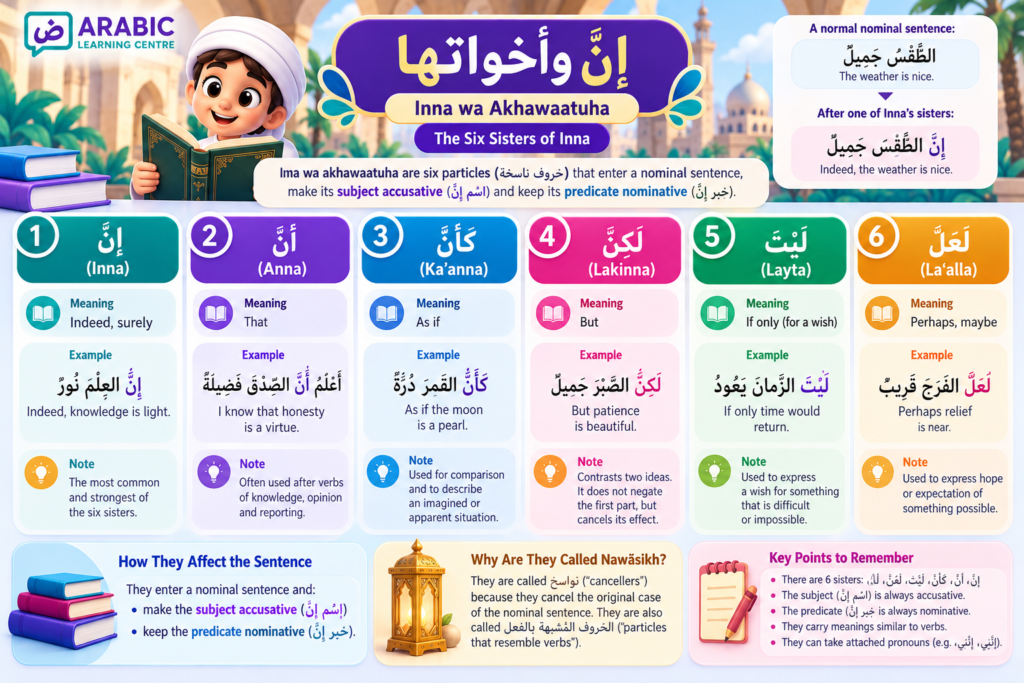
Inna wa Akhawaatuha (إِنَّ وَأَخَوَاتُهَا), “Inna and its sisters,” are six particles: إِنَّ (indeed), أَنَّ (that), كَأَنَّ (as if), لَكِنَّ (but), لَيْتَ (if only) and لَعَلَّ (perhaps). They enter a nominal sentence, make its subject accusative and keep its predicate nominative.
A normal nominal sentence has two nominative parts: الطَّقْسُ جَمِيلٌ, “The weather is nice.” Add one of Inna’s sisters and the subject switches to the accusative: إِنَّ الطَّقْسَ جَمِيلٌ. The subject is now called ism Inna (اسم إنَّ), and the predicate is called khabar Inna (خبر إنَّ).
Grammarians call these particles nawāsikh (نواسخ), “cancellers,” because they cancel the original case of the sentence. They also call them الحروف المشبهة بالفعل, “particles that resemble verbs”: they end in fatha like past-tense verbs, take attached pronouns (إِنَّنِي، إِنَّكَ), and carry meanings verbs usually carry.
Below, each of the six sisters gets its own section, with its meaning, real examples and one detail that makes it different from the others.
1. إِنَّ (Inna): Indeed
إِنَّ is the head of the family and the most common of the six. It adds emphasis and certainty, and translates as “indeed” or “certainly,” though English often leaves it untranslated.
| Example | Translation | Type of khabar |
| إِنَّ الشَّمْسَ حَارَّةٌ | The sun is indeed hot. | Single word |
| إِنَّ الطُّلَّابَ مُجْتَهِدُونَ | Indeed, the students are diligent. | Single word (plural) |
| إِنَّ الحَقَّ صَوْتُهُ مَسْمُوعٌ | Indeed, truth: its voice is heard. | Nominal sentence |
| إِنَّ ابْنِي يَلْعَبُ بِالكُرَةِ | Indeed, my son is playing with the ball. | Verbal sentence |
| إِنَّ الكِتَابَ فَوْقَ الطَّاوِلَةِ | Indeed, the book is on the table. | Adverbial phrase |
The Quran opens countless verses with Inna, which makes it the best place to see the rule in action.
In Surat Al-Baqarah, Allah tells the believers to seek help through patience and prayer, then gives the reason in a short, emphatic sentence:
إِنَّ اللَّهَ مَعَ الصَّابِرِينَ
“Indeed, Allah is with the patient.”
The ism here is لفظ الجلالة (اللهَ), accusative with a fatha. The khabar is the adverbial phrase مَعَ الصَّابِرِينَ. Inna turns a simple statement into a firm promise.
Surat Al-‘Asr opens with an oath by time, and the answer to that oath begins with Inna:
إِنَّ الْإِنسَانَ لَفِي خُسْرٍ
“Indeed, mankind is in loss.”
الإنسانَ is the ism of Inna, and فِي خُسْرٍ is its khabar. Notice the extra لَـ on the khabar: an oath, then Inna, then the emphatic lam give the strongest emphasis Arabic can build.
Good to know: Inna’s hamza takes a kasra at the start of speech, after قالَ (to say), and after an oath. That is why Arabic says قالَ إِنَّ الطَّعَامَ لَذِيذٌ (“He said that the food was delicious”), never قال أنَّ. Inna is also the only sister whose khabar can take the emphatic lam (لَـ): إِنَّ سَمِيرًا لَمُجْتَهِدٌ.
2. أَنَّ (Anna): That
أَنَّ also expresses emphasis, but it never starts a sentence. Something must come before it, usually a verb of knowing, hearing or saying (other than قال). It translates as “that.”
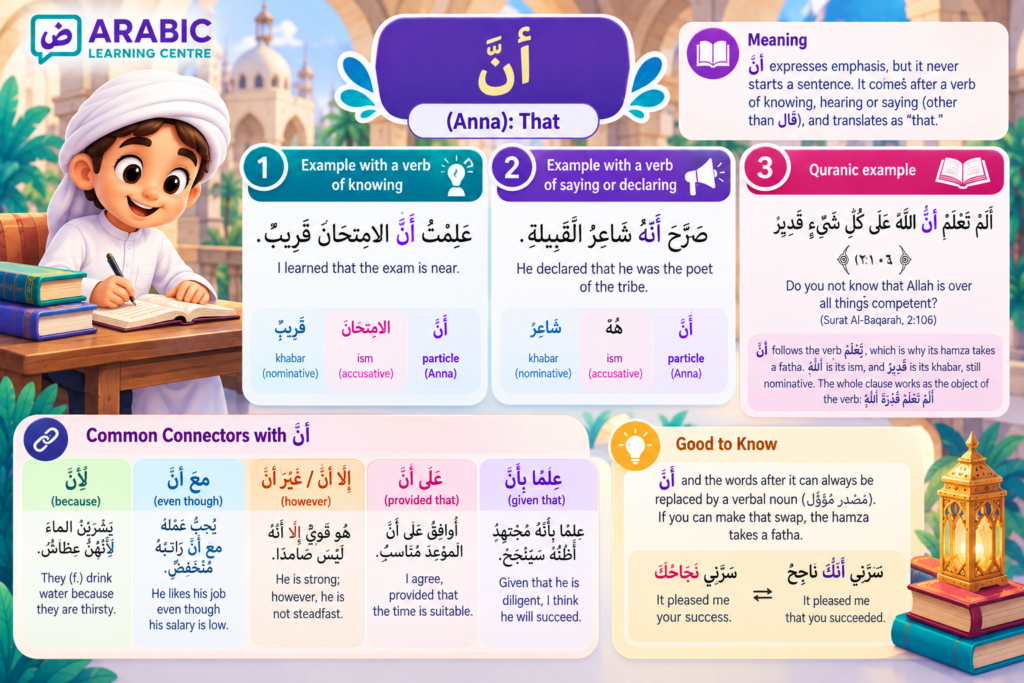
- عَلِمْتُ أَنَّ الامْتِحَانَ قَرِيبٌ, “I learned that the exam is near.”
- صَرَّحَ أَنَّهُ شَاعِرُ القَبِيلَةِ, “He declared that he was the poet of the tribe.”
In Surat Al-Baqarah, right after speaking about the abrogation of verses, Allah asks a rhetorical question built on Anna:
أَلَمْ تَعْلَمْ أَنَّ اللَّهَ عَلَىٰ كُلِّ شَيْءٍ قَدِيرٌ
“Do you not know that Allah is over all things competent?”
أَنَّ follows the verb تَعْلَمْ, which is why its hamza takes a fatha.
اللهَ is its ism, and قَدِيرٌ is its khabar, still nominative. The whole clause works as the object of the verb: أَلَمْ تَعْلَمْ قُدْرَةَ اللَّهِ.
Anna also joins prepositions and other words to build some of the most useful connectors in written Arabic:
- لِأَنَّ (because): يَشْرَبْنَ المَاءَ لِأَنَّهُنَّ عِطَاشٌ, “They (f.) drink water because they are thirsty.”
- مَعَ أَنَّ (even though): يُحِبُّ عَمَلَهُ مَعَ أَنَّ رَاتِبَهُ مُنْخَفِضٌ, “He likes his job even though his salary is low.”
- إِلَّا أَنَّ / غَيْرَ أَنَّ (however): هُوَ قَوِيٌّ إِلَّا أَنَّهُ لَيْسَ صَامِدًا, “He is strong; however, he is not steadfast.”
- عَلَى أَنَّ (provided that): أُوَافِقُ عَلَى أَنَّ المَوْعِدَ مُنَاسِبٌ, “I agree, provided that the time is suitable.”
- عِلْمًا بِأَنَّ (given that): عِلْمًا بِأَنَّهُ مُجْتَهِدٌ أَظُنُّهُ سَيَنْجَحُ, “Given that he is diligent, I think he will succeed.”
Good to know: Anna and the words after it can always be replaced by a verbal noun (مصدر مؤول).
سَرَّنِي أَنَّكَ نَاجِحٌ (“It pleased me that you succeeded”) means سَرَّنِي نَجَاحُكَ. If you can make that swap, the hamza takes a fatha.
3. كَأَنَّ (Ka’anna): As If
كَأَنَّ compares its ism to its khabar. Use it when you see a resemblance between two things. It translates as “as if” or “it is as though.”
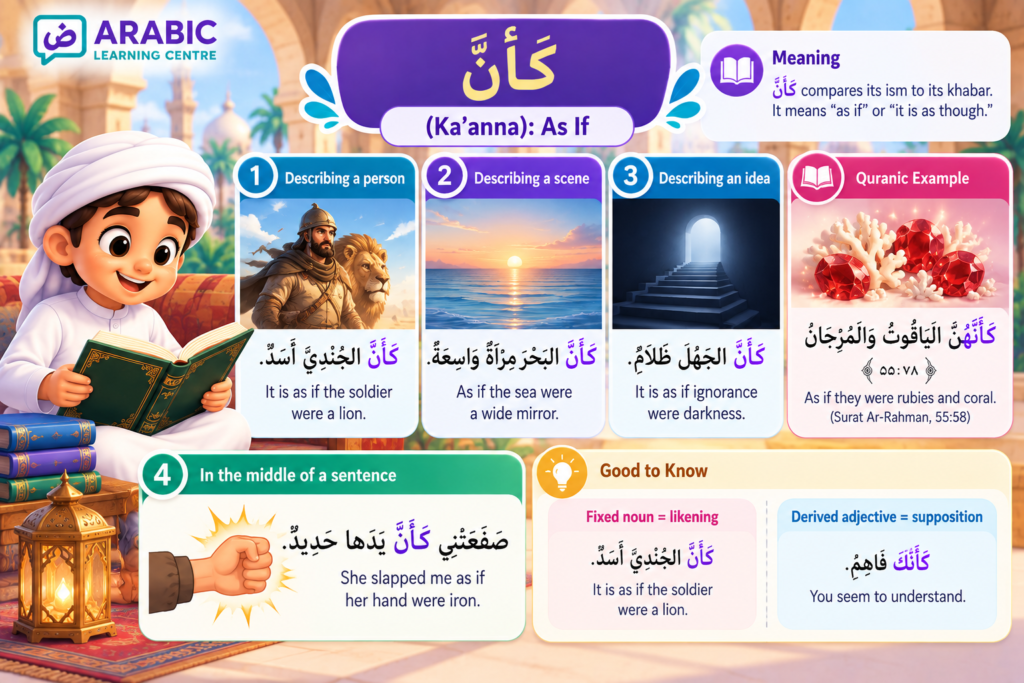
In everyday Arabic, you might praise a brave soldier with كَأَنَّ الجُنْدِيَّ أَسَدٌ, “It is as if the soldier were a lion,” or describe a calm sea with كَأَنَّ البَحْرَ مِرْآةٌ وَاسِعَةٌ, “as if the sea were a wide mirror.” Writers use it for ideas too: كَأَنَّ الجَهْلَ ظَلَامٌ, “It is as if ignorance were darkness.” Ka’anna can even sit in the middle of a sentence: صَفَعَتْنِي كَأَنَّ يَدَهَا حَدِيدٌ, “She slapped me as if her hand were iron.”
In Surat Ar-Rahman, describing the companions of Paradise, the Quran uses Ka’anna to paint their beauty in a single image:
كَأَنَّهُنَّ الْيَاقُوتُ وَالْمَرْجَانُ
“As if they were rubies and coral.”
The ism of Ka’anna is the attached pronoun هُنَّ, built in the position of accusative. The khabar is اليَاقُوتُ, nominative with a damma, and المَرْجَانُ is joined to it. The comparison shows their clarity and colour without a long description.
Good to know: when the khabar of Ka’anna is a fixed noun (أسد، مرآة), it expresses likening. When it is a derived adjective, it expresses supposition instead: كَأَنَّكَ فَاهِمٌ means “You seem to understand,” not “as if you were understanding.”
Inside Our Classrooms
See how we make learning interactive and engaging! Watch a quick snippet of our live, conversational classes in action:
4. لَكِنَّ (Lakinna): But
لَكِنَّ introduces information that corrects or contrasts with what came before, so the listener does not reach the wrong conclusion. Grammarians call this istidrāk (استدراك). It comes in the middle of speech and is often preceded by و.
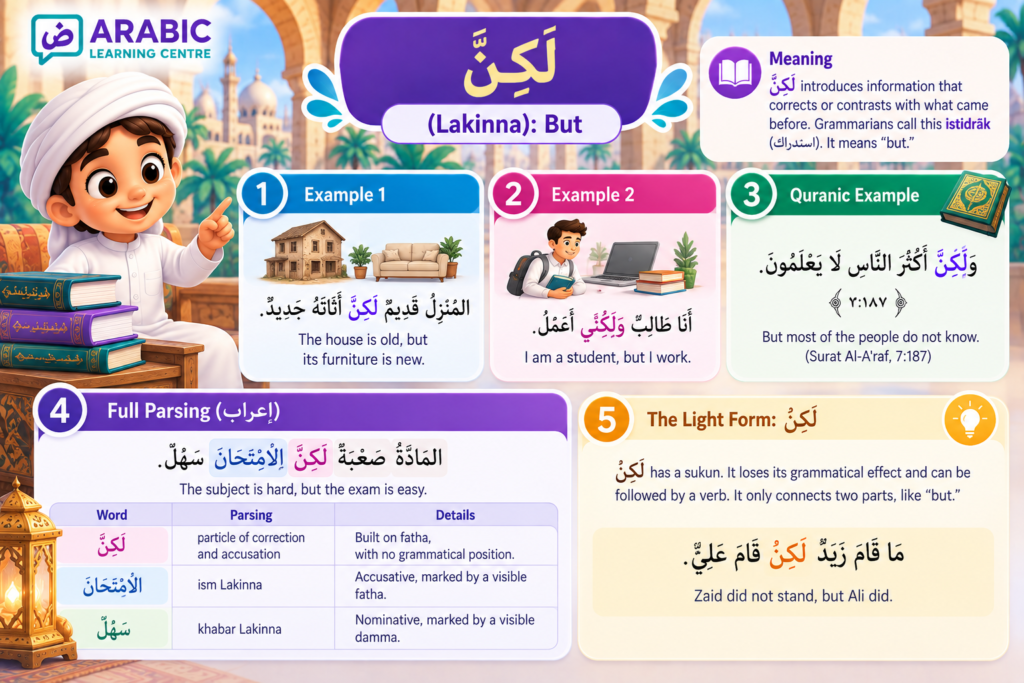
You use it the same way you use “but” in English: المَنْزِلُ قَدِيمٌ لَكِنَّ أَثَاثَهُ جَدِيدٌ, “The house is old, but its furniture is new,” or أَنَا طَالِبٌ وَلَكِنِّي أَعْمَلُ, “I am a student, but I work.” Here is a full parsing (إعراب) of one example, المَادَّةُ صَعْبَةٌ لَكِنَّ الامْتِحَانَ سَهْلٌ (“The subject is hard, but the exam is easy”):
- لَكِنَّ: a particle of correction and accusation, built on fatha, with no grammatical position.
- الامْتِحَانَ: ism Lakinna, accusative, marked by a visible fatha.
- سَهْلٌ: khabar Lakinna, nominative, marked by a visible damma.
A phrase you will meet again and again in the Quran closes a verse in Surat Al-A’raf, where people ask the Prophet ﷺ when the Hour will come. He is told that its knowledge is with Allah alone:
وَلَٰكِنَّ أَكْثَرَ النَّاسِ لَا يَعْلَمُونَ
“But most of the people do not know.”
أَكْثَرَ is the ism of Lakinna, accusative with a fatha, and the verbal sentence لَا يَعْلَمُونَ is its khabar. Lakinna corrects a false impression: the truth is clear, yet most people do not realise it.
Good to know: Lakinna has a light form, لَكِنْ, with a sukun. The light form loses its grammatical effect and can even be followed by a verb: مَا قَامَ زَيْدٌ لَكِنْ قَامَ عَلِيٌّ (“Zaid did not stand, but Ali did”).
5. لَيْتَ (Layta): If Only
لَيْتَ expresses a wish (تمنّي) for something impossible or very unlikely. It is usually preceded by the vocative particle يَا and translates as “if only” or “I wish.”
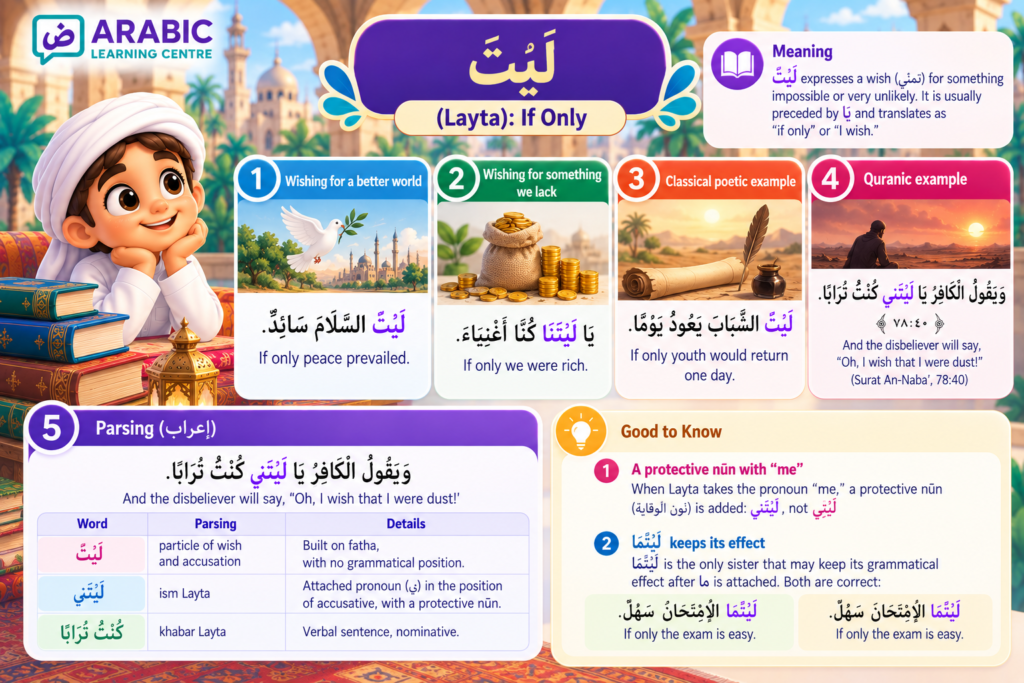
Layta always reaches for something out of reach. A person dreaming of a better world might say لَيْتَ السَّلَامَ سَائِدٌ, “If only peace prevailed,” while someone short of money might sigh يَا لَيْتَنَا كُنَّا أَغْنِيَاءَ, “If only we were rich.” The most quoted example of all is لَيْتَ الشَّبَابَ يَعُودُ يَوْمًا, “If only youth would return one day.”
That last line comes from classical Arabic poetry; youth cannot return, which is exactly why Layta fits.
The Quran uses Layta for the deepest regret of all. Surat An-Naba’ closes with a scene from the Day of Judgment, when the disbeliever sees what his hands have sent ahead:
وَيَقُولُ الْكَافِرُ يَا لَيْتَنِي كُنتُ تُرَابًا
“And the disbeliever will say, ‘Oh, I wish that I were dust!'”
The ism of Layta is the ي of the speaker, protected by نون الوقاية, and the khabar is the verbal sentence كُنْتُ تُرَابًا. The wish can never come true, and that is precisely the job of Layta.
Good to know: when Layta takes the pronoun “me,” a protective nun (نون الوقاية) is added: لَيْتَنِي, not لَيْتِي. Also, لَيْتَمَا is the only sister that may keep its effect after ما is attached: both لَيْتَمَا الامْتِحَانُ سَهْلٌ and لَيْتَمَا الامْتِحَانَ سَهْلٌ are correct.
6. لَعَلَّ (La’alla): Perhaps
لَعَلَّ expresses hope or expectation for something that can actually happen. It translates as “perhaps,” “maybe” or “hopefully.” When the expected thing is good, grammarians call it rajā’ (رجاء, hope); when it is feared, ishfāq (إشفاق, apprehension).
| Example | Translation | Meaning |
| لَعَلَّ النَّصْرَ قَرِيبٌ | Perhaps victory is near. | Hope |
| لَعَلَّ المَحْصُولَ وَفِيرٌ | Hopefully the harvest is plentiful. | Hope |
| لَعَلَّ المُسَافِرَ هَالِكٌ | Perhaps the traveller has perished. | Apprehension |
| لَعَلَّ عِنْدَ الغَائِبِ عُذْرًا | Perhaps the absent one has an excuse. | Hope |
Surat At-Talaq uses La’alla within the rules of divorce. Allah tells husbands not to drive divorced wives out of their homes during the waiting period, then adds:
لَا تَدْرِي لَعَلَّ اللَّهَ يُحْدِثُ بَعْدَ ذَٰلِكَ أَمْرًا
“You do not know; perhaps Allah will bring about after that a [different] matter.”
The ism of La’alla is لفظ الجلالة (اللهَ), and the khabar is the verbal sentence يُحْدِثُ بَعْدَ ذَلِكَ أَمْرًا. La’alla fits perfectly: reconciliation is still possible, and the verse keeps that hope alive.
Good to know: the key difference from Layta is possibility. Layta wishes for the unlikely (لَيْتَ الشَّبَابَ يَعُودُ), while La’alla hopes for the possible (لَعَلَّ النَّصْرَ قَرِيبٌ). In poetry, the first lam is sometimes dropped: عَلَّ النَّصْرَ قَرِيبٌ.
Inna wa Akhawaatuha at a Glance
The table below sums up all six sisters, their meaning and one example of each.
| Particle | Transliteration | Meaning | English | Example |
| إِنَّ | Inna | Emphasis (توكيد) | Indeed | إِنَّ العِلْمَ نُورٌ |
| أَنَّ | Anna | Emphasis in a clause (توكيد) | That | عَلِمْتُ أَنَّ الخَيْرَ مُنْتَصِرٌ |
| كَأَنَّ | Ka’anna | Likening (تشبيه) | As if | كَأَنَّ الجُنْدِيَّ أَسَدٌ |
| لَكِنَّ | Lakinna | Correction (استدراك) | But | الجَوُّ مُمْطِرٌ لَكِنَّهُ حَارٌّ |
| لَيْتَ | Layta | Wishing (تمنّي) | If only | لَيْتَ السَّلَامَ سَائِدٌ |
| لَعَلَّ | La’alla | Hope (ترجّي) | Perhaps | لَعَلَّ النَّصْرَ قَرِيبٌ |
How Inna and Its Sisters Change the Sentence?
All six sisters follow the same grammar rules. Once you learn them for إِنَّ, they apply to the whole family.
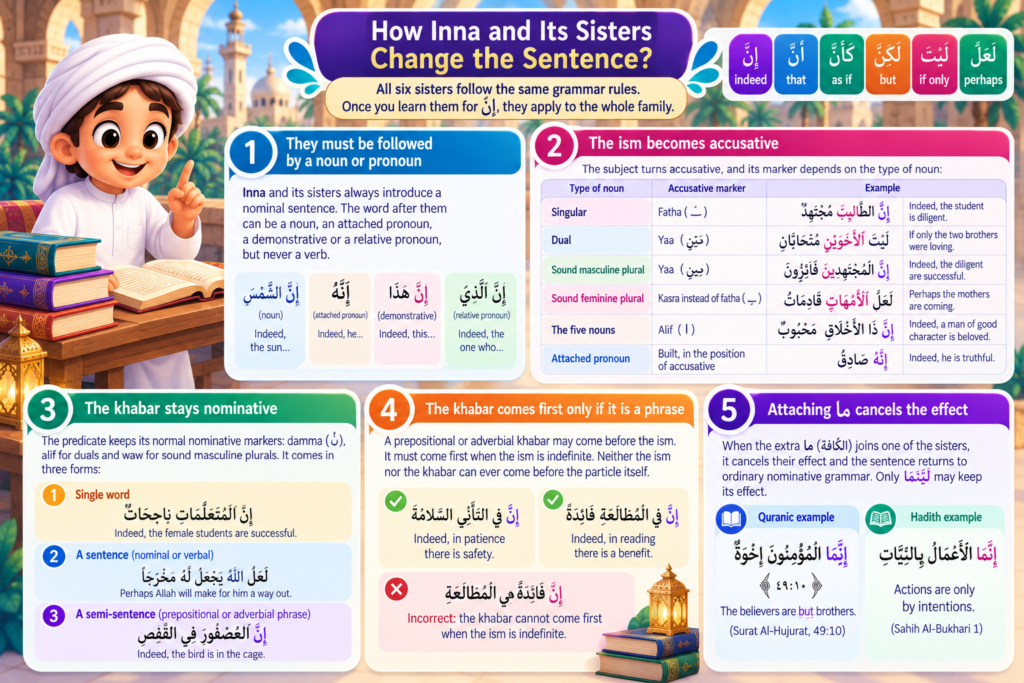
1. They must be followed by a noun or pronoun
Inna and its sisters always introduce a nominal sentence. The word after them can be a noun (إِنَّ الشَّمْسَ), an attached pronoun (إِنَّهُ), a demonstrative (إِنَّ هَذَا) or a relative pronoun (إِنَّ الَّذِي), but never a verb.
2. The ism becomes accusative
The subject turns accusative, and its marker depends on the type of noun:
| Type of noun | Accusative marker | Example |
| Singular | Fatha | إِنَّ الطَّالِبَ مُجْتَهِدٌ |
| Dual | Yaa (ـَيْنِ) | لَيْتَ الأَخَوَيْنِ مُتَحَابَّانِ |
| Sound masculine plural | Yaa (ـِينَ) | إِنَّ المُجْتَهِدِينَ فَائِزُونَ |
| Sound feminine plural | Kasra instead of fatha | لَعَلَّ الأُمَّهَاتِ قَادِمَاتٌ |
| The five nouns | Alif | إِنَّ ذَا الأَخْلَاقِ مَحْبُوبٌ |
| Attached pronoun | Built, in the position of accusative | إِنَّهُ صَادِقٌ |
Pronouncing these endings correctly matters as much as knowing them. If short vowels and case endings still trip you up, focused Arabic pronunciation lessons make a real difference.

3. The khabar stays nominative
The predicate keeps its normal nominative markers: damma (مُجْتَهِدٌ), alif for duals (مُتَحَابَّانِ) and waw for sound masculine plurals (فَائِزُونَ). It comes in three forms:
- Single word: إِنَّ المُتَعَلِّمَاتِ نَاجِحَاتٌ.
- Sentence, nominal or verbal, with a pronoun pointing back to the ism: إِنَّ الحَقَّ صَوْتُهُ مَسْمُوعٌ, لَعَلَّ اللَّهَ يَجْعَلُ لَهُ مَخْرَجًا.
- Semi-sentence, a prepositional or adverbial phrase: إِنَّ العُصْفُورَ فِي القَفَصِ.
4. The khabar comes first only if it is a phrase
A prepositional or adverbial khabar may come before the ism: إِنَّ فِي التَّأَنِّي السَّلَامَةَ. It must come first when the ism is indefinite: إِنَّ فِي المُطَالَعَةِ فَائِدَةً, never إنَّ فائدةً في المطالعةِ. Neither the ism nor the khabar can ever come before the particle itself.
5. Attaching ما cancels the effect
When the extra ما (ما الكافة) joins one of the sisters, it cancels their effect and the sentence returns to ordinary nominative grammar. Only لَيْتَمَا may keep its effect.
The clearest Quranic example comes from Surat Al-Hujurat, which reminds the believers of the bond between them:
إِنَّمَا الْمُؤْمِنُونَ إِخْوَةٌ
“The believers are but brothers.”
المُؤْمِنُونَ keeps its waw because it is now a mubtada’, not the ism of Inna.
إِنَّمَا also adds restriction (حصر): the believers are nothing but brothers.
The same structure opens one of the best-known hadiths. Umar ibn Al-Khattab reported that he heard the Prophet ﷺ say:
إِنَّمَا الْأَعْمَالُ بِالنِّيَّاتِ
“Actions are only by intentions.”
الأَعْمَالُ is nominative as a mubtada’, and بِالنِّيَّاتِ is its khabar. Without ما, Inna would make it الأعمالَ; the attached ما stops that and limits the meaning, so deeds are judged by their intentions.
Common Mistakes with Inna wa Akhawaatuha
The rules are clear, but learners often slip when choosing the case ending or the right sister. The key is to find the ism and khabar before writing a single vowel.
| Common mistake | Wrong | Correct |
| Leaving the ism nominative | إنَّ الطقسُ جميلٌ | إنَّ الطقسَ جميلٌ |
| Making the khabar accusative | إنَّ الطالبَ مجتهدًا | إنَّ الطالبَ مجتهدٌ |
| Using أنَّ after قال | قال أنَّ البابَ مفتوحٌ | قال إنَّ البابَ مفتوحٌ |
| Forgetting the plural yaa | إنَّ المسلمونَ صادقونَ | إنَّ المسلمينَ صادقونَ |
| Using fatha on a feminine plural | إنَّ المعلماتَ مجتهداتٌ | إنَّ المعلماتِ مجتهداتٌ |
| Keeping the effect after إنَّما | إنَّما المؤمنينَ إخوةٌ | إنَّما المؤمنونَ إخوةٌ |
| Using لعلَّ for the impossible | لعلَّ الشبابَ يعودُ يومًا | ليتَ الشبابَ يعودُ يومًا |
The most common mistake of all is mixing Inna up with Kana. Both are nawāsikh, but their effects are exact opposites. Inna wa Akhawaatuha are particles that make the subject accusative and leave the predicate nominative: إِنَّ الطَّقْسَ جَمِيلٌ. Kana wa Akhawaatuha are verbs that do the reverse, keeping the subject nominative and making the predicate accusative: كَانَ الطَّقْسُ جَمِيلًا.
A simple rule to remember: Inna changes the word right after it, while Kana changes the predicate at the end. Many learners first drill this contrast in the classic Madinah books, and our Madinah Arabic course follows the same step-by-step method with a live tutor.

Don’t Just Take Our Word For It
Take a look inside our vibrant classes and see our students and teachers in action. Click below to watch our classroom experience:
Learn Arabic Grammar the Right Way with Arabic Learning Centre
Reading a rule is one thing; using it correctly in every sentence is another. Many learners can recite the six sisters of Inna but still write إنَّ الطقسُ or قال أنَّ when they speak or write.
At Arabic Learning Centre, we close that gap through live one-to-one lessons with experienced Arabic tutors, turning grammar topics like Inna and its sisters into skills you actually use.
Your tutor builds a plan around your level and goals, whether you want to understand the Quran, read classical texts, or master Modern Standard Arabic. Each lesson moves from clear explanation to real examples from the Quran, hadith and everyday Arabic, then to your own sentences, with instant correction at every step.
Because classes are online, you learn from anywhere and at times that fit your schedule. You set the pace, and your tutor tracks your progress, so every new rule builds on the last one instead of being forgotten after the lesson ends.
Book your free trial lesson with Arabic Learning Centre today and see the difference for yourself.
Courses We Offer:
- Business Arabic Course
- Learn Arabic from Zero
- Medical Arabic Course
- Learning Arabic for Non Arabic Speakers
- Learn Arabic in Saudi Arabia
- Learn to Read Arabic Course
- Arabic Grammar Course

Conclusion
Inna wa Akhawaatuha look like six separate rules, but they share one pattern: the ism becomes accusative and the khabar stays nominative. Only the meaning changes, from emphasis with إِنَّ to hope with لَعَلَّ.
Start with إِنَّ and أَنَّ, since you will meet them on every page. Then add كَأَنَّ and لَكِنَّ, and finish with the pair that learners confuse most: لَيْتَ for the impossible and لَعَلَّ for the possible.
These particles are more than grammar drills. As the verses in this guide show, each sister carries part of the message: إِنَّ turns a statement into a promise, لَكِنَّ corrects a false assumption, لَيْتَ voices regret, and لَعَلَّ keeps hope alive. Once you recognise them, you start to hear the tone of a verse, a hadith or a line of poetry, not just its words.
The best way to make the rule stick is to see it in context. Read a short passage every day, underline each sister of Inna, and name its ism and khabar before you check the endings. Within a few weeks, the accusative after Inna will feel as natural as any other word.
Frequently Asked Questions
What are the 6 sisters of Inna?
They are إِنَّ (indeed), أَنَّ (that), كَأَنَّ (as if), لَكِنَّ (but), لَيْتَ (if only) and لَعَلَّ (perhaps). Together they are called Inna wa Akhawaatuha, إنَّ وأخواتها.
What do Inna and its sisters do to a sentence?
They make the subject accusative, now called ism Inna, and keep the predicate nominative, now called khabar Inna: الطَّقْسُ جَمِيلٌ becomes إِنَّ الطَّقْسَ جَمِيلٌ.
What is the difference between إِنَّ and أَنَّ?
Both express emphasis.
إِنَّ starts a sentence or follows قال or an oath, while أَنَّ comes in the middle of a sentence and means “that.”
What is the difference between لَيْتَ and لَعَلَّ?
لَيْتَ wishes for something impossible or very unlikely, while لَعَلَّ hopes for something that can actually happen.
Why are they called “sisters”?
Because all six have the same grammatical effect on the sentence, as members of one family. Inna, the most common, is treated as the eldest sister.
Is لا one of Inna’s sisters?
Some grammarians add لا النافية للجنس (as in لا رَجُلَ فِي البَيْتِ), because it works the same way. Most textbooks still teach the six covered here.