 Arabic Grammar

Arabic words can change in small but meaningful ways depending on the role they play in a sentence. A tiny vowel at the end of a noun may tell you who performed an action, what received it, or how one word connects to another. This system is known as I’rab (الإعراب), and understanding it is an important step toward reading Arabic with greater accuracy and confidence.
For beginners, I’rab can initially seem complicated because it introduces terms such as Raf’, Naṣb, Jarr, Mu’rab, and Mabni.
But the basic idea is much simpler than the terminology suggests. Instead of memorizing every grammar rule at once, you can begin by learning what the main endings mean and noticing how they change in short, familiar sentences.
In this guide, you’ll learn what I’rab is, how its main cases work, which words change their endings, and how to recognize I’rab in everyday Arabic and Quranic examples. You’ll also explore common beginner mistakes and practical ways to develop your understanding without feeling overwhelmed.
What Is I’rab, Exactly?
In simple terms, I’rab (الإعراب) is the system of grammatical endings that shows the role a word plays in an Arabic sentence. These endings often appear as short vowel sounds at the end of a word, and they can change according to how that word functions in the sentence.
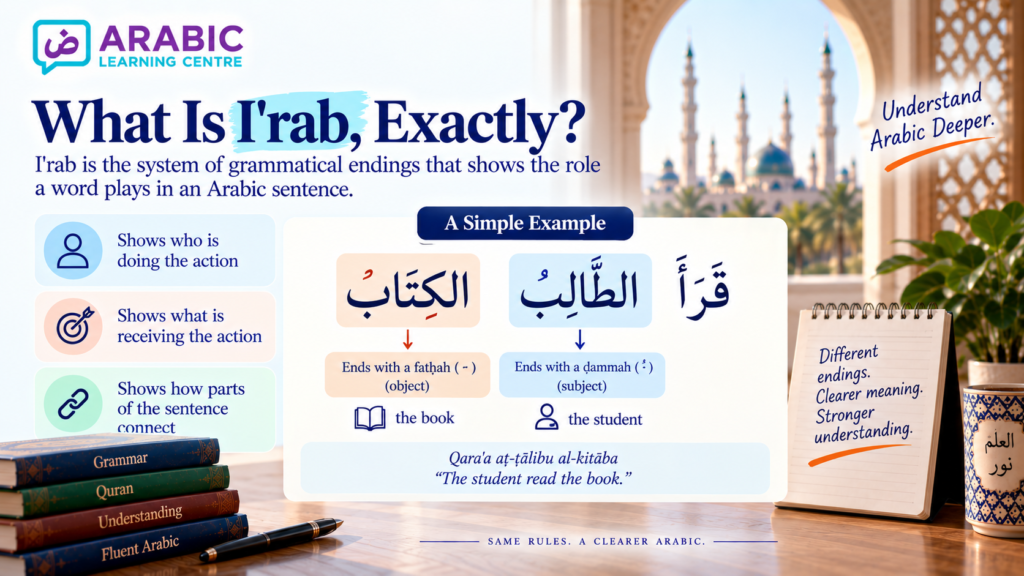
For example, a noun may take one ending when it is the subject performing the action, another when it is the object receiving the action, and another when it comes after a preposition.
Instead of looking only at word order, Arabic uses these grammatical markers to help show how the words in a sentence relate to one another.
This is what makes I’rab so important. By identifying a word’s grammatical role through its ending, learners can understand who is doing the action, what is receiving it, and how different parts of the sentence connect. Once you begin recognizing these patterns, longer Arabic sentences become much easier to analyze and understand.
A Simple Example to Start With
Take this short sentence:
قَرَأَ الطَّالِبُ الكِتَابَ Qara’a aṭ-ṭālibu al-kitāba “The student read the book.”
Look closely at the endings:
- الطَّالِبُ (aṭ-ṭālibu) ends with a ḍammah ( ُ ) — because the student is the one doing the reading.
- الكِتَابَ (al-kitāba) ends with a fatḥah ( َ ) — because the book is the thing being read.
Nothing about the word order tells you this. It is the vowel ending that tells you exactly who is acting and who is being acted upon. That is the whole purpose of I’rab in a single example.
Does I’rab Apply to Every Arabic Word?
No. One of the most important things to understand before studying the different cases of I’rab is that not every Arabic word changes its ending. Some words have endings that change according to their grammatical position, while others remain fixed.

This distinction gives us two important terms: Mu’rab (مُعْرَب) and Mabni (مَبْنِيّ).
- Mu’rab (مُعْرَب): A word whose ending can change according to its grammatical role in the sentence. Most Arabic nouns and adjectives are Mu’rab, and present-tense verbs are generally Mu’rab as well. These are the words where the signs of I’rab become especially important.
- Mabni (مَبْنِيّ): A word whose basic ending remains fixed even when its grammatical position changes. Pronouns, many demonstratives, and particles are common examples. Past-tense and imperative verbs are also generally Mabni.
Understanding this distinction makes I’rab much easier to study. When you encounter a Mu’rab word, its ending can provide an important clue to its grammatical role.
With a Mabni word, however, you do not look for the same kind of changing ending; instead, its grammatical position is understood from the structure and context of the sentence.
The Three Main Cases of I’rab
Arabic grammar organizes I’rab around three primary cases for nouns, plus a special case that applies only to certain verbs.
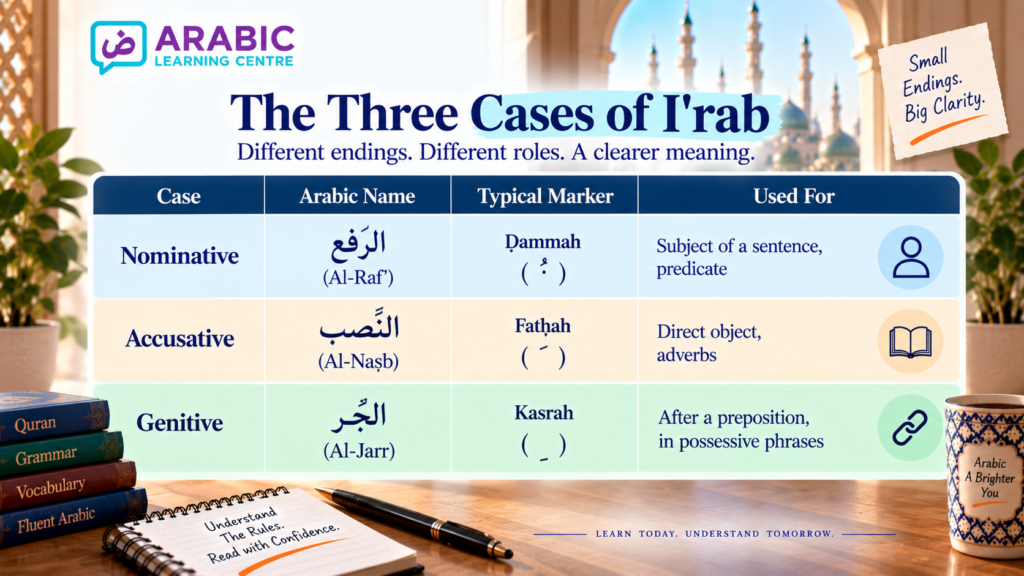
A fourth case, the Jussive (الجزم / Al-Jazm), applies specifically to certain verb forms — typically in negative commands or conditional sentences — and is marked by the absence of a vowel (سكون / sukūn) rather than an added one.
The Nominative Case (الرفع)
The nominative case marks the subject of a sentence or the predicate that describes it. You’ll usually see a ḍammah on a definite noun, or a double ḍammah (tanwīn) on an indefinite one.
مُحَمَّدٌ طَالِبٌ Muḥammadun ṭālibun “Muhammad is a student.”
Both مُحَمَّدٌ and طَالِبٌ are nominative here — the first as the subject, the second as the predicate describing him.
The Accusative Case (النصب)
The accusative case most commonly marks the direct object of a verb — the thing receiving the action.
أَكَلَ الوَلَدُ التُّفَّاحَةَ Akala al-waladu at-tuffāḥata “The boy ate the apple.”
الوَلَدُ (the boy) is nominative, since he performs the action. التُّفَّاحَةَ (the apple) is accusative, since it receives the action of eating.
The Genitive Case (الجر)
The genitive case appears after prepositions, and also in possessive phrases (called Idafah), where one noun is linked directly to another.
قَلَمُ الطَّالِبِ Qalamu aṭ-ṭālibi “The student’s pen.”
الطَّالِبِ takes the genitive kasrah because it is the second part of a possessive construction — literally “the pen of the student.”
Inside Our Classrooms
See how we make learning interactive and engaging! Watch a quick snippet of our live, conversational classes in action:
Everyday Examples of I’rab in Arabic
The best way to understand I’rab is to see how it changes the endings of words in simple Arabic sentences. Instead of memorizing case rules separately, notice how the grammatical role of each word determines its ending.
كَتَبَ مُحَمَّدٌ الرِّسَالَةَ
Kataba Muḥammadun ar-risālata — “Muhammad wrote the letter.”
Here, مُحَمَّدٌ is nominative because he performs the action, while الرِّسَالَةَ is accusative because it receives the action.
قَرَأَتْ مَرْيَمُ الكِتَابَ
Qaraʾat Maryamu al-kitāba — “Maryam read the book.”
The same pattern appears again: مَرْيَمُ is the subject and therefore nominative, while الكِتَابَ is the direct object and therefore accusative.
ذَهَبَ أَحْمَدُ إِلَى السُّوقِ
Dhahaba Aḥmadu ilā as-sūqi — “Ahmad went to the market.”
Here, أَحْمَدُ is nominative as the subject. السُّوقِ is genitive because it follows the preposition إِلَى (to).
الهَاتِفُ عَلَى المَكْتَبِ
Al-hātifu ʿalā al-maktabi — “The phone is on the desk.”
الهَاتِفُ is nominative as the subject of the sentence, while المَكْتَبِ is genitive because it follows the preposition عَلَى (on).
These examples show the basic pattern clearly: a subject is commonly nominative, a direct object is commonly accusative, and a noun after a preposition is genitive.
Once you start identifying these relationships first, the final vowel becomes much easier to understand instead of feeling like something you simply have to memorize.
Building comfort with sentences like these takes more than reading examples once — it takes regular practice putting new words into short sentences of your own.
A structured vocabulary-building course can help you learn new words the right way from the start, inside real sentence patterns rather than as isolated translations, so the vowel endings feel natural rather than memorized.

I’rab Markers for Dual and Plural Nouns
The usual signs of I’rab are ḍammah, fatḥah, and kasrah, but not every Arabic noun shows its grammatical case with these three vowels.
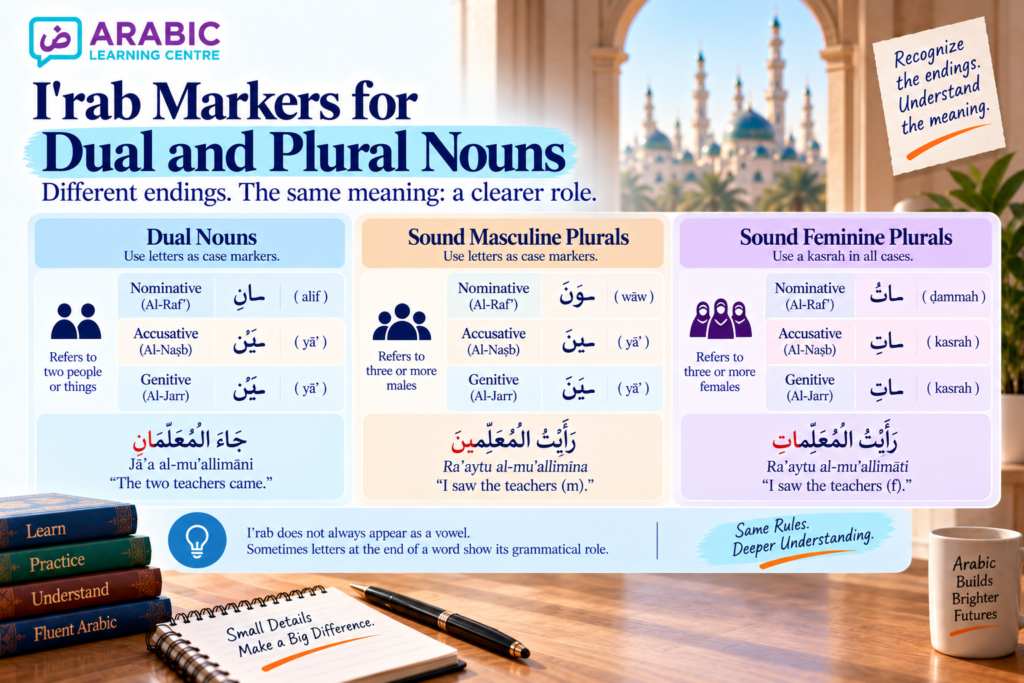
Some types of nouns use letters as case markers instead.
- Dual nouns (words referring to exactly two people or things) use alif (ا) in the nominative case and yā’ (ي) in the accusative and genitive cases.
- Sound masculine plurals use wāw (و) in the nominative case and yā’ (ي) in the accusative and genitive cases.
- Sound feminine plurals are slightly different: they use kasrah instead of fatḥah in the accusative case.
For example:
جَاءَ المُعَلِّمَانِ
Jā’a al-mu’allimāni — “The two teachers came.”
Here, المُعَلِّمَانِ is the subject of the sentence, so it is in the nominative case. Because it is a dual noun, its nominative sign is alif, which appears in the ending ـَانِ (-āni).
Compare that with:
رَأَيْتُ المُعَلِّمَيْنِ
Ra’aytu al-mu’allimayni — “I saw the two teachers.”
Here, المُعَلِّمَيْنِ is the object, so it is accusative. The dual changes from ـَانِ (-āni) to ـَيْنِ (-ayni).
The important idea is that I’rab does not always appear as a vowel at the end of a word. Sometimes a change in the word’s ending — such as ـانِ, ـينِ, or ـونَ — tells you its grammatical role. Once you recognize these endings, dual and plural nouns become much easier to read and understand.
The Importance of I’rab in Understanding the Qur’an
I’rab becomes especially important in Quranic Arabic, where a change in a grammatical ending can affect how a verse is understood.
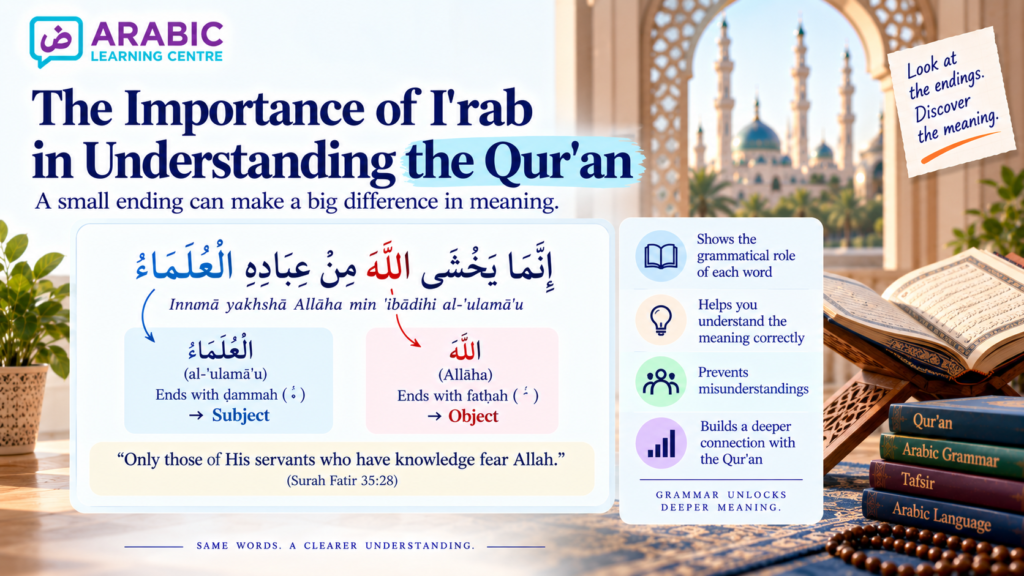
These case endings help identify the grammatical role of each word, showing, for example, who is performing an action and who or what receives it.
A clear example appears in the verse:
إِنَّمَا يَخْشَى اللَّهَ مِنْ عِبَادِهِ الْعُلَمَاءُ
Innamā yakhshā Allāha min ‘ibādihi al-‘ulamā’u
Here, اللَّهَ (Allāha) carries fatḥah, marking it as the object of the verb يَخْشَى (fears), while الْعُلَمَاءُ (al-‘ulamā’u) carries ḍammah, marking it as the subject. The I’rab therefore makes the meaning clear: “Only those of His servants who have knowledge fear Allah.”
Without recognizing these grammatical endings, a learner could misunderstand who fears whom. This is why studying I’rab is valuable for Quranic Arabic: it helps students see how grammar shapes meaning and understand verses more accurately rather than relying only on word order.
Arabic teachers therefore encourage students to slow down and pay close attention to word endings when reading the Qur’an. Even a small vowel at the end of a word can reveal its grammatical function and clarify how the words in a verse relate to one another.
Common I’rab Mistakes Beginners Should Avoid
Learning I’rab becomes much easier when you know which mistakes to watch for. Beginners often understand the basic rules but make small errors when applying them while reading or analyzing sentences. Here are four common mistakes to avoid:
1. Confusing Case Endings with Tanwīn
A single vowel and tanwīn may look similar, but they are not the same. For example, ـُ is a single ḍammah, while ـٌ is ḍammatayn (tanwīn). Tanwīn generally appears on indefinite nouns, so recognizing the difference is important when identifying a word’s grammatical form.
2. Ignoring Final Endings When Reading
Beginners sometimes focus on the main letters of a word and overlook its final vowel. However, that ending may tell you whether the noun is nominative, accusative, or genitive. When practicing I’rab, slow down and pay particular attention to the end of each word.
3. Assuming Every Arabic Word Changes
Not every word has a changing ending. Mu’rab (مُعْرَب) words can change according to their grammatical position, while Mabni (مَبْنِي) words keep a fixed form. Trying to apply changing case endings to every word can therefore create unnecessary confusion.
4. Relying on Translation Instead of Sentence Structure
Knowing the English meaning of a sentence does not automatically reveal the I’rab of its Arabic words. Instead, identify the structure: What is the verb? Who is performing the action? What is the object? Is a noun preceded by a preposition? Asking these grammatical questions helps you understand why each word carries a particular ending.
The key is to treat I’rab as a way of reading the structure of an Arabic sentence, not simply as a set of vowels to memorize. With regular practice, the endings begin to function as useful clues that make Arabic sentences easier to analyze.
How to Learn I’rab Without Feeling Overwhelmed?
Learning I’rab does not require mastering every Arabic grammar rule at once. In fact, trying to memorize too many rules before applying them can make the subject feel more complicated than it really is.
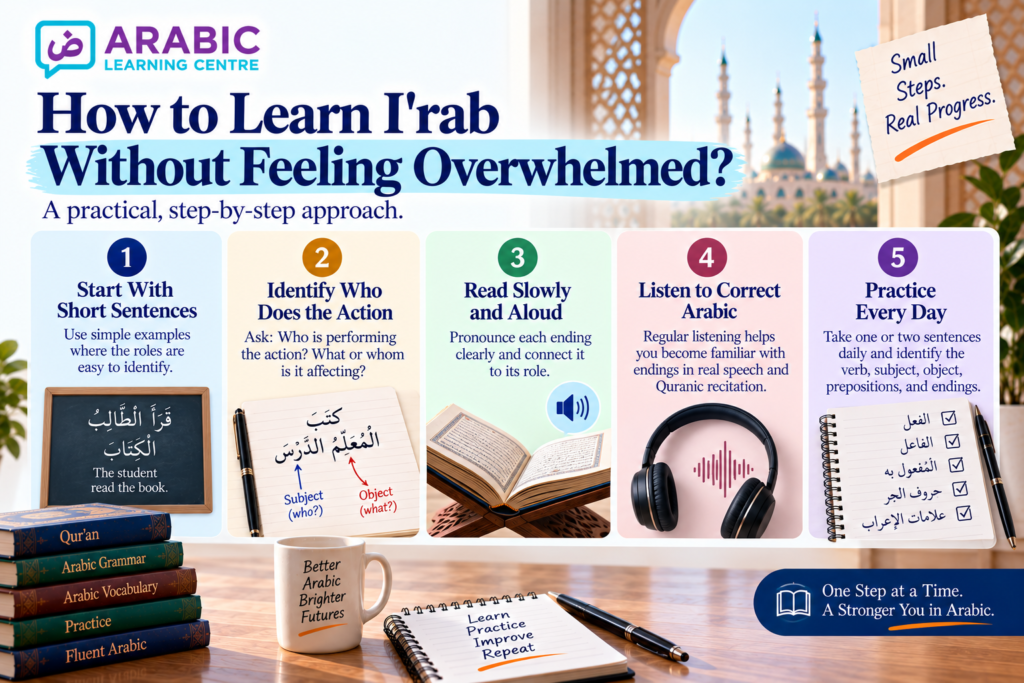
A better approach is to build your understanding gradually through simple sentences and regular practice.
1. Start With Short, Clear Sentences
Begin with sentences where the grammatical roles are easy to identify. Simple examples allow you to focus on the endings without being distracted by complicated structures.
2. Identify Who Does the Action and What Receives It
When you see a verb, ask: Who is performing the action? Then ask: What or whom is the action affecting? These questions help you recognize the subject and object, which is an important first step in determining their I’rab.
3. Read Slowly and Aloud
Do not rush through the final vowels. Pronounce each ending clearly and connect it to the word’s grammatical role. Reading aloud helps turn I’rab from an abstract grammar rule into a pattern you can hear and recognize.
4. Listen to Correct Arabic Recitation and Speech
Regular listening helps you become familiar with Arabic sounds and grammatical endings when they are pronounced. For Quranic Arabic in particular, listening to careful recitation while following the written text can help you notice endings more easily.
5. Practice I’rab Every Day
You do not need a long study session. Take one or two short sentences each day and identify the verb, subject, object, prepositions, and case endings. Consistent practice will gradually make grammatical patterns easier to recognize.
The goal is not to memorize every rule immediately. Instead, learn one pattern, recognize it in real Arabic, and practise it until it becomes familiar. Over time, I’rab becomes less about guessing endings and more about understanding how the sentence is constructed.
As your understanding grows, try writing your own short sentences and marking the correct ending yourself before checking it. Practicing this kind of guided writing practice is one of the fastest ways to move I’rab from “something I recognize” to “something I use automatically.”

Don’t Just Take Our Word For It
Take a look inside our vibrant classes and see our students and teachers in action. Click below to watch our classroom experience:
Build a Stronger Foundation in Arabic with Arabic Learning Centre
Understanding I’rab becomes much easier when grammar is learned through real examples, regular practice, and structured guidance rather than isolated rules.
At Arabic Learning Centre, students can develop their Arabic step by step while strengthening the vocabulary, reading, writing, and grammatical skills needed to understand how the language actually works.
Whether you are starting with the basics or want to become more confident in understanding Arabic sentence structure and Quranic Arabic, structured learning can help turn rules such as I’rab from something you simply memorize into something you can recognize and apply naturally.
Start learning with Arabic Learning Centre and build the foundation you need to read, understand, and use Arabic with greater confidence.
Courses We Offer:
- Arabic Course for Beginners
- Arabic Classes for Adults
- Arabic Classes for Ladies
- Advanced Arabic Course
- Intensive Arabic Course

Conclusion
I’rab may seem like a collection of small vowel marks and grammatical rules at first, but its real purpose is much more practical: it helps reveal the structure and meaning of an Arabic sentence.
Once you understand why a word is nominative, accusative, or genitive, those final endings begin to make sense rather than feeling like details that simply have to be memorized.
You do not need to learn every rule and exception at once. Start by recognizing the basic cases, identifying subjects and objects, noticing what happens after prepositions, and practicing with short sentences.
As these patterns become familiar, you can gradually move on to duals, plurals, more advanced sentence structures, and Quranic Arabic.
Most importantly, make I’rab something you use, not just something you study. Read Arabic aloud, examine word endings, write your own examples, and ask yourself why each ending appears where it does.
With consistent practice, I’rab becomes a valuable tool for understanding Arabic more accurately and reading the language with greater confidence.
Frequently Asked Questions About I’rab
1. Is I’rab Difficult to Learn for Beginners?
I’rab can seem difficult at first because learners encounter several new grammatical terms and endings at the same time. However, beginners do not need to master every rule immediately. Starting with simple sentences and learning to identify subjects, objects, and nouns after prepositions makes the system much easier to understand.
2. What Are the Main Signs of I’rab?
The three basic I’rab signs for nouns are ḍammah (ـُ) for the nominative case, fatḥah (ـَ) for the accusative case, and kasrah (ـِ) for the genitive case. Some nouns, such as dual nouns and sound masculine plurals, use letters like alif, wāw, and yā’ as grammatical markers instead.
3. Does Every Arabic Word Have I’rab?
No. Arabic distinguishes between Mu’rab (مُعْرَب) words, whose endings may change according to their grammatical position, and Mabni (مَبْنِيّ) words, whose basic forms remain fixed. Recognizing this distinction prevents learners from looking for changing case endings where they do not apply.
4. Why Is I’rab Important for Understanding the Qur’an?
I’rab helps identify the grammatical relationship between words in a Quranic verse. Case endings can show which noun is the subject, which is the object, and how different parts of the verse relate to each other. This makes I’rab particularly useful for learners who want to deepen their understanding of Quranic Arabic.
5. Can I Understand Arabic Without Learning I’rab?
You can learn basic vocabulary and understand some Arabic without advanced knowledge of I’rab, but studying it gives you a much clearer understanding of sentence structure. It becomes increasingly valuable when reading formal Arabic, classical texts, and the Qur’an.
6. What Is the Best Way to Practice I’rab?
Start with short Arabic sentences and identify the verb, subject, object, and prepositions before looking at the final vowels. Then explain why each word has its particular ending. Regular reading, writing, and sentence analysis will help these patterns become increasingly familiar.