 Arabic Grammar

Learning Arabic as a beginner can feel challenging at first. You are learning a new writing system, unfamiliar sounds, different sentence structures, and vocabulary that may work very differently from English. Making mistakes is therefore a normal part of the process.
However, some mistakes do more than produce an incorrect word or sentence. They can create learning habits that slow your progress for months.
Understanding the common mistakes new Arabic learners make can help you build a stronger foundation and spend your study time on the skills that actually move you forward.
Below are 15 mistakes Arabic beginners frequently make, along with practical ways to correct them.
1. Relying on Transliteration Instead of Learning Arabic Script
Transliteration means reading Arabic words spelled out in Latin letters — writing “marhaba” instead of مرحباً. It’s a shortcut that lets a beginner pronounce a phrase before they can read a single Arabic letter.
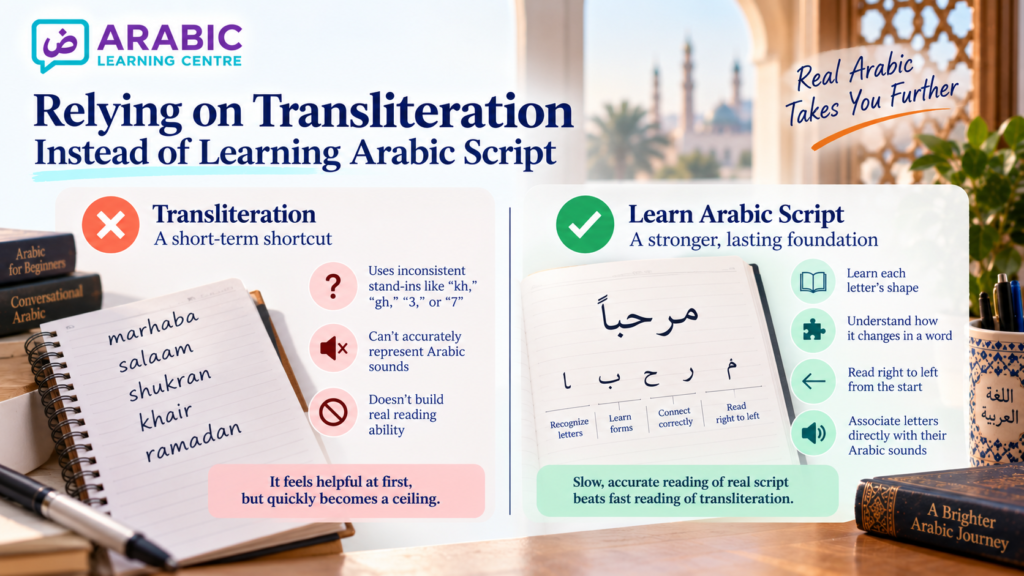
The problem is that Arabic has sounds English letters can’t represent accurately. Learners end up depending on inconsistent stand-ins like “kh,” “gh,” “3,” or “7,” which never translates into real reading ability.
The habit feels productive for the first few weeks, then quietly becomes the ceiling on how far a learner can go without starting over.
The fix is to start the alphabet immediately, even if progress feels slow at first. That means recognizing each letter’s shape, learning how it changes depending on where it sits in a word, connecting letters correctly, and reading right to left from the very first lesson — associating every letter directly with its Arabic sound rather than an English approximation.
Slow, accurate reading of real script beats fast reading of transliteration every time.
Learners who need a systematic introduction to sentence formation, conjugation, morphology, and other structures can use a structured Arabic Grammar Course alongside their regular reading and speaking practice.

2. Confusing Similar-Looking Arabic Letters
Several Arabic letters share almost the same shape and differ only by the number or position of dots:
- ب – ت – ث
- ج – ح – خ
- س – ش
- ص – ض
- ع – غ
A beginner can understand this in theory and still misread these letters at normal reading speed.
One pattern shows up consistently: the confusion rarely happens letter by letter — it happens inside full words, read quickly. That points to a recognition gap rather than a shape problem, which is exactly what grouped-letter drills are built to close.
Practicing similar-shaped letters together, rather than in strict alphabetical order, trains the eye to catch the difference automatically. Reading short combinations side by side — بَ – تَ – ثَ, عَ – غَ — and writing them by hand reinforces the visual gap until it stops requiring conscious effort.
Working through a structured Arabic curriculum with feedback from a real teacher catches this kind of confusion early. A teacher hears the mixed-up sound in your reading before it becomes a habit, which is harder to do alone with an app or a book.
3. Ignoring Arabic Pronunciation
Letters like ع، ح، خ، ق، ص، ض require tongue and throat positions that don’t exist in English. Replacing them with the nearest English sound feels easier in the short term, but the habit becomes harder to correct the longer it continues.
Certain pairs cause the most confusion in practice:
| Letter pair | What differs |
| س / ص | Regular vs. emphatic (heavier) articulation |
| ت / ط | Regular vs. emphatic articulation |
| ح / ه | Throat constriction vs. simple breath |
| ع / أ | Deep throat sound vs. simple glottal stop |
Correcting this starts with listening closely to a native or qualified speaker and repeating individual sounds before attempting full words.
Recording yourself occasionally and comparing it against a reliable model catches drift early — while it’s still an easy fix, rather than months later when the sound has become automatic.
Vocabulary and Grammar Mistakes
These three mistakes trace back to the same root cause: learning Arabic as isolated facts instead of as a connected system.
4. Memorizing Vocabulary Without Context
Recognizing a word on a flashcard doesn’t mean you can use it. Arabic words change with gender, number, possession, and grammatical position, and their natural meaning often depends on the words around them.
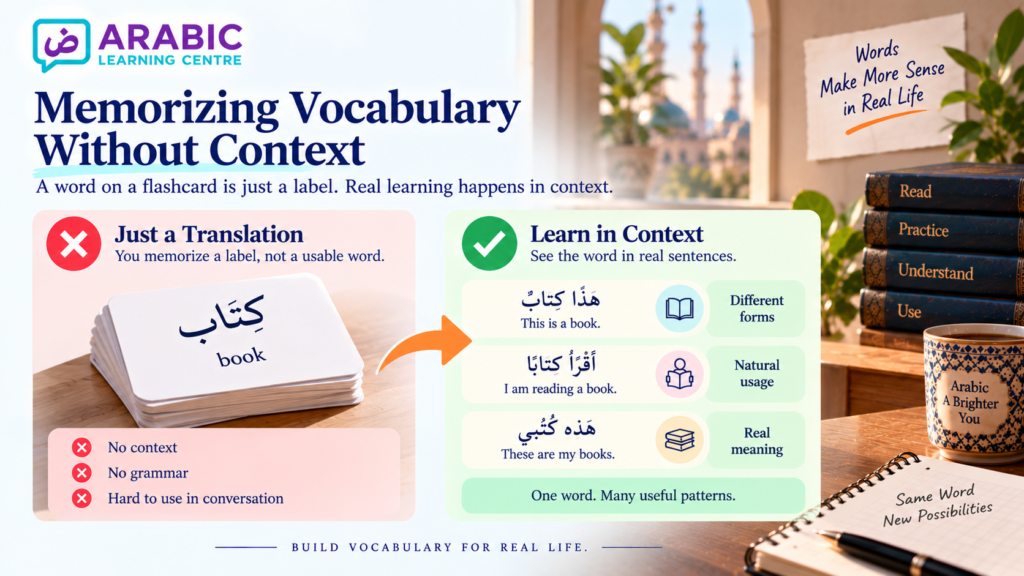
A learner who only ever meets كِتَاب as “book = كتاب” has memorized a label, not a usable word.
The stronger approach is learning new words inside short sentences from the start:
- هَذَا كِتَابٌ — This is a book
- أَقْرَأُ كِتَابًا — I am reading a book
- هَذِهِ كُتُبِي — These are my books
That single word is now tied to three usage patterns instead of one flat translation — which is closer to how the word will actually show up in conversation or reading.
5. Translating Every Sentence Directly From English
Building an English sentence in your head and swapping each word for Arabic rarely produces natural Arabic.
Languages aren’t substitution codes. Arabic has its own sentence patterns, prepositions, and idioms — and even simple English verbs like “make,” “get,” or “take” map onto completely different Arabic verbs depending on context.
The way out of this is learning complete expressions rather than individual word translations. When you meet a new verb, notice which nouns and prepositions typically appear with it, and start asking “how do Arabic speakers actually use this word?” instead of only “what does this word mean?” Over time, that question shifts how you form ideas in Arabic instead of translating them.
6. Memorizing Arabic Grammar Without Applying It
Studying conjugation tables and grammatical terminology for hours doesn’t automatically produce the ability to build a sentence. Grammar should explain how Arabic works, not sit as a list of abstract rules a learner can recite but not use.

How to Turn a Grammar Rule Into an Active Skill?
The fix is applying every rule the moment you learn it: read a few examples, identify the rule inside each one, build a sentence of your own using it, say it aloud, then write it without looking at the model.
A structured grammar course that pairs each rule with immediate practice gets you here faster than a textbook alone, because the practice is built into the lesson instead of left for later.
Speaking and Listening Mistakes
It’s possible to study Arabic vocabulary and grammar for months while barely speaking or listening to it — and that gap between passive and active knowledge is one of the most common complaints intermediate learners have about their own beginner stage.
7. Practicing Reading but Avoiding Speaking
Understanding a sentence when you read it and producing that same sentence in conversation use different mental processes.
Reading is recognition; speaking is retrieval under time pressure, and the two skills don’t automatically transfer.
The fix is speaking with the Arabic you already have instead of waiting until it feels “good enough.” Start with simple sentences — أنا طالب، أنا أتعلم العربية — and lengthen them gradually as vocabulary grows.
Reading aloud, describing objects around you, and short dialogues with a teacher or language partner all build this retrieval skill directly, in a way that more reading never will.
Inside Our Classrooms
See how we make learning interactive and engaging! Watch a quick snippet of our live, conversational classes in action:
8. Not Listening to Enough Arabic
Textbook exercises don’t reproduce connected speech, natural pauses, or real speaking speed.
A learner can become comfortable reading while finding ordinary spoken Arabic surprisingly hard to follow, because the two skills are trained separately.
Useful listening material at the beginner stage includes:
- Beginner dialogues
- Slow-spoken content designed for learners
- Teacher recordings
- Conversations with native speakers
You don’t need to understand everything at first. Recognizing sounds and familiar words is enough to build on, and comprehension grows naturally as exposure adds up.
Young learners generally benefit from shorter lessons, visual activities, repetition, guided pronunciation, simple vocabulary, and gradual literacy development.
Parents teaching preschool-age children can therefore choose age-specific programs such as Arabic Lessons for Kindergarten instead of relying on materials originally created for adult learners.

9. Being Afraid to Make Mistakes
Some learners understand far more Arabic than they’re willing to use, because they’re waiting for their grammar and pronunciation to be “perfect” before speaking. That moment rarely arrives on its own.
Aiming for clear communication before perfect communication changes this. When corrected, repeat the correct form and move on rather than dwelling on the error. Confidence is a result of speaking regularly — not a precondition for it.
Working with a live tutor removes a lot of this fear in practice, because corrections happen in real time, in a low-stakes setting, instead of building up silently in your own head.
10. Trying to Learn Too Much at Once
Studying vocabulary, grammar, handwriting, conversation, pronunciation, and conjugation simultaneously usually produces information overload: constant studying with very little retained by the end of the week.
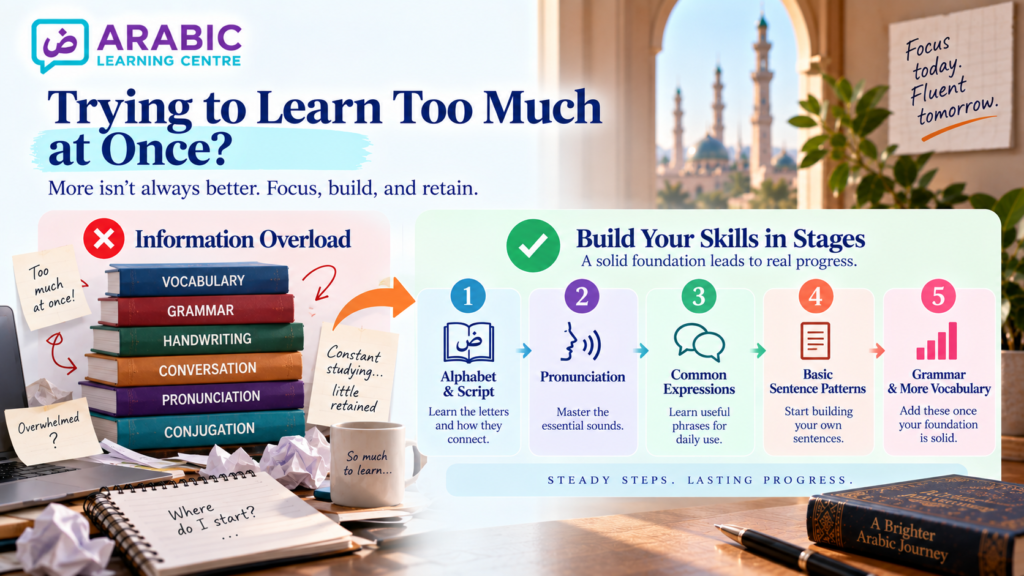
Building skills in stages solves this. A reasonable starting stage covers the alphabet, essential pronunciation, common expressions, and basic sentence patterns. Grammar and larger vocabulary sets get added once that foundation feels solid, not before.
11. Learning MSA and Several Dialects Without a Clear Goal
Modern Standard Arabic and spoken dialects — Egyptian, Levantine, Gulf, Moroccan, and others — share a linguistic foundation but differ in vocabulary, pronunciation, and everyday expressions.
Tracking multiple versions of the same phrase before building a basic foundation creates confusion rather than flexibility.
The clearest fix is deciding the goal first:
| If your goal is… | Then prioritize… |
| Reading, writing, news, academic Arabic | Modern Standard Arabic |
| Talking with people in one specific country or region | That region’s spoken dialect |
| Both, long-term | MSA first as a foundation, dialect added once basics are solid |
You can eventually study both — the point is choosing deliberately instead of collecting phrases from several varieties at random.
12. Using Learning Materials That Don’t Match the Learner’s Age or Level
A resource can be linguistically correct and still be the wrong fit. Long explanations of Arabic morphology built for university students won’t work for a five-year-old, and short, gamified activities built for children will feel slow to an adult beginner.

Matching materials to both age and proficiency level fixes this directly. Younger learners generally need shorter lessons, repetition, and guided pronunciation practice, while adult beginners need pacing and explanations built specifically for adult learners — not a repurposed children’s course, and not the reverse.
13. Studying Irregularly
Three hours on Saturday followed by six days of nothing means much of the previous lesson is forgotten by the time the next session starts.
Long, irregular sessions are usually less effective than short, consistent ones, because language retention depends on repeated exposure more than total hours.
A simple daily routine — even ten to fifteen minutes — closes this gap:
- Review previous vocabulary
- Read a few Arabic sentences
- Listen to a short recording
- Practice one grammar pattern
Consistency outperforms marathon sessions almost every time.
14. Switching Between Too Many Arabic Resources
Apps, YouTube channels, textbooks, and tutors each introduce vocabulary and grammar in a different order.
Constantly switching between them means never completing a structured sequence, and it’s easy to spend more time comparing resources than actually studying.
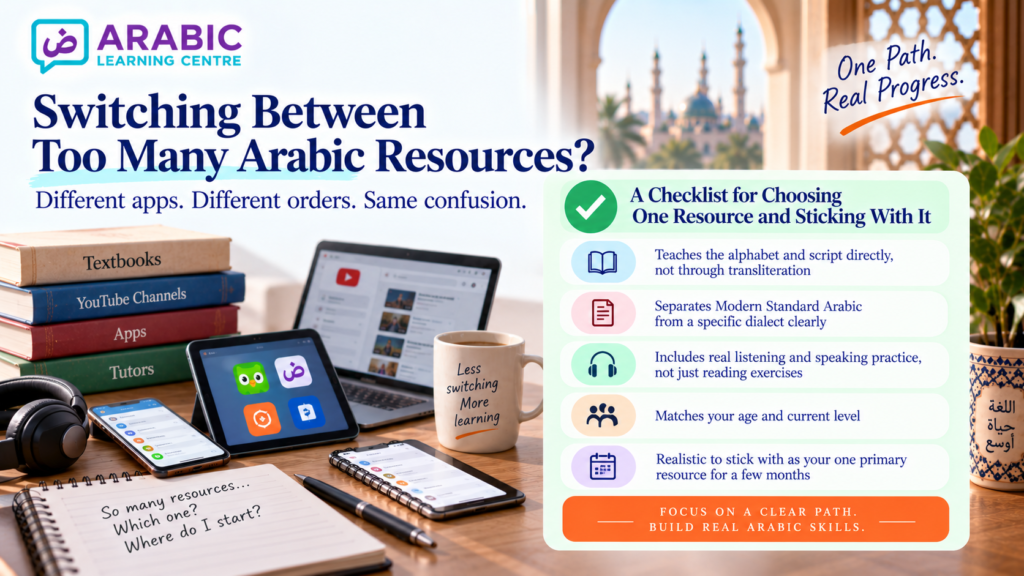
A Checklist for Choosing One Resource and Sticking With It
Before choosing your main Arabic learning resource, use the following checklist to make sure it can support consistent and structured progress:
- Teaches the alphabet and script directly, not through transliteration.
- Separates Modern Standard Arabic from a specific dialect clearly.
- Includes real listening and speaking practice, not just reading exercises.
- Matches your age and current level.
- Realistic to stick with as your one primary resource for a few months.
Pick one primary path — a course or teacher — and use everything else as a supplement, not a replacement. Structured programs like the courses at Arabic Learning Centre are built around exactly this problem: one clear sequence covering script, pronunciation, grammar, and speaking together, so learners aren’t left assembling their own curriculum from five different apps.
15. Expecting Fast Fluency
Early progress feels fast — new letters, new phrases, visible wins every week. As the language advances, progress slows down, which doesn’t mean it has stopped; it means the gains are less visible day to day.
Replacing vague goals with measurable ones brings that visibility back: learn the alphabet, read a short paragraph accurately, learn 20 useful expressions, hold a two-minute conversation, write five sentences about your day.
Small, specific milestones make progress easy to track again, even when fluency itself still feels far off.
Don’t Just Take Our Word For It
Take a look inside our vibrant classes and see our students and teachers in action. Click below to watch our classroom experience:
Avoid Common Learning Mistakes With Arabic Learning Centre
Many beginner mistakes happen when learners try to build their Arabic skills without a clear learning sequence.
Arabic Learning Centre provides structured Arabic learning that brings together script, pronunciation, vocabulary, grammar, listening, and speaking, helping learners develop their skills progressively instead of depending on scattered resources or shortcuts.
Whether you are starting with the Arabic alphabet or working toward more confident communication, guided learning can help you identify mistakes early and build stronger habits from the beginning.
Start your free trial with Arabic Learning Centre and begin building your Arabic skills on a clear, structured learning path.
Courses We Offer:
- Arabic Course for Beginners
- Arabic Classes for Adults
- Arabic Classes for Ladies
- Advanced Arabic Course
- Intensive Arabic Course

Conclusion
Most of the common mistakes new Arabic learners make trace back to one root cause: trying to progress without a clear structure.
Relying on transliteration, translating word-for-word from English, memorizing grammar without practice, avoiding speaking, and switching resources constantly all slow progress the same way — they replace real skill-building with a shortcut that feels productive.
The fix isn’t more hours of study. It’s combining the right skills in the right order: real script from day one, pronunciation practiced against a native model, vocabulary learned inside sentences, grammar applied immediately, and speaking started before it feels comfortable.
Avoiding these mistakes won’t make Arabic easy overnight, but it removes the habits that quietly cost learners months of progress — which is most of what separates steady beginners from stalled ones.
Frequently Asked Questions
What Is the Most Common Mistake New Arabic Learners Make?
One of the most common mistakes is relying on transliteration instead of learning Arabic script. Transliteration can help briefly at the beginning, but learners should start recognizing Arabic letters and connecting them directly with their sounds as early as possible.
Should I Learn Arabic Grammar or Vocabulary First?
Beginners do not need to choose one exclusively. Start with essential vocabulary and simple sentence patterns, then introduce basic grammar gradually. Learning grammar through words and sentences you can actually use is generally more effective than memorizing rules in isolation.
Should Beginners Learn Modern Standard Arabic or a Dialect First?
It depends on your goal. Modern Standard Arabic (MSA) is particularly useful for reading, writing, formal communication, news, and academic contexts, while a dialect is more relevant for everyday communication within a particular region.
How Often Should a Beginner Study Arabic?
Consistency is more important than occasional long study sessions. Even 10–15 minutes of focused daily practice can help learners regularly review vocabulary, read Arabic, listen to the language, and practise grammar patterns.
Is It Okay to Use Several Arabic Learning Apps and Resources?
Additional resources can be useful as supplements, but constantly switching between apps, textbooks, channels, and courses can disrupt your progress. Choose one structured primary learning path and use other resources to support it rather than repeatedly replacing it.
How Can I Avoid Common Mistakes When Learning Arabic?
Build your skills progressively: learn the Arabic script early, practise accurate pronunciation, learn vocabulary in context, apply grammar through sentences, listen to Arabic regularly, and start speaking before you feel completely confident.