 Learn Arabic
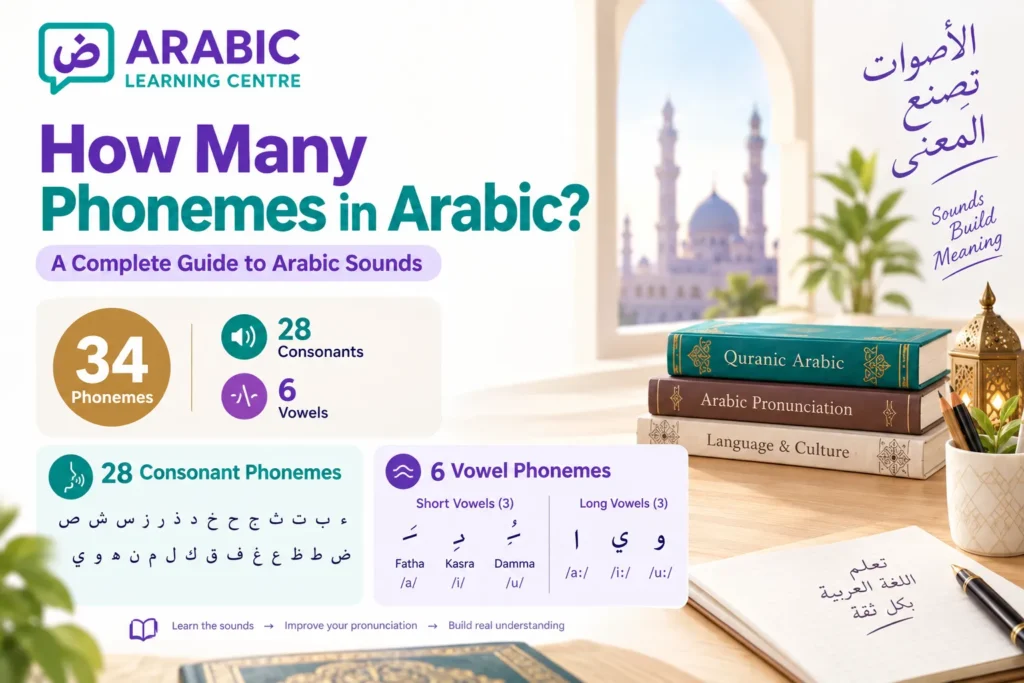
If you are learning Arabic pronunciation, you may wonder: how many phonemes in Arabic are there? The commonly cited answer for Modern Standard Arabic is 34 phonemes, consisting of 28 consonant phonemes and 6 vowel phonemes. The vowels are generally divided into three short vowels and three corresponding long vowels.
This number is greater than the 28 letters usually associated with the Arabic alphabet because letters and phonemes are not exactly the same thing. Arabic writing represents consonants prominently, while short vowels are normally represented by diacritical marks rather than independent alphabet letters.
Understanding these Arabic sounds is useful for anyone learning to speak, read, or understand the language because changing a single phoneme can change the form and meaning of a word.
What Is a Phoneme in Arabic?
A phoneme is a basic sound unit that can distinguish one linguistic form from another. It is not necessarily the same as a written letter.
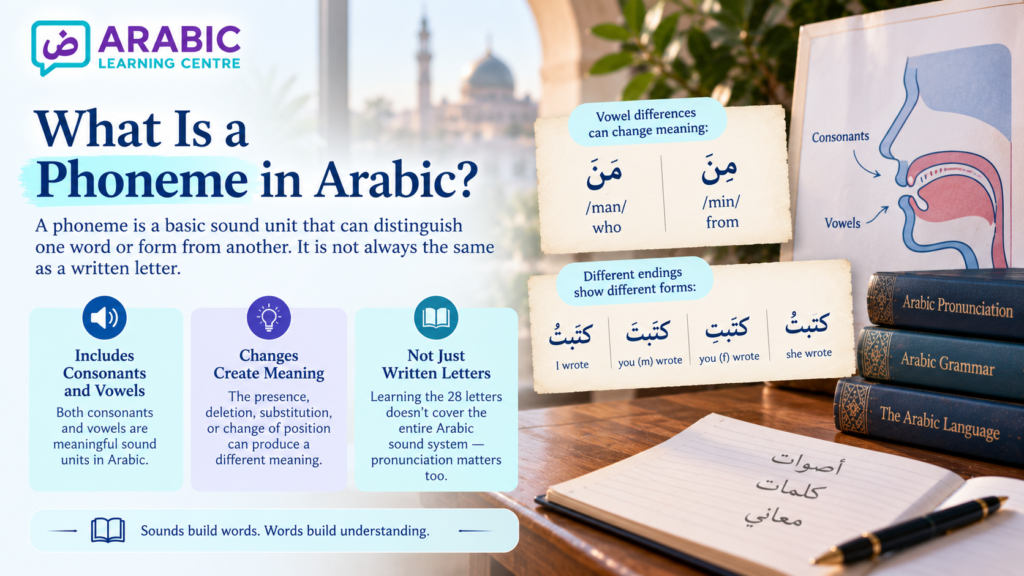
Arabic includes both consonants and vowels as meaningful sound units. The source material describes the phoneme as a fundamental sound whose presence, deletion, substitution, or change of position can produce a different meaning. It also emphasizes that vowels can perform this distinguishing function, rather than being treated merely as additions to consonants.
For example, vowel differences in Arabic can distinguish words and grammatical forms. The source gives examples involving forms such as مَن /man/ and مِن /min/, as well as كتبتُ، كتبتَ، كتبتِ، كتبتْ, where changes in the final vowel contribute to changes in grammatical meaning.
This is one reason Arabic learners need to study pronunciation alongside the alphabet rather than assuming that learning the 28 written letters means they have learned the entire Arabic sound system.
Read also: 10 Famous Arabic Poems Every Arabic Learner Should Know
How Many Phonemes Are in Arabic?
In the commonly used analysis presented here, Arabic has 34 phonemes.
They can be summarized as follows:
| Type of Phoneme | Number |
| Consonants | 28 |
| Short vowels | 3 |
| Long vowels | 3 |
| Total | 34 |
The source material likewise states that Arabic consists of 34 phonemic units, including consonants and vowels.
So, when someone asks how many sounds in Arabic there are in a phonological sense, 34 is a useful standard answer for Modern Standard Arabic.
However, the precise analysis can vary depending on the linguistic framework being used and whether dialectal Arabic, allophones, secondary features, or other phonetic distinctions are being counted.
Read also: How Are Arabic Names Structured? – A Step-by-Step Guide
What Are the 28 Consonant Phonemes in Arabic?
Arabic has 28 consonant phonemes in the classification used here.
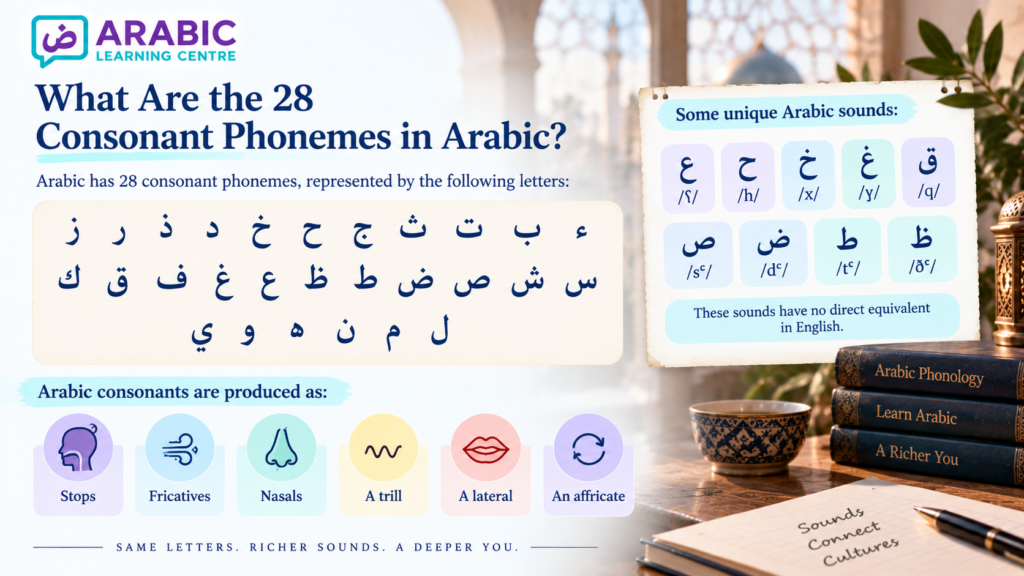
These consonants are represented broadly by the following Arabic letters:
ء، ب، ت، ث، ج، ح، خ، د، ذ، ر، ز، س، ش، ص، ض، ط، ظ، ع، غ، ف، ق، ك، ل، م، ن، ه، و، ي
Arabic includes several consonant sounds that have no direct equivalent in English, which can make them especially important for learners. Examples include:
- ع /ʕ/
- ح /ħ/
- خ /x/
- غ /ɣ/
- ق /q/
- ص /sˤ/
- ض /dˤ/
- ط /tˤ/
- ظ /ðˤ/
Arabic consonants can also be classified according to how they are produced, including stops, fricatives, nasals, a trill, a lateral, and an affricate.
Read also: I’rab Arabic Grammar – A Simple Guide for Beginners
What Are the 6 Vowel Phonemes in Arabic?
Alongside its consonants, Modern Standard Arabic is commonly analysed as having six basic vowel phonemes: three short and three long.
Short Vowels in Arabic
The three basic short vowels are:
| Arabic Mark | Name | Approximate Representation |
| َ | Fatha | /a/ |
| ِ | Kasra | /i/ |
| ُ | Damma | /u/ |
Unlike most consonants, these short vowels are represented using diacritical marks rather than ordinary independent letters.
Long Vowels in Arabic
Arabic also has three corresponding long vowel phonemes:
| Long Vowel | Common Representation |
| ا | /aː/ |
| ي | /iː/ |
| و | /uː/ |
Vowel length matters because short and long vowels can create meaningful distinctions in Arabic. The source specifically stresses that the type, position, length, and shortness of vowels can affect meaning and therefore should be considered in phonemic analysis.
For learners interested in understanding these distinctions within formal Arabic texts, studying a structured Classical Arabic course can provide a stronger foundation in pronunciation, vocabulary, morphology, and grammatical patterns.

Why Does Arabic Have 34 Phonemes but Only 28 Letters?
The difference comes from the fact that letters and phonemes are not the same thing. Letters are written symbols, while phonemes are distinctive sounds that can differentiate meaning.
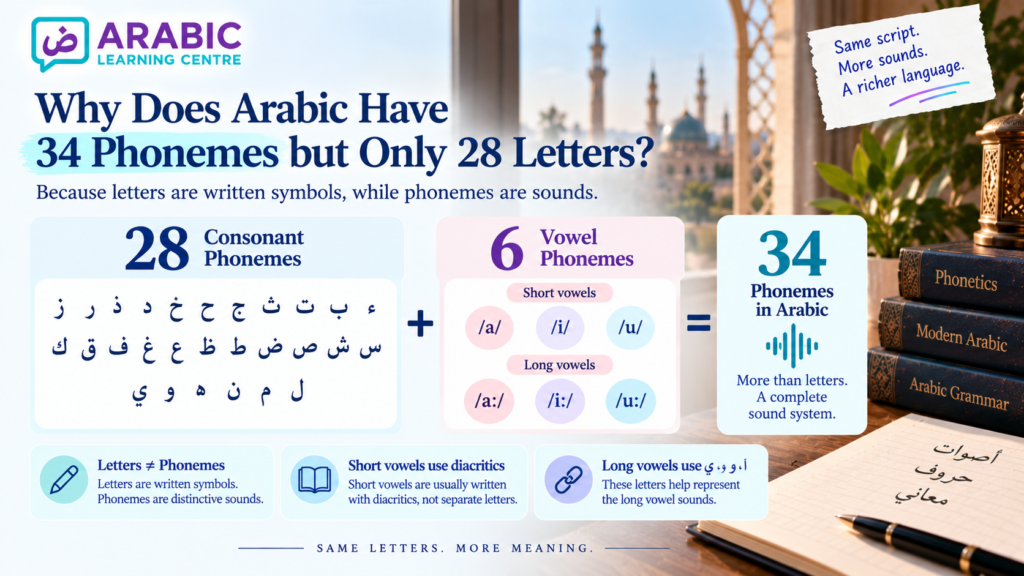
In the phonological analysis used here, Modern Standard Arabic has 34 basic phonemes: 28 consonants and 6 vowels. The six vowels consist of three short vowels—/a/, /i/, /u/—and three corresponding long vowels—/aː/, /iː/, /uː/.
The Arabic alphabet, however, is conventionally described as having 28 basic letters. Short vowels are normally represented by diacritics rather than independent letters, while ا، و، and ي participate in representing long vowels.
Therefore, in this analysis:
28 consonant phonemes + 6 vowel phonemes = 34 phonemes
This is why learning the 28 Arabic letters alone does not cover the entire sound system. Learners also need to recognize and pronounce the short and long vowel contrasts accurately.
Inside Our Classrooms
See how we make learning interactive and engaging! Watch a quick snippet of our live, conversational classes in action:
How Are Arabic Letters and Sounds Different?
Arabic letters and phonemes are closely related, but they describe two different things: how Arabic is written and how it is pronounced.
| Feature | Arabic Letters | Arabic Phonemes |
| What they are | Written symbols | Distinctive speech sounds |
| Main role | Represent Arabic in writing | Represent Arabic pronunciation |
| Example | ب، ت، ك | /b/, /t/, /k/ |
| Short vowels | Not counted among the 28 basic letters | /a/, /i/, /u/ are vowel phonemes |
| How learners use them | Recognize and read words | Pronounce and distinguish sounds |
Short Vowels Show Why Letters and Phonemes Are Not the Same
Fatha, kasra, and damma represent the short vowels /a/, /i/, and /u/. They affect pronunciation but are written as diacritical marks rather than counted among the 28 basic Arabic letters.
For learners, the key is to connect:
written form → sound → pronunciation → meaning
This connection becomes especially important when reading Arabic without full vowel markings.
What Is the Difference Between a Phoneme and an Allophone?
A phoneme is a distinctive sound category in a language, while an allophone is a particular pronunciation of that phoneme that does not create a separate phonemic distinction.
| Feature | Phoneme | Allophone |
| Definition | A distinctive sound category | A pronunciation variant of a phoneme |
| Distinguishes meaning | Yes | Normally no |
| Notation | / / | [ ] |
| Arabic example | /l/ | Different realizations of /l/ |
The Arabic lām (ل) provides an example: its pronunciation can vary according to the phonetic environment while the variants may still belong to the same underlying phoneme /l/.
This also explains why “How many sounds are there in Arabic?” can have different answers. This article counts 34 phonemes, but the number becomes more complex if individual allophones and dialectal variations are included.
How Do Arabic Phonemes Change Meaning?
Phonemes play a crucial role in Arabic because changing a single sound can change the meaning or grammatical function of a word. This change may involve either a consonant or a vowel.
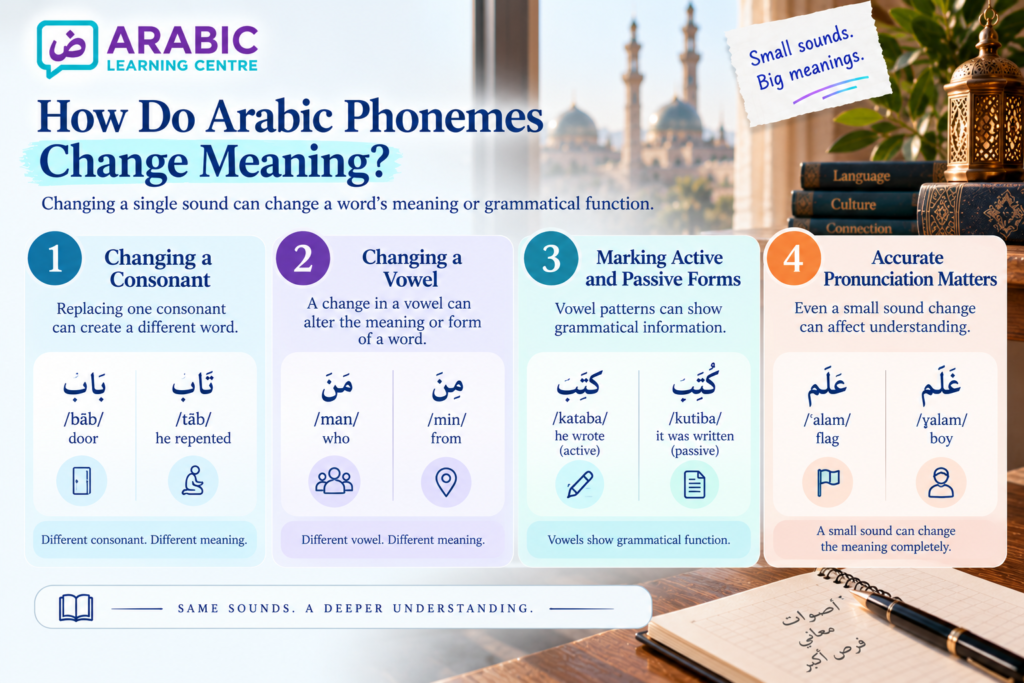
1. Changing a Consonant Can Create a Different Word
Replacing one consonant with another can produce an entirely different word. This demonstrates how consonants distinguish meaning in Arabic.
2. Changing a Vowel Can Change Meaning or Word Form
Arabic vowels are equally important. A change in a vowel can alter the meaning of a word or produce a different linguistic form, even when the main consonantal structure remains related.
3. Vowel Changes Can Mark Active and Passive Verb Forms
Vowel patterns can carry grammatical information. In Arabic, changing vowels can help distinguish between active and passive constructions and other grammatical forms.
4. Small Pronunciation Changes Can Affect Comprehension
Because both consonants and vowels distinguish meaning and grammatical function, accurate pronunciation is essential for understanding Arabic. Even a small sound change can result in a different word, meaning, or grammatical structure.
Are Arabic Phonemes the Same in Every Dialect?
Not necessarily The 34-phoneme figure is most useful when discussing the standard Arabic system described above. Spoken Arabic varieties can differ in how particular phonemes are pronounced, merged, or replaced.
A familiar example is ق /q/, whose realization varies considerably across Arabic-speaking regions. Similarly, ج can have noticeably different pronunciations depending on the dialect.
These differences do not make one variety inherently more correct than another. They demonstrate that Modern Standard Arabic and regional spoken varieties have related but not completely identical phonological systems.
For learners, the best approach depends on the goal. Someone studying formal texts may prioritize Modern Standard or Classical Arabic pronunciation, while someone primarily interested in everyday communication may also need systematic exposure to a spoken variety.
Why Are Arabic Phonemes Important for Learners?
Understanding the Arabic phoneme system gives learners a stronger foundation for pronunciation, listening, reading, and speaking.
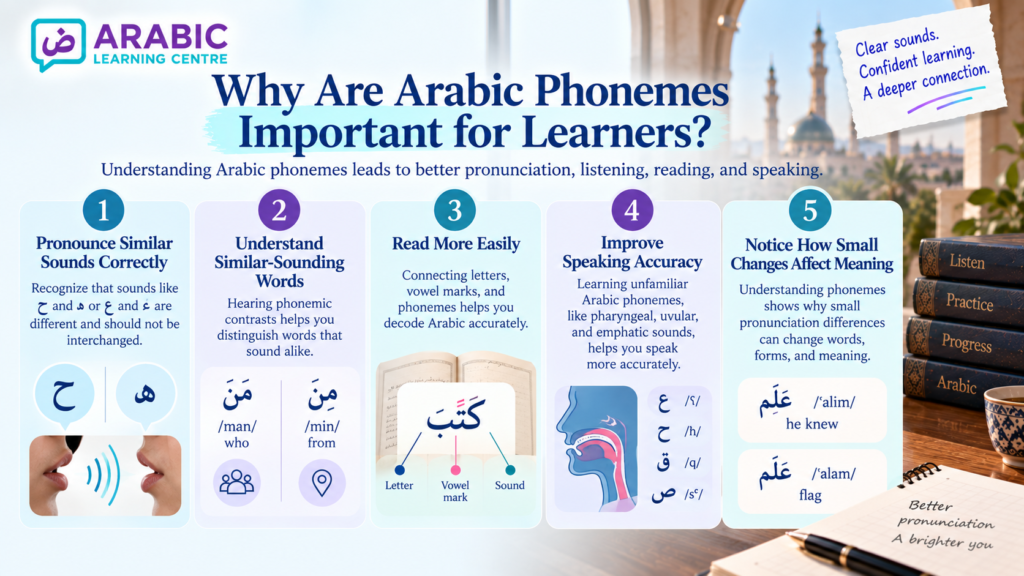
1. Phonemic Awareness Helps Learners Pronounce Similar Arabic Sounds Correctly
Learners begin to recognize that sounds such as ح and ه or ع and ء represent different phonemes and should not be pronounced interchangeably.
2. Recognizing Phonemic Contrasts Makes Similar-Sounding Words Easier to Understand
Learning to hear differences between Arabic sounds improves listening comprehension and helps learners distinguish words that may initially sound very similar.
3. Connecting Letters, Vowel Marks, and Phonemes Makes Arabic Easier to Read
Understanding how written letters and vowel marks correspond to sounds helps learners decode fully vocalized Arabic more accurately and confidently.
4. Learning Unfamiliar Arabic Phonemes Improves Speaking Accuracy
Arabic includes sounds that may require new articulatory habits, particularly pharyngeal, uvular, and emphatic consonants. Learning how these sounds are produced helps learners speak more accurately.
5. Phonemic Awareness Shows Why Small Pronunciation Differences Can Change Meaning
Understanding phonemes helps learners recognize which sound differences are functionally important in Arabic. This simplifies language learning by focusing attention on distinctions that can affect words, grammatical forms, and meaning.
For non-native learners, recognizing these sounds intellectually is only the first stage. They also need to hear how they are produced and practise using them in connected speech. A structured Arabic speaking course can help learners move from identifying Arabic sounds to producing them accurately in words, phrases, and conversations.

How to Learn Arabic Sounds More Effectively
Knowing that Arabic has 34 phonemes provides a useful foundation, but effective pronunciation requires learners to hear, produce, compare, and use those sounds in real speech.
1. Listen to Each Arabic Sound Before Trying to Produce It
Repeated listening helps learners build a clear mental model of each phoneme and recognize how it differs from other Arabic sounds.
2. Observe How the Mouth and Throat Produce Difficult Arabic Sounds
Pay attention to the position of the tongue, lips, teeth, and throat. This is especially important for sounds that do not exist in the learner’s first language.
3. Practise Difficult Phonemes in Isolation Before Using Them in Words
Producing a sound by itself allows learners to focus on its articulation without the additional difficulty of surrounding sounds.
4. Compare Similar Arabic Sounds Side by Side
Practising contrasting sounds together makes subtle differences easier to hear and produce, particularly when two phonemes initially sound almost identical.
5. Move From Individual Sounds to Complete Arabic Words and Sentences
Arabic sounds do not normally occur in isolation. Their actual pronunciation can be influenced by surrounding sounds, so practice should gradually progress from individual phonemes to words and connected speech.
6. Use Arabic Sounds in Real Conversations to Develop Natural Pronunciation
The final goal is not simply to pronounce individual phonemes correctly, but to produce them accurately and naturally within sentences and everyday conversation.
Don’t Just Take Our Word For It
Take a look inside our vibrant classes and see our students and teachers in action. Click below to watch our classroom experience:
Turn Your Knowledge of Arabic Sounds Into Real Speaking Skills
Understanding Arabic phonemes is an important first step, but accurate pronunciation develops through listening, guided practice, and real communication.
At Arabic Learning Centre, learners can go beyond studying individual sounds and learn how to use Arabic naturally in words, sentences, and conversations.
With structured Arabic courses, you can strengthen your pronunciation, improve your listening and speaking skills, and become more confident distinguishing and producing the sounds that make Arabic unique.
Start your free trial with Arabic Learning Centre today and turn your understanding of Arabic sounds into accurate pronunciation and confident communication.
Courses We Offer:
- Quranic Arabic Course
- Arabic Course for Islamic Studies
- Learn Arabic for New Muslims
- Learn Arabic Letters for Tajweed
- Al Azhar Arabic Course
- Madinah Arabic Course

Conclusion
Arabic phonemes are much more than individual sounds to memorize. They form the foundation of how words are pronounced, distinguished, and understood.
Knowing that Arabic has 28 consonant phonemes and 6 vowel phonemes helps learners see why mastering the alphabet alone does not provide a complete understanding of the Arabic sound system.
More importantly, phonemic awareness connects pronunciation with listening, reading, speaking, and comprehension.
By learning to recognize similar sounds, distinguish short and long vowels, and practise phonemes within complete words and sentences, learners can gradually develop clearer and more natural Arabic.
The goal, therefore, is not simply to know how many phonemes are in Arabic, but to understand how those sounds work together and use them confidently in real communication.
Frequently Asked Questions
How many phonemes in Arabic are there?
Modern Standard Arabic is commonly described as having 34 phonemes in the analysis used here: 28 consonant phonemes and 6 vowel phonemes.
How many sounds in Arabic are there?
If “sounds” refers specifically to phonemes, the answer is generally 34. If allophones, dialectal pronunciations, and other phonetic variations are included, there can be many more actual sound realizations.
Does Arabic have 28 or 34 sounds?
Arabic has 28 basic alphabet letters, but the phonemic system described here contains 34 units because it also counts three short and three long vowels.
How many vowel phonemes are there in Arabic?
Modern Standard Arabic is commonly analysed as having six basic vowel phonemes: /a/, /i/, /u/, /aː/, /iː/, and /uː/.
What is the difference between a phoneme and an Arabic letter?
A letter is a written symbol, whereas a phoneme is a functional sound unit. They often correspond, but they are not identical. Arabic short vowels, for example, function phonologically even though they are normally represented by diacritics rather than independent alphabet letters.
Why are phonemes important when learning Arabic?
Phonemes help learners distinguish words, recognize spoken Arabic, pronounce difficult consonants, understand vowel contrasts, and connect written Arabic with natural speech. Since changes in consonants or vowels can contribute to changes in linguistic form and meaning, phonemic awareness is an important foundation for accurate Arabic communication.