 Arabic Alphabet & Writing
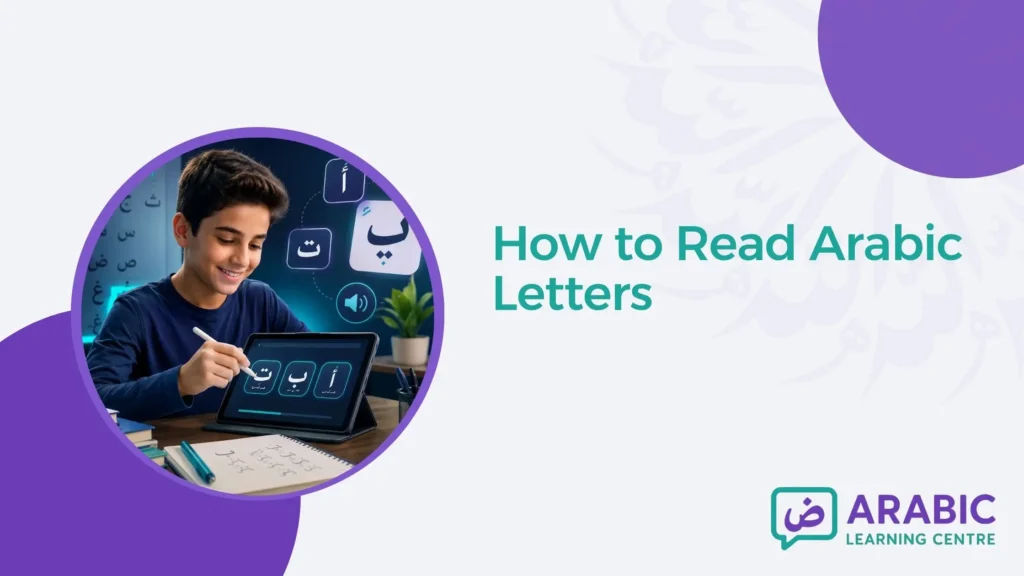
Every beginner who opens an Arabic text for the first time makes the same mistake: they try to memorize 28 completely separate symbols. After two weeks, they still hesitate on half of them. The problem is not their memory — it is their method. Arabic does not have 28 unique shapes. It has approximately 10 core shapes, each modified by dots. Once you see the pattern, the alphabet reorganizes itself in your mind from a wall of foreign symbols into a logical, learnable system. This guide teaches you to read Arabic letters the way the shape system actually works.
1- Arabic Has 10 Core Shapes, Not 28 Separate Letters to Memorize
The most important insight for any beginner learning how to read Arabic letters is this: most Arabic letters are not independent shapes. They are variations of a smaller set of base forms, distinguished only by the number and position of dots — called nuqat (نُقَط).
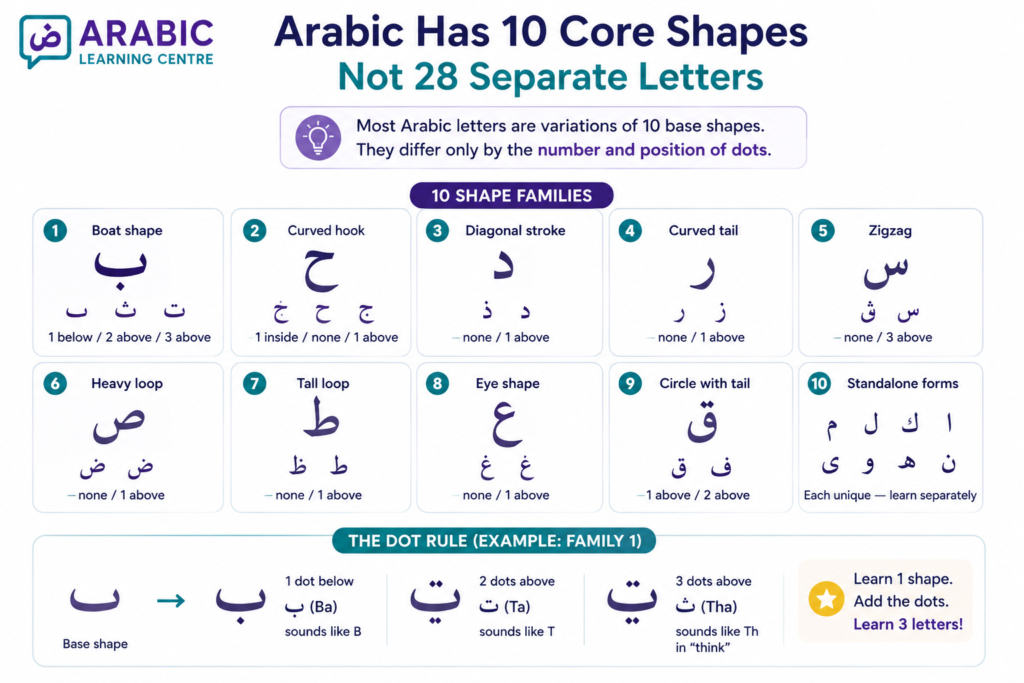
The complete shape family system organizes all 28 Arabic letters into groups that share the same base form:
| Shape Family | Base Shape | Letters in Family | What Changes |
| Family 1 | Boat shape | ب، ت، ث | 1 dot below / 2 dots above / 3 dots above |
| Family 2 | Curved hook | ج، ح، خ | 1 dot inside / no dot / 1 dot above |
| Family 3 | Diagonal stroke | د، ذ | No dot / 1 dot above |
| Family 4 | Curved tail | ر، ز | No dot / 1 dot above |
| Family 5 | Zigzag | س، ش | No dot / 3 dots above |
| Family 6 | Heavy loop | ص، ض | No dot / 1 dot above |
| Family 7 | Tall loop | ط، ظ | No dot / 1 dot above |
| Family 8 | Eye shape | ع، غ | No dot / 1 dot above |
| Family 9 | Circle with tail | ف، ق | 1 dot above / 2 dots above |
| Family 10 | Standalone forms | ا، ك، ل، م، ن، هـ، و، ي | Each unique — learn separately |
This means that when you learn how to read Arabic letters for beginners, you are not memorizing 28 random symbols. You are learning approximately 10 base shapes and then applying a simple dot-counting rule to distinguish the letters within each family.
The dot rule that unlocks every family:
- One dot below = ب (Ba) — sounds like B.
- Two dots above = ت (Ta) — sounds like T.
- Three dots above = ث (Tha) — sounds like Th in “think.”
Same shape. Three completely different sounds. The dots are everything. Write the base shape once, then add the dots — and you have learned three letters simultaneously instead of three separate ones.
At The Arabic Learning Centre, the Arabic Classes for Non-Arabic Speakers introduces letters in shape families from the very first lesson — so beginners build visual recognition patterns instead of relying on rote memorization.

Learn Arabic letters through patterns, not memorization.
2- Every Arabic Letter Has Four Positional Forms That Reading Requires
Knowing a letter’s isolated shape is only the beginning. How to read Arabic letters in English-language learning resources almost never addresses this clearly enough: every Arabic letter changes its visual appearance depending on where it sits inside a word.
The four positional forms every letter takes:
| Form | When It Appears | Description |
| Isolated | Letter stands alone | Full shape — what you see in alphabet charts |
| Initial | Letter begins a word | Connected only to the right — tail trimmed |
| Medial | Letter sits mid-word | Connected on both sides — most abbreviated form |
| Final | Letter ends a word | Connected only to the left — tail adjusted |
The practical consequence: a beginner who only drills isolated letter shapes for two weeks will open a real Arabic word and not recognize the letters they just spent two weeks studying. The shapes look different in connected text.
The solution is to practice each letter in all four forms simultaneously from Day 1. For example, the letter Ba (ب):
| Form | Shape | Notes |
| Isolated | ب | Full boat shape with one dot below |
| Initial | بـ | Connects forward — tail shortened on right |
| Medial | ـبـ | Connected on both sides — minimized |
| Final | ـب | Connects from left only — tail on right preserved |
The core shape — the horizontal stroke with one dot below — remains constant across all four forms. The connecting tails are what change. Once you see this logic applied to Ba, it extends naturally to every other letter in the same family.
Six letters are non-connectors — they never connect to the letter that follows them, regardless of position. These six have only two forms instead of four:
| Letter | Name | Why It Matters |
| ا | Alif | When you see it mid-word, the next letter starts fresh |
| د | Dal | Creates a visible break in word flow |
| ذ | Dhal | Same break pattern as Dal |
| ر | Ra | Very common — its non-connecting nature affects nearly every word |
| ز | Zay | Same pattern as Ra |
| و | Waw | Extremely common — must be memorized as non-connector from Day 1 |
Memorize these six as a group before attempting to read connected text. When you encounter one mid-word, you know the cursive flow breaks there and the next letter begins a new connected cluster.
Inside Our Classrooms
See how we make learning interactive and engaging! Watch a quick snippet of our live, conversational classes in action:
3- Arabic Letters in English Approximations Reveal Three Sound Categories
How to read Arabic letters in English pronunciation guides works differently from how to read Arabic letters directly from their shapes — because Arabic has three distinct sound categories, and English can only approximate two of them.
The three sound categories every beginner must understand:
Category 1 — Familiar sounds (English speakers can produce these immediately):
| Arabic Letter | English Approximation | Sound Description |
| ب | B | “B” in boy — accurate |
| ت | T | “T” in top — accurate |
| د | D | “D” in dog — accurate |
| ز | Z | “Z” in zero — accurate |
| س | S | “S” in sun — accurate |
| ش | Sh | “Sh” in ship — accurate |
| ف | F | “F” in fan — accurate |
| ك | K | “K” in king — accurate |
| ل | L | “L” in lamp — accurate |
| م | M | “M” in moon — accurate |
| ن | N | “N” in name — accurate |
| و | W | “W” in water — accurate |
| ي | Y | “Y” in yes — accurate |
Category 2 — Near approximations (English speakers can get close with practice):
| Arabic Letter | English Approximation | Sound Description |
| ث | Th | “Th” in think — close but softer |
| ج | J | “J” in jump — varies by dialect |
| ذ | Dh | “Th” in this — voiced version |
| ر | R | Rolled R — like Spanish “pero” |
| خ | Kh | Like Scottish “loch” |
| غ | Gh | French uvular R — approximation only |
Category 3 — No English equivalent (require native audio and physical practice):
| Arabic Letter | Articulation Point | Why English Cannot Approximate It |
| ح | Middle throat | Deep breathy H — English H comes from much higher |
| ع | Middle throat | Voiced constriction with no English parallel |
| ص | Tongue + emphatic | Heavy S with tongue pressed to roof of mouth |
| ض | Tongue + emphatic | Unique to Arabic — no other language produces this identically |
| ط | Tongue + emphatic | Heavy T produced further back than English T |
| ظ | Tongue + emphatic | Emphatic Dh — no English parallel |
| ق | Uvula | K produced from the uvula — not from the front of the mouth |
For Category 3 letters, Arabic letters in English approximations give you a placeholder, not an accurate sound. The only method that works for these seven letters is hearing them from a native speaker and physically practicing the articulation point until your vocal tract learns the movement.
At The Arabic Learning Centre, the Arabic Speaking Course provides real-time Makharij correction for every Category 3 letter from the very first session — the only reliable way to build accurate pronunciation of sounds English cannot represent.

Correct your Arabic letter pronunciation with native guidance
4- Arabic Letters Are Produced from Five Articulation Regions in the Body
How to read Arabic letters for beginners requires not just visual recognition but acoustic recognition — knowing what each letter sounds like when you hear it in real speech. The science behind Arabic letter sounds is called Makharij al-Huruf (مَخَارِج الحُرُوف) — literally “exit points of the letters.” Every Arabic letter originates from a specific location in the vocal tract.
There are 17 precise articulation points organized into five regions:
| Region | Letters Produced Here | Key Characteristic |
| Throat (deepest to nearest) | ء، هـ، ع، ح، غ، خ | Six throat letters — hardest for English speakers |
| Deep tongue | ق، ك | Back of tongue meets soft palate — produces “heavy K” sounds |
| Middle tongue | ج، ش، ي | Middle of tongue meets hard palate |
| Tip of tongue | ت، د، ط، ن، ل، ر، ث، ذ، ظ، س، ص، ز | Largest group — tip of tongue against gums, teeth, or palate |
| Lips | ب، م، و | Both lips together or lower lip against upper teeth |
The practical reading application of Makharij: when two letters look similar in written form and you are unsure which one you are reading, the articulation point tells you which sound belongs there.
If the word context suggests a throat letter, you know it cannot be ب — ب comes from the lips. This cross-checking between visual form and expected sound resolves ambiguity in connected text faster than any other method.
Three articulation insights that immediately improve reading accuracy:
- Emphatic letters (ص، ض، ط، ظ) always produce a “heavier,” fuller sound that affects surrounding vowels — words containing them sound distinctly different from words containing their non-emphatic counterparts (س، د، ت، ذ).
- Throat letters (ع، ح، غ، خ) require the body to produce sounds from further back than any English sound — using a mirror to observe throat movement while practicing these letters accelerates accurate production.
- The letter ق (Qaf) is produced from the uvula — the furthest-back point in the mouth. Confusing it with ك (Kaf), which comes from the soft palate, changes word meanings completely.
قَلْب (qalb) means “heart” — كَلْب (kalb) means “dog.”
5- Reading Arabic Letters Inside Real Words Starts from Day Three
The most damaging mistake beginners make when learning how to read Arabic letters is spending weeks drilling isolated letter shapes before ever attempting to read a connected word. Research on Arabic reading consistently shows that learners who move to real words from Day 3 onward develop reading recognition significantly faster than those who delay.
The reason is visual: Arabic letters in real words look different from their isolated forms. A learner who has spent two weeks on isolated Ba (ب) will open the word بَيْت (bayt — house) and struggle to identify the letter they just memorized — because the connected initial form looks different from the isolated chart shape they drilled.
The correct progression from Day 1 to reading real words:
- Days 1–2: Learn the isolated forms of Shape Family 1 (ب، ت، ث) and Shape Family 2 (ج، ح، خ). Focus on the base shape first, then add dots.
- Day 3: Read these six letters inside real Arabic words — do not wait until you know all 28 letters. Start with words like بَيْت (bayt — house) and بَاب (baab — door).
- Days 4–7: Add Shape Families 3 and 4 (د، ذ، ر، ز). Immediately practice reading words containing these letters alongside the letters from Days 1–2.
- Week 2: Add the remaining shape families two per day. By the end of Week 2, you should be reading simple vowelized words — not just recognizing isolated letters.
Beginner words organized by shape family for immediate reading practice:
| Word | Transliteration | Meaning | Letters Featured |
| بَيْت | bayt | house | ب، ي، ت |
| بَاب | baab | door | ب، ا، ب |
| كِتَاب | kitaab | book | ك، ت، ا، ب |
| دَرَسَ | darasa | he studied | د، ر، س |
| جَبَل | jabal | mountain | ج، ب، ل |
| رَجُل | rajul | man | ر، ج، ل |
| شَمْس | shams | sun | ش، م، س |
| كَلْب | kalb | dog | ك، ل، ب |
Each word above contains only letters from the first four shape families — making them ideal for reading practice before the full alphabet is complete.
At The Arabic Learning Centre, the Arabic Grammar Course moves students from letter recognition to reading real Arabic sentences through structured live instruction — with a certified native tutor confirming accurate reading of every word in real time.

Move from letter recognition to reading real Arabic words
6- The Five Most Common Reading Errors and Their Direct Fixes
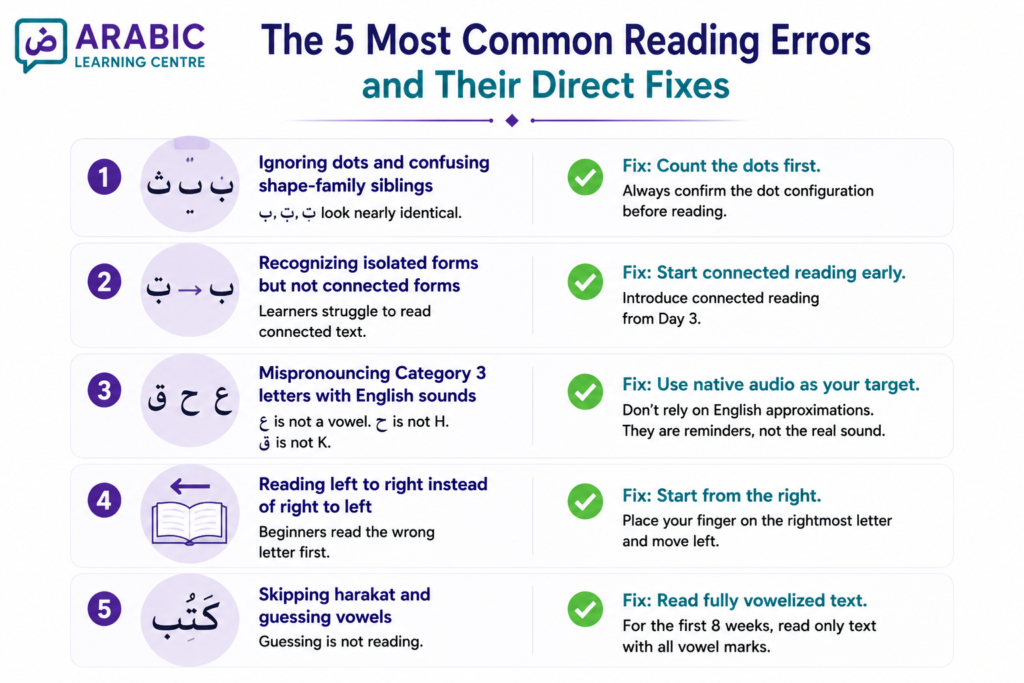
Understanding what causes reading errors is as valuable as knowing the correct method. These five mistakes appear consistently among beginners learning how to read Arabic letters — and every one of them has a direct, practical fix.
The five errors and their fixes:
Confusing shape-family siblings by ignoring dots
ب، ت، ث look nearly identical — beginners who focus on the shape without counting dots misread them constantly. Fix: always count the dots before producing the sound. Never read a letter without confirming its dot configuration first.
Recognizing isolated forms but not connected forms
Two weeks of isolated letter drilling produces learners who cannot read connected text. Fix: introduce connected reading from Day 3 — never delay real words until all 28 letters are memorized in isolation.
Mispronouncing Category 3 letters by substituting English sounds
ع is not a vowel.
ح is not the English H.
ق is not the English K. Fix: for these seven letters, refuse to use the English approximation as your target. The approximation is a reminder, not the actual sound — use native audio as your reference for these letters only.
Reading left to right instead of right to left
Arabic text direction is the opposite of English. Beginners consistently read the wrong letter first in an unfamiliar word. Fix: place a finger at the rightmost letter of every new word and move left — use physical guidance until right-to-left reading becomes automatic.
Read Also: How to Read Arabic Quran?
Skipping harakat and guessing vowels
Beginners who attempt to read unvowelized text before building vocabulary are not reading — they are guessing. Fix: read only fully vowelized text for the first 8 weeks. Every vowel mark that is present is information — never skip it.
Read Also: How to Read Arabic Indic Numbers
Don’t Just Take Our Word For It
Take a look inside our vibrant classes and see our students and teachers in action. Click below to watch our classroom experience:
Read Also: How to Read Arabic in English Letters?
Start Reading Arabic Letters at The Arabic Learning Centre
The shape family method, the four positional forms, the three sound categories, the Makharij articulation points, and the Day 3 reading practice — every element of this guide is actionable independently. What self-study cannot provide is the real-time correction that catches errors the learner cannot hear themselves making.
The Arabic Learning Centre provides exactly that:
- Certified Arab tutors with native-level proficiency who identify shape confusion, dot misreading, and articulation errors in real time during every session.
- One-on-one live sessions structured around the shape family method — moving from the first family through to reading connected Arabic words at each student’s specific pace.
- Real-time Makharij correction for the Category 3 letters — the sounds that English cannot approximate and that require physical guidance to produce correctly.
- Female Arabic teacher options for learners who prefer culturally sensitive instruction.
- Flexible scheduling across all global time zones — EST, PST, GMT, CET, IST, GST, and MYT.
- Monthly progress reports and written feedback after every session.
Courses We Offer:
- Business Arabic Course
- Learn Arabic from Zero
- Medical Arabic Course
- Learning Arabic for Non Arabic Speakers
- Learn Arabic in Saudi Arabia
- Learn to Read Arabic Course
- Arabic Grammar Course
- Arabic Speaking Course
- Arabic Script writing course
- Arabic Vocabulary Course
- Arabic Pronunciation Course
Your free trial lesson is one step away
Conclusion
How to read Arabic letters is not a matter of memorizing 28 separate symbols — it is a matter of recognizing 10 base shapes, counting dots, learning four positional forms per letter, and understanding which sounds have English equivalents and which require native audio. The shape family method reorganizes the Arabic alphabet from a wall of foreign symbols into a logical pattern system that the brain processes far more efficiently than rote memorization.
FAQ
How to read Arabic letters for complete beginners with no prior knowledge?
Start with Shape Family 1 — ب، ت، ث. Learn the base boat shape first, then add dots: one below for Ba, two above for Ta, three above for Tha. Practice these three inside real words on Day 3 before moving to the next family.
How to read Arabic letters in English approximations accurately?
Use English approximations for Category 1 and 2 letters — these are close enough to build initial recognition. For the seven Category 3 letters (ح، ع، ص، ض، ط، ظ، ق), use native audio recordings only — English approximations mislead more than they help for these sounds.
Why do Arabic letters look different inside words than in the alphabet chart?
Every Arabic letter has four positional forms — isolated, initial, medial, and final. The connecting tails change based on position, but the core shape and dots remain constant. Practice all four forms of each letter from Day 1 to avoid this confusion in connected text.
What are the six non-connecting Arabic letters and why do they matter for reading?
The six non-connectors — ا، د، ذ، ر، ز، و — never connect to the letter that follows them. They create visible breaks in connected Arabic text. Recognizing these six immediately tells you where one letter cluster ends and the next begins inside a word.
How long does it take to read Arabic letters fluently?
With 20–30 minutes of daily practice using the shape family method, most motivated beginners recognize all 28 letters within 2 weeks and read simple vowelized words within 4–6 weeks. Reading speed increases naturally as word recognition becomes automatic.
Related Articles
Arabic Alphabet & Writing