 Arabic Alphabet & Writing
| Key Takeaways |
| Arabic letter worksheets cover tracing, colouring, dot-to-dot, and positional forms across isolated, initial, medial, and final positions. |
| Free high-quality PDF worksheets are available from sites like Arabic Seeds, Sadeky, IqraGames, and Teachers Pay Teachers with no account required. |
| Each Arabic letter has up to four written forms; practising all four positions on dedicated worksheets is the fastest way to reach reading fluency. |
| Adult beginners benefit most from worksheets that combine letter-form tables with writing practice lines rather than child-only colouring activities. |
| Pairing printed worksheets with live instruction accelerates progress significantly compared to self-study with worksheets alone. |
Arabic letter worksheets are printable or downloadable practice sheets that teach learners to recognize, trace, and write the 28 letters of the Arabic alphabet — in their isolated, initial, medial, and final forms.
The challenge is knowing which ones are genuinely worth your time. Some worksheets are designed for young children only, others skip the critical letter-position practice that every reader needs, and many free resources are scattered across dozens of websites.
Below, we have collected the best Arabic letter worksheets currently available — free downloads first, paid resources second — with direct links and an honest assessment of who each one suits best.
1. Free Islamic Arabic Alphabet Colouring and Tracing Worksheets
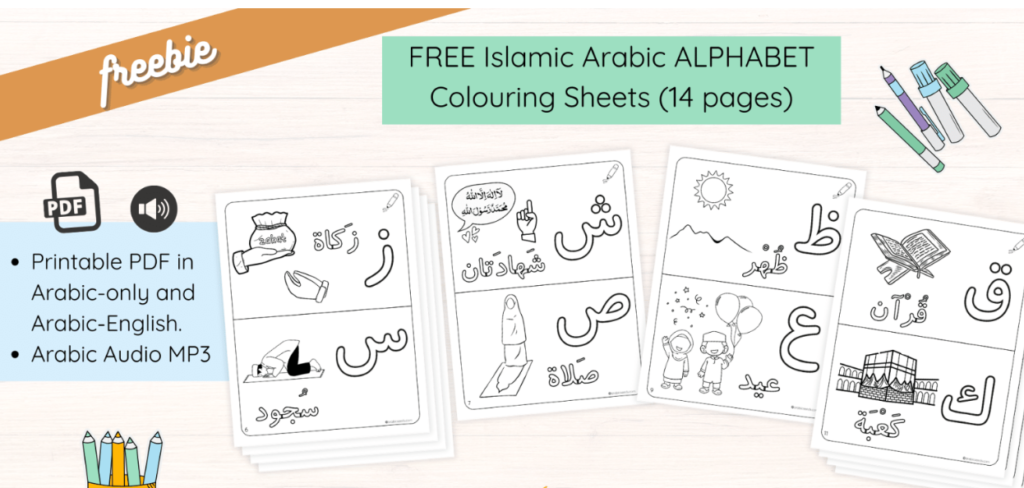
Arabic Seeds offers a free, beautifully designed set of Arabic alphabet worksheets that pair every letter with an Islamic vocabulary word and a corresponding illustration. Each sheet includes a large letter to colour, dotted tracing lines, and an audio MP3 for pronunciation support — making these one of the most complete free beginner sets available.
Each of the 28 letters gets its own page. The Islamic vocabulary focus — words drawn from everyday Muslim life — makes these especially suitable for Muslim learners of all ages, not only children.
The bilingual PDF option (Arabic-English) means you can see the transliteration alongside the Arabic script, which supports learners who are still building their alphabet recognition.
Download here (free): Free Islamic Arabic Alphabet Colouring Worksheets PDF
Two PDF versions are available: Arabic-only and Arabic-English. An MP3 audio file is included at no charge. These worksheets are for personal use only — not for commercial classroom distribution.
Best suited for: Muslim beginners of all ages; homeschooling families; adult learners who find visual context helpful when memorizing letter sounds.
2. Free Arabic Alphabet Tracing Worksheets (Alif to Yaa)
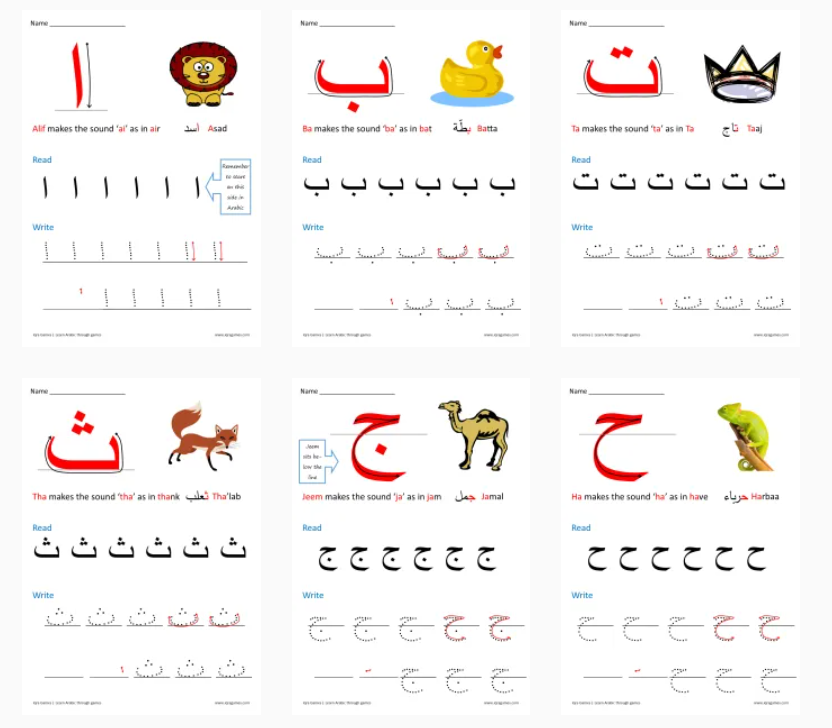
The Sadeky Free Arabic Alphabet Tracing Worksheets cover the full Arabic alphabet across two downloadable PDF sets: Alif to Sheen in one file, and Saad to Yaa in the second. Each page pairs a dotted tracing letter with a corresponding animal image, giving learners a visual vocabulary anchor for each sound.
Each page includes an Arabic letter with a corresponding animal picture and tracing space, and the worksheets are provided in high-quality PDF format for home and school printing.
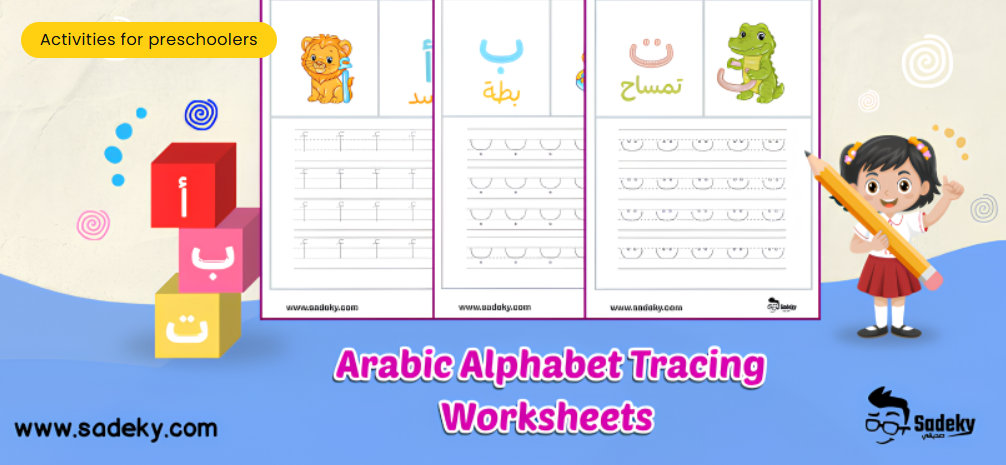
The animal vocabulary approach is a proven mnemonic device. When a learner writes ب (Baa) alongside a picture of a duck (بطة, baTTa), the sound-image link accelerates retention considerably.
These worksheets are clean and well-structured — appropriate for adults as much as children, despite the animal illustrations.
Best suited for: Young beginners and adult beginners who learn well through visual association; parents teaching Arabic at home.
At The Arabic Learning Centre, we recommend pairing any worksheet resource with our Arabic writing course, where certified instructors guide you through letter formation, positional rules, and connected-script reading in structured 1-on-1 sessions.
Enroll in Our Arabic Script Writing Course Today With a Free Trial

Read also: How to Learn Arabic as an English Speaker?
3. Free Arabic Alphabet Dot-to-Dot Letter Formation Worksheets
IqraGames provides free Arabic alphabet dot-to-dot worksheets specifically designed to teach correct letter formation strokes. Rather than simply tracing a pre-formed letter, learners join numbered dots to build the letter themselves — which develops genuine stroke-order memory rather than passive copying.
The worksheets teach Arabic letter formation through a dot-to-dot method: learners join the dots and then continue writing independently. A full compilation of all letters is available as a single practice book download from their site.
From an instructional standpoint, this dot-to-dot approach is one we recommend highly at The Arabic Learning Centre. Passive tracing can become mechanical very quickly — learners complete the page without truly internalizing the stroke sequence. The dot-to-dot method forces active construction of each letter, which produces noticeably stronger retention.
Download here (free): IqraGames — Arabic Letter Formation Worksheets
Best suited for: Beginners who have already been introduced to letter names and sounds but need to solidify correct writing formation.
Shots Videos from Our Courses
4. Free Individual Arabic Letter Worksheets (Per-Letter Pages)
BelarabyApps publishes individual, dedicated worksheets for each of the 28 Arabic letters — available as free printable PDFs. Each letter page teaches the letter through three structured exercises: tracing the large letter form, dot connection, and repeated independent writing — then introduces the letter across words with all three short vowel markers (Fatha, Kasra, Damma).
This per-letter structure is pedagogically sound. Learners drill ش (Sheen) before moving to ص (Saad), rather than rushing through all 28 letters in a single session. Each page also shows vocabulary words carrying that letter, including with diacritical marks (tashkeel) — an important feature that many free worksheets skip entirely.
Access individual letter worksheets here (free):
- Baa (ب): belarabyapps.com/letter-baa-worksheets
- Daal (د): belarabyapps.com/letter-daal-worksheets
- Sheen (ش): belarabyapps.com/letter-sheen-worksheets
- Meem (م): belarabyapps.com/letter-meem-worksheets
- Ghayn (غ): belarabyapps.com/letter-ghain-worksheets
All 28 letters are available by navigating the site’s Arabic letters section.
Best suited for: Self-study learners who prefer to focus on one letter at a time and need vocabulary examples with full tashkeel.
Our Arabic course for beginners is structured by our certified Arabic instructors to take learners from zero script knowledge to functional reading, systematically and without gaps.
Join Our Arabic Course for Beginners With a Free Trial

Read also: The Best Way to Learn Arabic Vocabulary
5. Free Arabic Letter Worksheets Covering All Four Written Forms
Education.com hosts a strong library of free Arabic letter worksheets that specifically target all four positional forms of each letter — isolated, initial, medial, and final. This focus on positional variation is what makes them more useful for reading-readiness than most basic tracing sheets.
Each worksheet covers the four written forms of a letter — isolated, initial, medial, and final — with practice writing and related vocabulary.
Understanding positional forms is where most beginners get stuck. The letter ج (Jeem), for example, looks markedly different depending on where it sits in a word. Many learners recognize ج in isolation but fail to identify ـجـ when embedded mid-word. Worksheets that explicitly drill all four positions close this gap far faster than isolated-form-only practice.
Access here (free — individual letter pages): Arabic Language Worksheets
Filter by letter to find the specific sheet you need. Sheets are available individually for each of the 28 letters.
Best suited for: Intermediate beginners who know basic letter names and are transitioning toward connected-script reading.

Read also: The Best Arabic Tracing Worksheets
6. Free Arabic Alphabet Tracing Worksheets Bundle
Teachers Pay Teachers hosts a large collection of free Arabic letter worksheets — many covering the full alphabet from Alif to Yaa in a single downloadable PDF. The free section includes full tracing worksheet sets, letter-sound phonics sheets, and handwriting workbooks designed for both children and adult beginners.
TPT Arabic alphabet worksheets include colouring pages, tracing sheets, and letter recognition activities for preschool through beginner learners, with many available at no cost.
One particularly useful free resource on TPT is a full Arabic alphabet tracing workbook with directional arrows showing stroke starting points — a feature that many free PDFs omit. Directional guidance is critical for right-to-left script learners, especially adults retrained from left-to-right writing habits.
Browse and download here (free):
Filter results by “Free” to avoid paid listings. Look for resources with directional arrows and downloadable PDF format.
Best suited for: Teachers, homeschoolers, and adult self-study learners who want structured, classroom-tested materials.
How to Use Arabic Letter Worksheets Effectively?
Arabic letter worksheets produce the fastest results when used in a specific sequence: isolated form first, then positional forms, then connected writing, then word-level recognition. Jumping directly to full words without drilling individual letter positions is the most common reason learners plateau early.
At The Arabic Learning Centre, our instructors see this pattern consistently. Students who spend two to three weeks drilling individual letters — including all four positional forms — before attempting to read full words reach connected-script fluency roughly 40% faster in our instructors’ experience, compared with learners who rush to reading whole words before solidifying their letter base.
| Stage | Focus | Recommended Worksheet Type |
| Stage 1 | Letter recognition and sound | Colouring / flashcard sheets (Arabic Seeds, Sadeky) |
| Stage 2 | Stroke order and formation | Dot-to-dot formation sheets (IqraGames) |
| Stage 3 | Positional forms | Initial / medial / final worksheets (Education.com, AbtaulPrintable) |
| Stage 4 | Connected writing | Full-word writing practice (ArabicPod101, Etsy bundle) |
For children specifically, our online Arabic classes for kids integrate worksheet-style activities within live, engaging lessons — so children practise the same letter formation skills in a context that holds their attention far more effectively than solo worksheet sessions.
Enroll your child in our Arabic Classes for KIDS with a free trial

What Makes a Good Arabic Letter Worksheet for Non-Arabic Speakers?
A high-quality Arabic letter worksheet for non-native learners must include four elements: clear stroke directionality (right-to-left arrows), all four positional forms of each letter, tashkeel (short vowel diacritical marks) on example words, and sufficient blank writing lines for independent practice after tracing.
Stroke directionality is the most overlooked feature. Adult learners retrained from left-to-right writing habits will default to incorrect stroke direction without clear visual guidance. This is not a minor issue — incorrect stroke direction produces letters that look superficially correct but feel unnatural and slow the transition to fluent handwriting.
The letter ع (Ayn), for example, begins with a curve from right to left before hooking down. Learners who approach it left-to-right produce a recognizable shape but with a fundamentally different kinesthetic sequence.
Our instructors at The Arabic Learning Centre address this in our Arabic pronunciation course, where correct articulation — both spoken and written — is established from the first lesson.
See also our detailed guide to mastering the Arabic alphabet and our resource on the Arabic alphabet for kids for further guidance on structured letter learning.
Our Students Reviews
Start Learning Arabic Letters with Certified Instructors at The Arabic Learning Centre
The worksheets above give you excellent raw material for letter practice — but structured guidance transforms that practice into real reading ability.
The Arabic Learning Centre offers:
- 1-on-1 live instruction with certified native Arabic instructors
- Flexible scheduling available 24 hours a day, 7 days a week
- Structured curricula for all levels — from first letter to classical Arabic texts
- Dedicated courses for kids, adults, ladies, and new Muslims
- A free trial lesson to experience the teaching approach firsthand
Whether you want to read the Quran, speak conversational Arabic, or master the script from scratch, our Arabic Course for Beginners or learn to read Arabic course is the structured next step after worksheets. Book your free trial lesson today at The Arabic Learning Centre.
Check out our top courses in Arabic and choose the course you need to start learning Arabic today:
- Arabic Course for Beginners
- Arabic Script Writing Course
- Arabic Speaking Course
- Learn Arabic Letters for Tajweed
- Learning Arabic Grammar
- Arabic Vocabulary Course
- Fusha Arabic Course
- Classical Arabic Course
- Arabic Course for Islamic Studies
- Quranic Arabic Course
- Learn Arabic for New Muslims
Start with a FREE trial class and enhance your Arabic language skills

Frequently Asked Questions About Arabic Letter Worksheets
Are free Arabic letter worksheets good enough for serious learners?
Free Arabic letter worksheets — particularly from Arabic Seeds, IqraGames, and Sadeky — are genuinely high quality and suitable for serious study at the foundational stage. The limitation of free resources is typically scope: they cover tracing well but rarely include positional-form practice or tashkeel-marked vocabulary. Supplement free tracing sheets with positional-form worksheets for complete coverage.
What is the difference between a tracing worksheet and a writing practice worksheet?
A tracing worksheet provides a dotted or outlined letter that learners trace over — primarily building shape familiarity. A writing practice worksheet provides a model letter at the top and blank lines below for independent reproduction. Both are valuable: tracing first, independent writing second. Skipping the independent-writing stage is the most common worksheet mistake.
Should I learn all 28 letters before practising words?
Most learners benefit from introducing letters in groups of four to six before attempting simple words using those letters. You do not need all 28 letters before reading your first words. At The Arabic Learning Centre, our instructors typically introduce the حروف الشمسية (sun letters) and حروف القمرية (moon letters) groups progressively, allowing early word-reading practice from the third week of study.
At what age can children start using Arabic letter worksheets?
Children from around age 3 can begin with colouring-based Arabic letter pages that build visual familiarity without writing pressure. Formal tracing with pencils is typically introduced at age 4 to 5, when fine motor control is sufficiently developed. Dot-to-dot formation worksheets are well suited to ages 5 and above. Our Arabic alphabet for kids guide discusses age-appropriate approaches in more detail.
Can I learn to read Arabic from worksheets alone?
Worksheets are a vital practice tool but not a standalone learning system. They develop handwriting and visual recognition but cannot teach pronunciation, grammar patterns, or connected-text reading comprehension on their own. Most adult learners make significantly faster progress pairing worksheet practice with structured instruction — whether through how to learn Arabic resources or live instruction with a qualified teacher.
Related Articles
Arabic Alphabet & Writing