 Learn Arabic
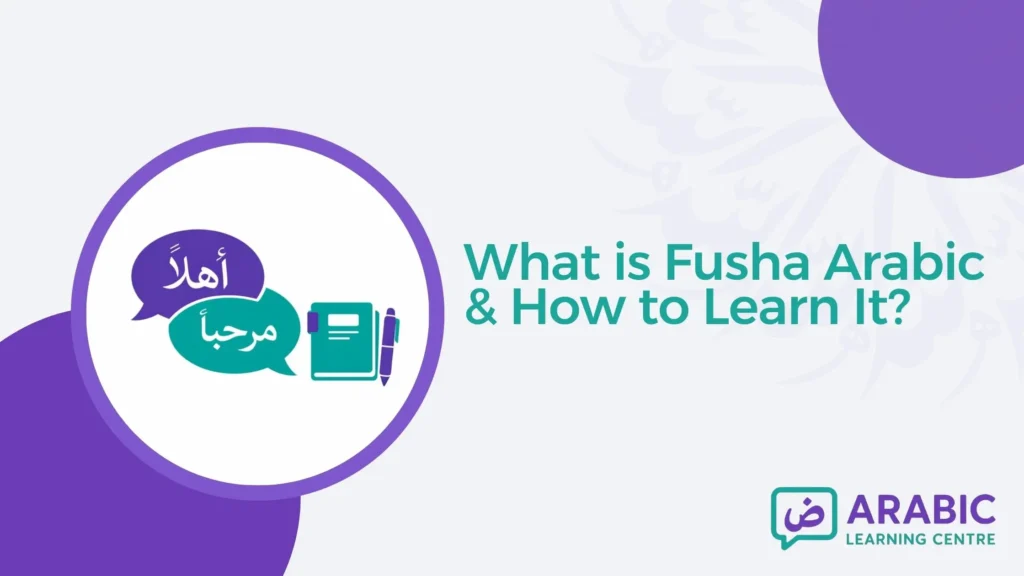
Fusha Arabic, also known as Modern Standard Arabic (MSA), is the standardized form of the Arabic language used in formal settings, literature, media, and education across the Arab world. It is rooted in the language of the Quran and ancient Arabic literature, serving as a timeless bridge that connects past with present.
While all spoken Arabic dialects are distinct from Fusha, it remains the common denominator, preserving the linguistic legacy of the Quran and the Prophet’s era. Saudi Arabian Arabic encompasses various regional dialects, while Fusha represents the classical and literary form of the language, rooted in the dialect of Hijaz where the Quran was revealed.
What is Fusha Arabic?
Fusha Arabic (الفُصْحَى — al-Fuṣḥā) is the classical and modern standard form of the Arabic language. It encompasses two closely related registers: Classical Arabic (al-ʿArabiyya al-Fuṣḥā al-Qadīma), the language of the Quran and pre-Islamic poetry, and Modern Standard Arabic (MSA) (al-Fuṣḥā al-Muʿāṣira), used in contemporary media and formal writing. Both share the same grammatical foundation. For learners, they are studied as a single unified system.
The word الفُصْحَى (al-Fuṣḥā) literally means “the most eloquent” or “the most clear.” It is the prestige form of Arabic — the variety that carries formal authority across the entire Arab world.
Unlike English, which has informal and formal registers within the same spoken language, Arabic has a more defined split: Fusha is the written and formal spoken standard, while local ʿāmmiyya (عامية) dialects are used in everyday conversation. A Moroccan and an Egyptian who cannot understand each other’s dialects can communicate in Fusha.
At The Arabic Learning Centre, our Fusha Arabic Course is specifically structured to guide non-Arabic speakers through Fusha from the ground up — covering both Quranic Arabic and Modern Standard Arabic in an organized, step-by-step curriculum delivered by certified Arabic instructors.
Join Our Fusha Arabic Course With a Free Trial

How to learn Fusha Arabic?
To learn Fusha Arabic, we start with learning the alphabet of Arabic and the basics of reading Arabic, then we start studying a curriculum that is prepared to teach Fusha Arabic.
We learn how to introduce ourselves in Fusha, greetings in Fusha, and so many other topics that are important to use Fusha in our daily routine. Reading The Holy Quran is helpful to make our tongue flexible and smooth when we try to speak in Fusha Arabic.
Beside the Holy Quran, reading and listening to Fusha texts like stories, poetry and cultural content could be very entertaining and helpful at the same time. Certainly, grammar is an essential element in learning Fusha.
1. Master the Arabic Script and Pronunciation
You cannot learn Fusha without reading Arabic script. Begin with the 28 letters, their four positional forms (isolated, initial, medial, final), and basic tashkeel (diacritical vowel markings). Most adult learners recognize all 28 letters within 3–4 weeks of daily 15-minute practice.
Pronunciation requires attention to sounds that do not exist in English: ع (ʿayn), غ (ghayn), ح (ḥāʾ), and خ (khāʾ) all have specific articulation points (makhārij) that must be trained early. Mispronouncing these consistently will create habits that become harder to correct later.
For a structured approach to pronunciation from the start, The Arabic Learning Centre’s guide on Arabic pronunciation and our Online Arabic Pronunciation Course address exactly these sounds with targeted practice.
Begin Pronouncing Arabic Fluently with a Free Trial

2. Study a Prepared Curriculum:
Follow a structured curriculum designed for Fusha Arabic. Learn how to introduce yourself, use greetings, and cover essential topics for daily use. Enroll in a curriculum specifically designed to teach Fusha Arabic.
Lessons will include how to introduce yourself, use greetings, and discuss everyday topics in Fusha. This structured approach ensures systematic progress in learning.
3. Practice with the Quran and Other Texts:
Read the Holy Quran to make your tongue flexible for speaking Fusha Arabic. Supplement this by reading and listening to Fusha texts like stories, poetry, and cultural content.
4. Build Core Grammar Systematically
After basic script literacy, begin grammar with nominal sentences, then verbal sentences, then iḍāfa, then adjective agreement. This sequence mirrors classical Nahw pedagogy for good reason — each structure builds on the previous one.
Do not attempt to memorize grammar rules in isolation. Every rule needs examples in full sentences.
If you want a full structured introduction to Arabic grammar from the foundation, our Arabic grammar guide for beginners covers the essential building blocks clearly.
At The Arabic Learning Centre, our Arabic Grammar Course introduces each structure alongside Quranic and classical text examples so learners see the rules functioning in authentic Fusha immediately.
Start Learning Arabic Grammar with a Free Trial

5. Engage with Fusha Texts:
Supplement your learning by reading and listening to Fusha Arabic texts, such as stories, poetry, and cultural content. This exposure is both entertaining and beneficial, helping you understand the language in different contexts.
6. Consistent practice is key:
Use Fusha Arabic in your daily routine by speaking, writing, and listening to the language as much as possible. Daily practice reinforces what you’ve learned and helps you retain new information.
7. Seek Feedback:
Regularly seek feedback from teachers or fluent speakers. This will help you identify and correct mistakes, and improve your pronunciation and fluency.
Book a FREE session with one of our native Arabic-certified teachers
8. Use Language Learning Apps:
Utilize apps and online resources specifically designed for learning Fusha Arabic. These tools often provide interactive exercises, quizzes, and pronunciation guides to support your learning process.
9. Join Language Exchange Programs:
Participate in language exchange programs where you can practice Fusha Arabic with native speakers or fellow learners. This interaction provides practical experience and enhances your conversational skills.
10. Immerse Yourself in the Language:
Create an immersive environment by surrounding yourself with Fusha Arabic. Watch Arabic TV shows, listen to Arabic radio, and engage with Arabic media. Immersion helps you think in the language and improves your fluency.
Shots Videos from Our Courses
Read also: Which Arabic Dialect Should I Learn to Understand The Quran?
How to master Fusha Arabic online?
Learning Arabic online has become very easy in the last few years, but there are some instructions that one could care about to learn Fusha Arabic properly.
1. Choosing a reliable teacher is a must:
Selecting a trustworthy and experienced teacher is essential for effective online learning. Look for educators who specialize in teaching Fusha Arabic and have a track record of success in helping students achieve their language goals.
2. Following a clear plan to develop language skills.
Develop a structured learning plan to systematically improve your language skills. Set specific objectives for each learning session and track your progress over time. A clear plan will keep you focused and motivated throughout your online learning journey.
3. Using a suitable curriculum for your goals.
Find a curriculum that aligns with your language learning goals. Whether you’re aiming to improve your reading, writing, speaking, or listening skills, choose a curriculum that provides comprehensive instruction in Fusha Arabic and offers engaging learning materials.
4. Having a fixed time to practice Fusha with your teacher
Schedule fixed times to practice Fusha Arabic with your teacher regularly. Consistent practice is key to mastering any language, and having dedicated practice sessions will help you reinforce your skills and progress more quickly.
5. Make presentations in Fusha about topics that you studied.
Apply your learning by creating presentations or discussions in Fusha Arabic about topics you’ve studied. This hands-on approach will deepen your understanding of the language and improve your ability to express yourself effectively.
At The Arabic Learning Centre, our Classical Arabic Course and Arabic Course for Beginners are delivered entirely online by certified native Arabic instructors through 1-on-1 personalized sessions. This means your specific errors — in iʿrāb, pronunciation, or root identification — get corrected in real time, not six weeks later when a bad habit has already formed.
Join Our Classical Arabic Course With a Free Trial

Linguistic properties of Fusha Arabic.
Fusha Arabic has different linguistic properties; we will mention six of them.
1. Verbal or nominal sentences:
Sentences in Fusha can be verbal sentences or nominal sentences. description description description description description description description
2. Shorter Sentences:
Any element in Fusha sentence can be deleted if there is evidence that refers to it. description description description description description description description
3. Heavy and light sounds:
Fusha Arabic has 7 heavy sounds, 3 sounds that can be heavy or light and the rest of the sounds are always light. description description description description description description
4. Fusha is A symbolic language
Fusha Arabic is a symbolic language. “Symbols of letters make different pronunciations. description description description description description description description
5. Sounds Are Signs of Its Meaning:
The sounds of Fusha Arabic are a sign of its meaning. description description description description description description description description description description description
6. Endless Number of vocabularies and synonyms
Fusha Arabic has an enormous number of vocabularies and synonyms. description description description description description description description description description
Which Arabic dialect is closest to Fusha?
Actually, all the spoken dialects in Arab countries are far from Fusha and the people of each country believe that their dialect is the closest to Fusha Arabic. We can say that the Egyptian dialect is one of the easiest dialects to understand due to the wide spread of Egyptian culture in all Arab countries through books, novels, celebrities and lots of Egyptian people who live in Arab countries.
The spoken dialects nowadays are affected by other languages and this is very normal in all languages, but we have the Fusha language due to The Holy Quran, the prophet’s Ahadeeth (“PBU”), and Arabic literature.
Is modern standard Arabic the same as Fusha Arabic?
No, modern standard Arabic typically is not the same as Fusha Arabic. As Modern standard Arabic is a version of Fusha Arabic that is modified to suit the current time. “MSA” is at the same level as Fusha; it consists of the same grammar and vocabulary. Fusha expressions and formations are stronger than MSA expressions and formations.
Is Quranic Arabic the same as Fusha?
Yes, Quranic Arabic is the same as Fusha, but Quranic Arabic focuses on Islamic terminology and expressions.
Quranic Arabic as a sort of language is not common among Arab people, but it is very famous among Non native Arabic speakers who are Muslims and who are interested in learning Quran interpretation and Islamic studies such as: Fiqh, Sunnah of the Prophet “PBU,” and Sirah of the Prophet “PBU.”
Certainly, these branches of Islamic studies need an understanding of Arabic basics and Islamic terminology. That is why they learn Quranic Arabic. So Quranic Arabic is a part of Fusha Arabic.
Join Our Quranic Arabic Course With a Free Trial

Is Fusha Arabic The Same As Saudi Arabia Arabic?
No. But you can say that Fusha Arabic, also known as Classical Arabic, is rooted in the dialect of Hijaz, the region where the Quran was revealed and where the Prophet Muhammad “PBUH” lived.
This dialect evolved over time to become the standardized form of Arabic used in religious texts, literature, and formal contexts. While Saudi Arabian Arabic encompasses various regional dialects spoken in Saudi Arabia, Fusha Arabic represents the classical and literary form of the language, preserving the linguistic legacy of the Quran and the Prophet’s era.
Besides, we need to understand that Saudi Arabia covers a large area of Arab cities that were found before the revelation of Quran. The Quran was revealed in the dialect of Hijaz, and this is the dialect that the prophet “PBUH” spoke. This dialect in the time of the prophet “PBUH” shaped the Fusha Arabic that we have nowadays, but this dialect had so many changes through the years.
Note: The Holy Quran is one of the basic sources for Fusha and it was revealed in Mecca, which is located in Saudi Arabia. The prophet “PBUH” is the most capable person of speaking Fusha and he was born in Mecca, which has been Saudi Arabia.
Where is Fusha Arabic spoken?
Fusha Arabic is spoken only in three places. A city in Yemen is called Accad; a tribe in Saudi Arabia is called Fahm; and a city in Morrocco is called Tamanart. Notice: This information is not confirmed.
How long does it take to learn Fusha Arabic?
To learn Fusha Arabic, it takes at least a year. 400 hours of practicing Fusha Arabic are enough to master it. This period could be 10 months, a year, or maybe more than a year. It depends on how much time you give to Fusha Arabic in your routine. If someone is studying Fusha Arabic thrice a week, each time for 2 hours, it will take 10 months to master Fusha Arabic.
Is Quranic Arabic the same as Fusha?
Yes, Quranic Arabic is essentially a subset of Fusha Arabic. Fusha Arabic, also known as Classical Arabic, serves as the standard form of the language used in the Quran, ancient literature, and formal contexts.
Therefore, Quranic Arabic is a specific manifestation of Fusha Arabic, focusing on the language as it appears in the Quranic text. While there might be slight variations in vocabulary and usage between Fusha Arabic and the Arabic found in the Quran, they are largely synonymous and share the same grammatical rules and structures.
Difference Between Fusha Arabic And Quranic Arabic
Fusha Arabic, or Modern Standard Arabic (MSA), is a standardized language used in formal settings and education, evolving over time. Quranic Arabic, on the other hand, is the language of the Quran, preserved since revelation and primarily used for religious texts and rituals. The key difference lies in their usage contexts and association with formal vs. religious settings.
| Aspect | Fusha Arabic | Quranic Arabic |
| Scope of Usage | Standardized Form Used In Formal Settings, Media, | Language As It Appears Exclusively In The Quran, |
| Literature, And Spoken Arabic In Formal Contexts. | Reserved For Religious Texts And Rituals. | |
| Vocabulary and Style | Includes Wider Vocabulary And Expressions For | Contains Unique Vocabulary, Expressions, And Stylistic |
| Various Topics And Contexts. | Features Specific To The Quran, Reflecting Its | |
| Poetic And Eloquent Nature. | ||
| Evolution and Adaptation | Has Evolved Over Time And Continues To Adapt To | Remains Largely Preserved And Unchanged Since The |
| Modern Linguistic Trends. | Time Of Revelation. | |
| Usage | Taught In Educational Institutions And Used In | Primarily Studied For Understanding And Reciting The |
| Academic, Professional, And Religious Contexts. | Quran In Its Original Language During Religious | |
| Rituals, Prayers, And Memorization. |
Our Students Reviews
Start Learning Fusha Arabic with Certified Instructors at The Arabic Learning Centre
Fusha Arabic is learnable — systematically, at any age, with the right guidance. The grammar is structured and logical; the script is learnable in weeks; the vocabulary system, once understood by root, rewards every hour of effort.
The Arabic Learning Centre offers:
- Certified native Arabic instructors with structured Fusha curricula
- 1-on-1 personalized sessions tailored to your goals — Quran comprehension, MSA fluency, or classical scholarship
- Flexible 24/7 scheduling — learn from anywhere
- A free trial lesson to experience the teaching method before committing
Whether you are starting from zero or returning after previous study, our Classical Arabic Course and Arabic Grammar Course are structured to move you forward clearly.
Book your free trial lesson today and take your first step toward genuine Fusha literacy.
Check out our top courses in Arabic and choose what is the most course you need to start learning Arabic today:
- Arabic Course for Beginners
- Arabic Script Writing Course
- Arabic Speaking Course
- Learn Arabic Letters for Tajweed
- Learning Arabic Grammar
- Arabic Vocabulary Course
- Fusha Arabic Course
- Classical Arabic Course
- Arabic Course for Islamic Studies
- Quranic Arabic Course
- Learn Arabic for New Muslims
Start with a FREE trial class and enhance your Arabic language skills
Conclusion:
Fusha Arabic serves as the foundational form of the language, drawn from the Quran and ancient Arabic literature. While online resources facilitate learning Fusha Arabic, various curriculums are available to aid in its instruction. Modern Standard Arabic (MSA) is a derivative of Fusha Arabic, yet the latter is seldom spoken in contemporary contexts.
It’s important to note that spoken Arabic dialects differ from Fusha Arabic, which serves as the basis for Quranic Arabic. Mastering Fusha Arabic typically requires a minimum of 10 months of dedicated study, despite its infrequent use in daily conversation.