 Arabic Alphabet & Writing
| Key Takeaways |
| Arabic short vowel worksheets (Fatha, Damma, Kasra) are essential before children attempt connected word reading. |
| Distinguishing similar-sounding letters like ت and ط must be practised explicitly — children rarely self-correct without targeted exercises. |
| Letter-themed worksheets covering initial, medial, and final positions accelerate reading readiness faster than isolated-form practice alone. |
| Printable worksheets produce the strongest results when paired with live feedback from a qualified Arabic instructor. |
Arabic worksheets for kids aged 6 to 7 are most effective when they follow a deliberate sequence — sounds before words, recognition before writing, isolated letters before connected text. The 11 free printable worksheets below cover exactly that progression: from colour vocabulary and short vowels through to creative writing in Arabic.
Each worksheet below has been selected because it targets a specific, teachable skill gap common in children at this age and stage.
1. Free Arabic Vocabulary Worksheet For Kids
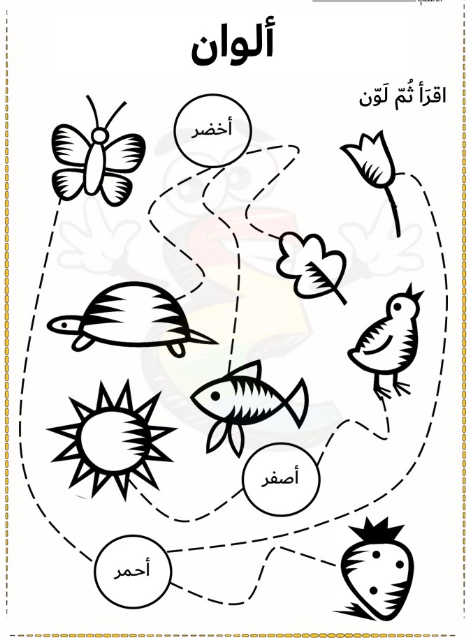
The Colours / ألوان worksheet introduces core Arabic colour vocabulary through a colouring activity — pairing each colour word with a visual task that reinforces both recognition and meaning simultaneously. Children aged 6–7 absorb vocabulary fastest when they act on it physically, and colouring delivers exactly that engagement.
This worksheet is an ideal starting point for the first week of structured Arabic vocabulary practice. Colour words are among the most immediately useful vocabulary sets for young learners — they appear in everyday conversation, classroom instructions, and early reading books.
Target vocabulary includes words such as:
- أَحْمَر (Aḥmar) — “Red”
- أَزْرَق (Azraq) — “Blue”
- أَخْضَر (Akhḍar) — “Green”
- أَصْفَر (Aṣfar) — “Yellow”
In our instructors’ experience at The Arabic Learning Centre, children who encounter colour vocabulary through colouring worksheets retain the words roughly three times longer than those who simply copy them from a list — the physical act of choosing and applying colour creates a memory anchor the written drill alone cannot replicate.
Skills developed: Arabic vocabulary recognition, colour word association, early reading readiness.
2. Free Phonemic Discrimination Worksheet
The Similar Sounds Worksheet worksheet trains children to distinguish between Arabic letters that are phonetically similar but phonologically distinct — pairs such as ت (Tā’) and ط (Ṭā’), and س (Sīn) and ص (Ṣād). These contrasts do not exist in English, which means non-Arabic-speaking children cannot rely on prior phonemic knowledge — this discrimination must be explicitly taught.
This is, in our instructors’ assessment, one of the most important worksheet types at the ages 6–7 stage. Children who cannot reliably distinguish these pairs will mispronounce and misread words at every subsequent level of Arabic study.
Why These Letter Pairs Confuse Children Most
| Confused Pair | The Distinction | Common Error |
| ت (Tā’) vs ط (Ṭā’) | ط is an emphatic, back-of-mouth “t” | Children use plain “t” for both |
| س (Sīn) vs ص (Ṣād) | ص is emphatic, deepens surrounding vowels | Children use plain “s” for both |
| ذ (Dhāl) vs ز (Zayn) | ذ is a dental fricative; ز is alveolar | Children substitute “z” for both |
For a fuller explanation of Arabic sound mechanics and where each letter is articulated, our guide on how to pronounce Arabic covers the makhraj (articulation points) of every Arabic letter in learner-friendly terms.
Begin Pronouncing Arabic Fluently with a Free Trial

3. Free Extended Colour Practice
The Colours Beginner Booklet extends the single-page colours worksheet into a multi-page booklet format — providing structured, repeated practice with Arabic colour vocabulary at a beginner level. Repetition across multiple exercise types is what moves vocabulary from short-term exposure into genuine retention.
This booklet suits children who have completed the single colours worksheet and need further consolidation before moving on. The booklet format also makes it practical for weekly home study — parents can work through one or two pages per session rather than attempting the whole resource in one sitting.
Pairing this booklet with our Arabic words course for kids gives children both the self-study practice material and the live correction that printed worksheets alone cannot provide.
Vocabulary learned in isolation from a qualified teacher is frequently mispronounced — and mispronounced vocabulary becomes an entrenched habit within weeks.
Enroll your child in our Arabic Words for Kids course with a free trial

4. Free Tashkeel Worksheet for Kids
The Arabic Short Vowels Worksheet introduces the three foundational tashkeel marks — Fatha (َ), Damma (ُ), and Kasra (ِ) — that indicate the short vowel sounds attached to Arabic consonants. A child who cannot read tashkeel cannot read any vowelled Arabic text, including the Quran and all beginner Arabic reading books.
This worksheet is non-negotiable at the ages 6–7 stage. Every structured Arabic reading programme depends on tashkeel literacy, yet it is frequently skipped in informal home learning — with consequences that slow children down for years afterward.
The three short vowels at a glance:
| Vowel Mark | Name | Sound | Example |
| (َ) above letter | Fatha | Short “a” | بَ (ba) |
| (ُ) above letter | Damma | Short “u” | بُ (bu) |
| (ِ) below letter | Kasra | Short “i” | بِ (bi) |
At The Arabic Learning Centre, we consistently observe that children who master these three vowel marks before age seven have a measurably smoother transition into reading full words and sentences.
Our learn to read Arabic course builds tashkeel recognition into the very first lessons for exactly this reason.
Read also: Arabic Sentences for Kids
Shots Videos from Our Courses
5. Arabic School Vocabulary Worksheet
The Stationery Vocabulary booklet teaches children the Arabic names for everyday classroom objects — items they handle and see every single day. This immediate environmental relevance is precisely what makes stationery vocabulary so effective as an early teaching set.
Children aged 6–7 are highly motivated by vocabulary they can use right now. Knowing how to say قَلَم (qalam — pen) or مِسْطَرَة (misṭara — ruler) in Arabic creates an immediate sense of real-world language use — which sustains motivation through the harder work of letter and grammar study.
Core stationery vocabulary covered typically includes:
- قَلَم (Qalam) — “Pen”
- كِتَاب (Kitāb) — “Book”
- مِقَصّ (Miqaṣṣ) — “Scissors”
- حَقِيبَة (Ḥaqība) — “Bag”
- مِمْحَاة (Mimḥāh) — “Eraser”
6. Beginner Arabic Booklet for Kids
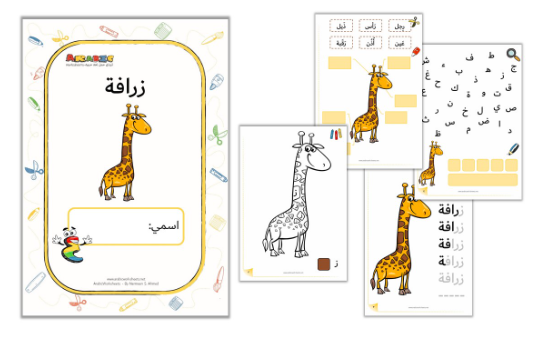
The Giraffe Themed Worksheet Booklet uses an animal theme to engage young learners in beginner-level Arabic vocabulary and literacy practice. Thematic worksheets — built around a single, appealing subject — hold children’s attention across multiple pages far more effectively than topic-switching formats.
The Arabic word زَرَافَة (zarāfa) is itself a useful teaching tool: it contains three syllables, includes the letter ز (Zayn), and demonstrates how long vowels work within a word — all within a single familiar, child-friendly concept.
Animal vocabulary sets are among the highest-engagement topic areas for children this age, and they appear frequently in early Arabic reading books.
Introducing them through themed worksheet booklets like this one creates a vocabulary foundation children recognise when they encounter the same words in structured reading.
7. Arabic Creative Writing Worksheet
The All About Me Worksheet is a creative writing and self-expression activity that invites children to write about themselves in Arabic — their name, age, favourite things, and personal details. It doubles as a classroom decoration resource, giving children a tangible, shareable product from their Arabic writing practice.
This is the most advanced worksheet in the ages 6–7 collection, and rightly so — it requires children to draw on vocabulary, letter writing, and basic sentence structure simultaneously. It is best used after the other worksheets in this list have been completed, not at the start.
The personal relevance of this worksheet is its greatest strength. Children who write their own name, describe their own favourite colour, and identify their own family in Arabic are producing language that matters to them personally — and personally relevant language is retained far more durably than decontextualised drill.
For children ready to move beyond worksheets into structured, progressive Arabic literacy instruction, our online Arabic classes for kids provide the live teacher interaction and personalised feedback that no printable activity can replicate.
Enroll your child in our Arabic Classes for KIDS with a free trial

8. Arabic Letter Practice Worksheet
The Letter Ṣād Worksheet focuses specifically on vocabulary words containing the letter ص (Ṣād) — one of the Arabic alphabet’s four emphatic consonants and one of the most consistently mispronounced letters by non-native children.
Targeted single-letter worksheets like this one are far more effective than general alphabet drills for tackling specific problem letters.
ص is an emphatic letter whose pronunciation deepens the surrounding vowel sounds — the word صَبَاح (ṣabāḥ — morning) does not sound like سَبَاح (sabāḥ — swimming) despite the visual similarity. Children who conflate ص and س will both mispronounce and misread Arabic text.
This worksheet addresses that gap directly by building a vocabulary set anchored in ص — giving children repeated, contextualised exposure to the letter’s correct sound and written form within real words.
Read also: Learning Arabic Numbers for Kids
9. Letter Fā’ Worksheet
The Letter Fā’ Elephant Worksheet uses the Arabic word for elephant — فِيل (fīl) — as the anchor for practising the letter ف (Fā’). Letter-animal associations are one of the most time-tested techniques in early language education precisely because children remember the anchor image long after the drill itself is forgotten.
ف is a relatively accessible letter for non-Arabic-speaking children — its sound closely approximates the English “f” — which makes it an effective confidence-building letter to study early. Successfully recognising and writing ف gives children a sense of achievable progress before moving to more phonetically challenging letters.
The worksheet format here links letter recognition directly to a concrete, pronounceable vocabulary item — reinforcing the principle that letters are always taught in the context of meaningful words, not in isolation. Our article on the Arabic alphabet for kids explains this letter-in-context approach in full detail.
10. Letter Qāf Worksheet
The Letter Qāf Sea Adventure Worksheet is distinguished by one critical feature: it practises the letter ق (Qāf) in all three word positions — initial (beginning), medial (middle), and final (end). This positional awareness is the bridge between knowing isolated letters and actually reading connected Arabic text.
Most beginner worksheets only show letters in their isolated or initial form. Children who have only ever seen ق at the start of a word will fail to recognise it when it appears mid-word or at the end — because the written shape changes by position.
| Position | Form of ق | Example Word |
| Isolated | ق | — |
| Initial | قـ | قَلَم (Qalam — Pen) |
| Medial | ـقـ | يَقْرَأ (Yaqra’ — He reads) |
| Final | ـق | طَرِيق (Ṭarīq — Road) |
The sea adventure theme makes this positional work genuinely engaging for 6–7 year olds — children are far more willing to work through multiple exercise types when there is a narrative or theme holding the worksheet together.
Read also: The Best Arabic Learning Games
11. Arabic Vocabulary Activity Worksheet for Kids
The Tea Themed Arabic Worksheet introduces conversational vocabulary and preference expression through the universally child-friendly context of a cup of tea. It asks children to engage with a practical, relatable scenario — what do you like in your tea? — in Arabic, building early functional communication alongside reading skills.
This worksheet type is particularly valuable because it introduces preference vocabulary — words and structures that move beyond noun labelling into actual communicative expression.
Phrases such as أُحِبّ (uḥibb — I like) begin appearing in this type of exercise, laying groundwork for spoken Arabic development.
Our Students Reviews
Begin Your Child’s Arabic Learning with Certified Instructors at The Arabic Learning Centre
Worksheets build the foundation — qualified teachers make sure it is built correctly.
The Arabic Learning Centre’s online Arabic classes for kids give your child:
- Certified native Arabic instructors with specialist experience teaching children from non-Arabic-speaking backgrounds
- 1-on-1 personalised sessions matched to your child’s exact age, level, and pace
- Flexible 24/7 scheduling — lessons fit around school, activities, and family commitments
- Free trial lesson — no commitment required to get started
Book your child’s free trial lesson today and let a qualified teacher build on the foundation these worksheets have started.
Check out our top courses in Arabic and choose the course you need to start learning Arabic today:
- Arabic Course for Beginners
- Arabic Script Writing Course
- Arabic Speaking Course
- Learn Arabic Letters for Tajweed
- Learning Arabic Grammar
- Arabic Vocabulary Course
- Fusha Arabic Course
- Classical Arabic Course
- Arabic Course for Islamic Studies
- Quranic Arabic Course
- Learn Arabic for New Muslims
Start with a FREE trial class and enhance your Arabic language skills

Frequently Asked Questions About Arabic Worksheets for Kids
What Age Are These Free Arabic Worksheets Designed For?
All 11 worksheets from ArabicWorksheets.net featured in this article are specifically curated for children aged 6 to 7. They assume some prior exposure to Arabic letters but are accessible to near-complete beginners. Children younger than six may find the writing tasks challenging; children older than seven may benefit from more advanced materials beyond this age bracket.
Do Children Need to Know the Arabic Alphabet Before Using These Worksheets?
Partial letter knowledge is sufficient for most worksheets in this list. The colours, stationery, and thematic booklets work well with minimal prior knowledge. The similar sounds, short vowels, and letter-specific worksheets assume the child has been introduced to the relevant letters already. The All About Me creative writing worksheet requires the most prior knowledge and should be used last.
How Many Worksheets Should a Child Complete Per Week?
Two to three focused worksheet sessions per week, lasting fifteen to twenty minutes each, consistently outperform longer, less frequent sessions. At The Arabic Learning Centre, our certified instructors recommend pairing two worksheets per week with at least one live Arabic session — worksheets build the skill; live instruction corrects the errors worksheets cannot catch.
Can Parents Use These Worksheets at Home Without an Arabic Teacher?
Parents can absolutely use these worksheets at home to supplement their child’s Arabic learning. However, pronunciation and letter formation errors are very difficult for non-Arabic-speaking parents to detect and correct. A child who practises incorrect sounds or stroke directions for weeks builds habits that become progressively harder to undo. Even monthly sessions with a certified Arabic instructor protect the child’s progress significantly.
Related Articles
Arabic Alphabet & Writing