 Arabic Resources & Courses
| Key Takeaways |
| Alif Baa by Brustad, Al-Batal, and Al-Tonsi is the most widely recommended starting point for learning Arabic letters and sounds from scratch. |
| Mastering Arabic 1 by Wightwick and Gaafar suits self-study learners and covers MSA grammar, script, and conversation in a single progressive course. |
| Al-Kitaab fii Ta’allum al-‘Arabiyya is the standard university-level Arabic textbook series, integrating formal and colloquial Arabic simultaneously. |
| Arabic for Dummies is the most accessible entry point for absolute beginners who find traditional textbooks intimidating. |
| Pairing any textbook with structured online instruction dramatically accelerates progress beyond what books alone can achieve. |
The best books for learning Arabic include Alif Baa, Mastering Arabic 1, Al-Kitaab, Complete Arabic (Teach Yourself), and Arabic for Dummies — each serving a different learner type and goal. Whether you are building Arabic script recognition from scratch, developing Modern Standard Arabic (MSA) grammar, or aiming for conversational fluency, the right book depends on your starting level and learning style.
That said, books are the starting point — not the finish line. The learners who progress fastest are those who combine structured textbook study with real, guided practice.
How to Choose The Best Books for Learning Arabic
The best books for learning Arabic accomplish four things: they sequence the material correctly, they explain the Arabic script before throwing sentences at you, they include audio support, and they are honest about the challenges.
A book that jumps into vocabulary before you can read the script will frustrate most adult learners within the first two weeks.
From our instructors’ experience at The Arabic Learning Centre, learners who start with a text that grounds them in letter recognition and basic phonology — before drilling grammar patterns — reach reading confidence roughly twice as fast as those who begin with phrase memorization. This sequencing principle should guide every book choice you make.
| Feature | Why It Matters for Arabic Learners |
| Arabic script introduced early | MSA is written — reading ability is non-negotiable |
| Audio support included | Pronunciation of letters like ع and غ requires modelled sound |
| Grammar graded by difficulty | Arabic morphology can overwhelm without scaffolding |
| Answer keys provided | Self-study learners need to verify exercises independently |
| Tashkeel (vowel diacritics) used initially | Short vowels are absent in standard text; beginners need them marked |
Our own Arabic Course for Beginners at The Arabic Learning Centre builds directly on the same foundational principles these books teach, adding the personalized correction and live speaking practice that no textbook can replicate.
Join Our Arabic Course for Beginners With a Free Trial

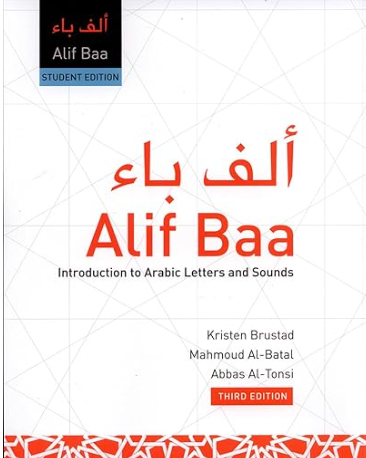
1. Alif Baa — Best for Learning the Arabic Script from Zero
Alif Baa: Introduction to Arabic Letters and Sounds by Kristen Brustad, Mahmoud Al-Batal, and Abbas Al-Tonsi is the single most recommended book for complete beginners starting with the Arabic alphabet. It covers all 28 letters with their four positional forms (isolated, initial, medial, and final), matching audio, and writing practice — making it the most structured introduction to Arabic reading available in English.
This is Volume 1 of the Al-Kitaab Arabic Language Program, used at universities across the United States and Europe. What separates Alif Baa from other alphabet books is its early integration of spoken Arabic alongside written forms, exposing learners to real pronunciation from page one.
Who Should Use Alif Baa?
Absolute beginners with zero prior Arabic exposure. It is particularly effective for anyone planning to continue with the Al-Kitaab series, since the two volumes are designed as a sequential program. Learners who complete Alif Baa are positioned to reach novice-intermediate proficiency in reading Arabic script — a foundation that takes most adult learners four to six weeks of consistent daily practice to consolidate.
If you want to understand the alphabet in depth before starting, our dedicated blog post on mastering the Arabic alphabet walks through exactly what to focus on first.
2. Mastering Arabic 1 Book
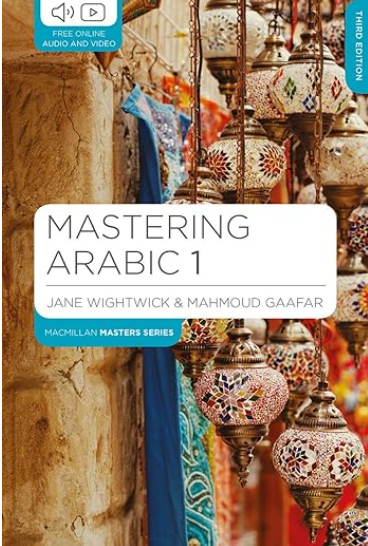
Mastering Arabic 1 by Jane Wightwick and Mahmoud Gaafar is the most accessible all-in-one introductory Arabic course for self-study learners. It teaches Modern Standard Arabic from the alphabet through intermediate grammar, with lively dialogues, cartoons, free online audio and video, and hundreds of exercises. This is the book that consistently earns the strongest learner satisfaction reviews across independent language learning communities.
The sequence is sensible for self-directed adults: script and letter forms first, then foundational vocabulary, then grammar structures introduced one at a time without overwhelming the reader. The free audio and video online are particularly valuable for training the ear to the sounds most non-Arabic speakers struggle with.
Shots Videos from Our Courses
What Mastering Arabic 1 Does Especially Well
It handles the Arabic root system (the three-letter root, known as الجذر al-jadhr) early and clearly — something many competing books delay or skip entirely. Understanding that most Arabic words derive from trilateral roots radically accelerates vocabulary retention.
In our instructors’ experience at The Arabic Learning Centre, students who grasp root patterns in the first month build vocabulary at a significantly faster rate than those who learn words in isolation without understanding the morphological relationships.
Students who want to continue structurally after completing Mastering Arabic 1 can build on that foundation through our Arabic Grammar Course, which deepens the Nahw concepts the textbook introduces.
Start Learning Arabic Grammar with a Free Trial

Read also: Is Arabic Worth Learning?
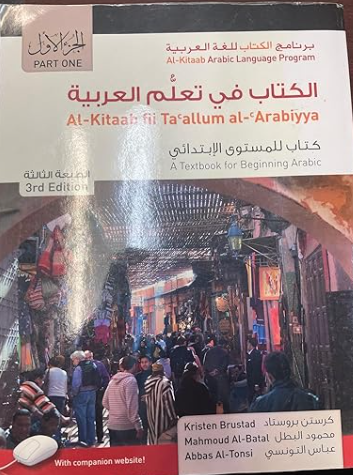
3. Al-Kitaab fii Ta’allum al-‘Arabiyya
Al-Kitaab fii Ta’allum al-‘Arabiyya (Part One, Third Edition) by Brustad, Al-Batal, and Al-Tonsi is the dominant Arabic textbook at universities globally — and for good reason.
It integrates MSA with both Egyptian and Levantine Arabic side by side, using colour-coded text, ensuring learners develop an understanding of both formal and spoken registers from early in their study.
This is not a gentle beginner’s book. The pace is demanding, and it assumes you have completed Alif Baa first.
For learners who thrive in structured, academically rigorous environments, Al-Kitaab provides the most thorough grounding in Arabic grammar, reading comprehension, and listening available in a single series.
Is Al-Kitaab Right for Self-Study Learners?
Al-Kitaab is most effective when used in a classroom setting or with an instructor. Solo learners often find the jump in difficulty between Alif Baa and Part One challenging without external support.
Those who do use it independently benefit significantly from supplementing it with live speaking practice — which is exactly what our Arabic Conversation Course at The Arabic Learning Centre provides alongside any textbook curriculum.
Enroll in Our Arabic Speaking Course Today With a Free Trial

Read also: UAE Arabic Language Learning
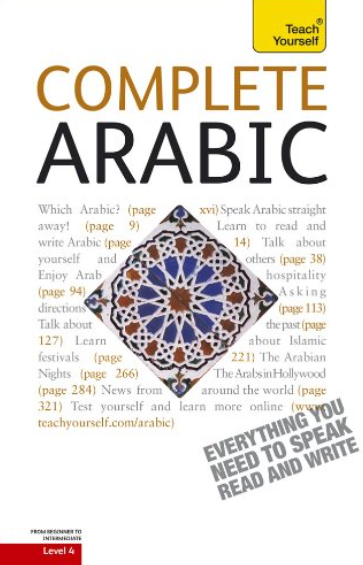
4. Complete Arabic Book
Complete Arabic: A Teach Yourself Guide by Jack Smart and Frances Altorfer is structured across 25 thematic chapters, moving from foundational grammar through intermediate-level Arabic in a single volume.
Its strength is the balance between accessible explanations and genuine grammatical depth — it does not oversimplify Arabic structures the way some commercial beginner books do.
Each chapter introduces vocabulary and grammar in parallel with cultural context, and the accompanying audio (performed by native speakers) focuses on real communicative situations rather than abstract drills.
For independent adult learners who want to reach B1-level competency through self-study, Complete Arabic is one of the most reliable paths available.
Read also: Why Learn Arabic?
What Distinguishes the Teach Yourself Approach
The book handles Arabic verb conjugation patterns with particular clarity — including the distinction between الفعل الماضي (al-fi’l al-māḍī, the past tense verb) and الفعل المضارع (al-fi’l al-muḍāri’, the present/imperfect tense) — which many beginner books address only superficially. Understanding these two core verb forms opens up the majority of Arabic sentence construction.
5. Arabic for Dummies
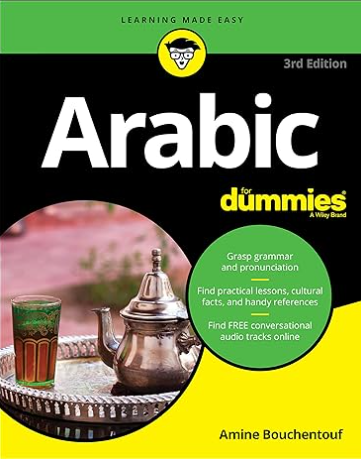
Arabic for Dummies by Amine Bouchentouf offers the most low-pressure introduction to MSA available. It teaches practical vocabulary, basic grammar, and conversational phrases in an encouraging tone that deliberately avoids the density of traditional textbooks.
For learners who feel daunted by Arabic’s reputation and need confidence before committing to a full course, this is an excellent first step.
The book covers greetings, introductions, dining, travel, directions, and emergency phrases — giving beginners immediately usable language before the grammar foundations are fully built. It includes a mini Arabic-English dictionary and verb tables for quick reference.
One Important Limitation to Know
Arabic for Dummies is a starting point, not a complete course. It teaches you to begin communicating but does not build the systematic grammar competence needed for reading authentic Arabic texts or advancing to intermediate fluency.
Most learners who use it effectively treat it as a bridge to a more structured resource — pairing it with our Learn to Read Arabic Course at The Arabic Learning Centre is a natural and effective next step.
Start Reading Arabic with a FREE Trial

How to Choose Between These Books for Learning Arabic Based on Your Goal?
Not all Arabic learners have the same destination. Your goal shapes your book choice more than anything else.
| Learning Goal | Recommended First Book | Recommended Next Step |
| Read and understand the Quran | Alif Baa → Al-Kitaab | Structured Quranic Arabic course |
| Conversational MSA for travel or business | Arabic for Dummies → Mastering Arabic 1 | Arabic Conversation Course |
| University or academic Arabic | Alif Baa → Al-Kitaab series | Advanced grammar instruction |
| Self-study to intermediate level | Mastering Arabic 1 → Complete Arabic | Arabic Grammar Course |
| First exposure — zero commitment yet | Arabic for Dummies | Mastering Arabic 1 |
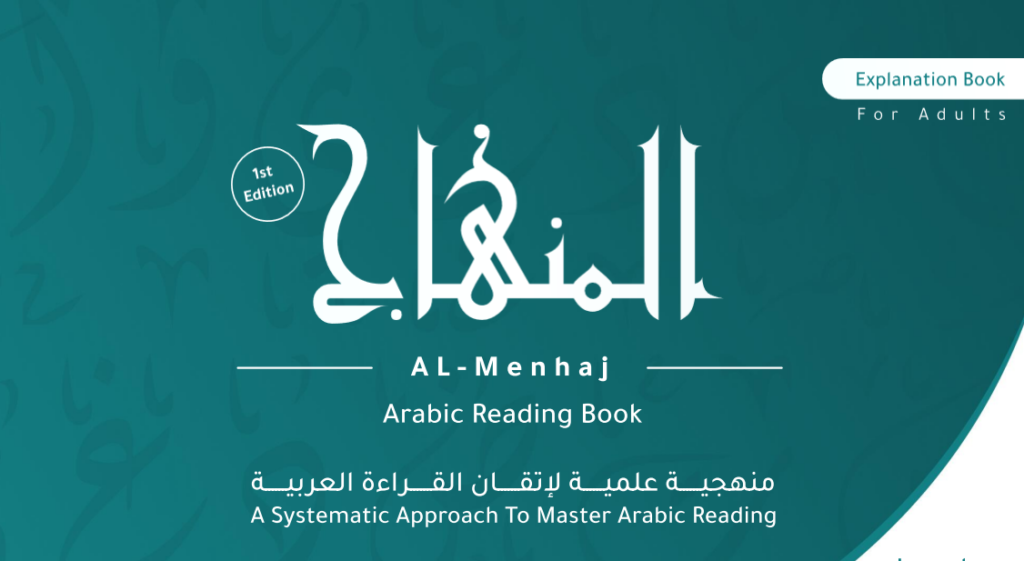
For Muslim learners specifically focused on Quranic reading, The Arabic Learning Centre’s Al-Menhaj Book offers a purpose-built resource for Arabic literacy in the context of Quran access — developed by experienced instructors with over 25 years of teaching expertise, and designed specifically for non-native speakers starting from zero.
Explore Al-Menhaj Book for Free
You may also find our guide on how to learn Arabic helpful for planning the bigger picture of your study approach beyond textbook selection.
Our Students Reviews
Start Learning Arabic with Certified Instructors at The Arabic Learning Centre
The books above provide excellent foundations — but the learners who advance fastest are those who combine structured reading with expert guidance.
The Arabic Learning Centre offers:
- Certified native Arabic instructors with structured curricula for every level
- 1-on-1 personalized lessons that address your exact pronunciation and grammar gaps
- Flexible 24/7 scheduling — you choose the time that fits your life
- Free trial lesson — experience our teaching method before committing
- Courses from complete beginners through advanced Classical Arabic (Fusha)
Whether you are starting from zero or building on a textbook foundation, our Arabic Course for Beginners will take your learning further than any book can alone.
Check out our top courses in Arabic and choose the course you need to start learning Arabic today:
- Arabic Course for Beginners
- Arabic Script Writing Course
- Arabic Speaking Course
- Learn Arabic Letters for Tajweed
- Learning Arabic Grammar
- Arabic Vocabulary Course
- Fusha Arabic Course
- Classical Arabic Course
- Arabic Course for Islamic Studies
- Quranic Arabic Course
- Learn Arabic for New Muslims
Start with a FREE trial class and enhance your Arabic language skills

Frequently Asked Questions About the Best Books for Learning Arabic
Which Arabic learning book is best for absolute beginners?
Alif Baa by Brustad, Al-Batal, and Al-Tonsi is the best starting point for complete beginners. It introduces all 28 Arabic letters with their positional forms, audio pronunciation, and writing practice. Learners with no prior exposure to Arabic script should complete Alif Baa before moving to any grammar-heavy textbook.
Can I learn Arabic from a book alone without a teacher?
Books like Mastering Arabic 1 and Complete Arabic are designed for self-study and can carry you to intermediate level independently. However, pronunciation accuracy — particularly for sounds like ع (‘ayn) and خ (khā’) — is very difficult to develop without a native or trained instructor correcting your output directly.
Is Arabic for Dummies a good book for learning Arabic grammar?
Arabic for Dummies covers basic grammar sufficiently for survival communication but does not provide the systematic Nahw instruction needed for reading, writing, or advancing beyond beginner level. For structured grammar development, Mastering Arabic Grammar by the same Wightwick-Gaafar team — or our dedicated Arabic Grammar Course — is more appropriate. You can read more about Arabic grammar for beginners on our blog.
How long does it take to learn Arabic from these books?
Completion time varies significantly by daily study commitment. Most adult learners working through Mastering Arabic 1 with 30–45 minutes of daily practice reach a functional beginner level within four to six months. To understand realistic timelines for full fluency, our article on how long it takes to learn Arabic covers this in detail.
Are there good Arabic books specifically for kids?
Children benefit most from books designed around visual learning and playful phonics rather than grammar explanation. Our online Arabic classes for kids at The Arabic Learning Centre are purpose-built for young learners, using age-appropriate materials that adapt to how children actually acquire language.
Related Articles
Arabic Resources & Courses