 Arabic Alphabet & Writing
Learning the Arabic alphabet is the foundation for mastering the Arabic language, whether for reading the Qur’an, daily communication, or academic study. The Arabic script consists of 28 unique letters, each with its own sound and multiple forms depending on its position in a word. Understanding these letters step by step helps learners progress from recognizing sounds to building words and complete sentences with confidence.
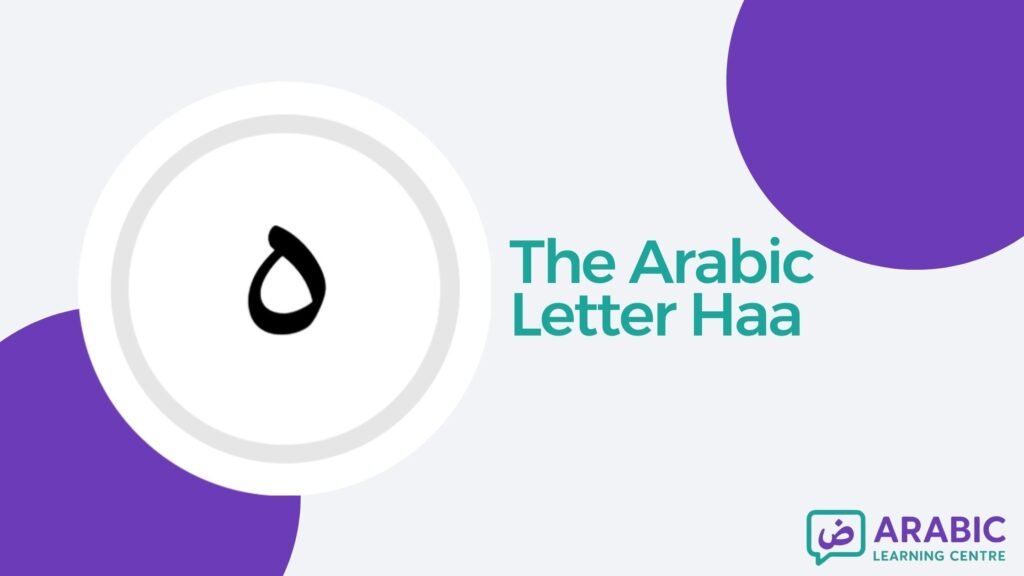
Among these letters, the Arabic letter Haa (هـ) stands out as a soft and gentle sound that appears frequently in everyday words. It corresponds to the English “H” and is easy to pronounce, making it one of the first letters children and beginners can grasp. Mastering the letter Haa is an important milestone for learners, as it enhances both reading fluency and writing accuracy.
Letter Haa – هـ
The letter Haa (هـ) is the twenty-sixth letter of the Arabic alphabet. It is a soft, voiceless sound produced from the throat, similar to the English “H” in words like home or happy. Haa is unique because, unlike some Arabic letters, it connects smoothly to both the letter before and after it, allowing it to blend easily within words. Its gentle sound makes it one of the lighter letters in Arabic, which helps learners pronounce it without much difficulty.
In written Arabic, Haa has a rounded form when isolated (هـ), but its shape changes depending on its position in the word. It can appear at the beginning, middle, or end of words, adapting its form while maintaining the same sound. Because Haa is found in many common Arabic words, mastering this letter is essential for building a strong foundation in reading and writing.
How to Identify The letter Haa – هـ

Recognizing the letter Haa (هـ) becomes simple once you learn its rounded shape. Unlike tall letters such as Alif, Haa is written with a small loop or circle that changes depending on its position in the word. It is one of the softer-looking letters in the Arabic script and does not carry dots, which makes it easy to distinguish from other letters like Jeem (ج) or Khaa (خ).
A key feature of Haa is its flexibility. It connects smoothly to the letters before and after it, and its form adapts according to where it appears in the word. Despite these variations, the sound of the letter always remains the same: a soft, breathy “h” sound.
Position | Example
– Beginning of the word: هلال (Hilal – crescent)
– Middle of the word: سهل (Sahl – easy)
– End of the word: وجه (Wajh – face)
Tip for learners: Look for a small circular or loop-like shape in the word. If you see this form at the start, middle, or end, it is most likely the letter Haa.
Letter Haa and هـ Forms: At the Beginning, Middle, and End of the word
Like many Arabic letters, Haa (هـ) changes its shape depending on where it appears in a word. Although the forms may look slightly different, the sound of the letter always stays the same. This flexibility helps the letter connect smoothly with other letters around it.
1- Beginning of the word: At the start, Haa usually looks like a small loop with a tail stretching to the left.
Example: هاتف (Haatif – phone)
2- Middle of the word: In the middle, Haa becomes smaller and connects on both sides, appearing like a tiny loop in between letters.
Example: مهر (Mahr – dowry)
3- End of the word: At the end, Haa can appear either closed (ـه) or open (ـهـ), depending on the handwriting style or font.
Example: وجه (Wajh – face)
Tip for learners: Always pay attention to how the letter is connected to the ones around it. Even if the shape changes, the soft “h” sound remains the same.

If you want to master the Arabic language step by step with professional native teachers, Arabic Learning Centre is the perfect choice. We provide interactive online Arabic classes for all levels, whether you are a complete beginner or already advanced. With flexible schedules, engaging resources, and personalized support, the Arabic Learning Centre makes learning Arabic simple, fun, and effective for both kids and adults.
Letter Haa/ هـ With Fatha ( َ )

When the letter Haa (هـ) carries a Fatha ( َ ), it produces the short vowel sound “Ha” (هَ). The Fatha is a small diagonal stroke written above the letter, and it gives the sound a quick “a” tone, similar to the “ha” in happy.
Examples:
– هَواء (Hawaa’ – air)
– هَدية (Hadiyyah – gift)
– هَرم (Haram – pyramid)
Tip for learners: Always look for the small line above the Haa to know it should be pronounced with an open “a” sound.
Letter Haa / هـ With Dammah ( ُ )

When the letter Haa (هـ) carries a Dammah ( ُ ), it produces the short vowel sound “Hu” (هُ). The Dammah is a small curl-shaped mark written above the letter, and it gives the sound a rounded “u” tone, similar to the “hu” in human.
Examples:
– هُدوء (Hudoo’ – calm)
– هُنا (Huna – here)
– هُجوم (Hujoom – attack)
Tip for learners: Remember that the Dammah makes the letter sound round and closed, like saying “oo.”
Letter Haa/ هـ With Kasrah ( ِ )

When the letter Haa (هـ) carries a Kasrah ( ِ ), it produces the short vowel sound “Hi” (هِ). The Kasrah is a small diagonal stroke placed below the letter, and it gives the sound a sharp “i” tone, similar to the “hi” in hill.
Examples:
– هِلال (Hilaal – crescent)
– هِبة (Hibah – gift)
– هِمّة (Himmah – effort/energy)
Tip for learners: Look below the letter for the small Kasrah line; it always signals the “i” sound.
Letter Haa/ هـ With sukoon ( ْ )

When the letter Haa (هـ) carries a Sukoon ( ْ ), it means the letter is pronounced without any vowel sound. The Sukoon is written as a small circle above the letter, showing that the Haa should be read softly and immediately connected to the letter before it.
Examples:
– فَهْم (Fahm – understanding)
– مُهْرة (Muhrah – young female horse)
– جُهْد (Juhd – effort)
Tip for learners: When you see Sukoon, stop the sound quickly without adding a vowel, just a soft “h” breath.
Examples of letter Haa/ هـ in Words
The letter Haa (هـ) appears very frequently in Arabic words. It can occur at the beginning, middle, or end of a word. Each position has a slightly different form, but the soft “h” sound remains the same. Recognizing Haa in different positions helps learners read more fluently and avoid confusing it with similar letters.
Here are some examples:
| Position | Arabic Word | Pronunciation | English Meaning |
| At the beginning | هلال / هاتف / هدية | Hilal / Haatif / Hadiyyah | Crescent / Phone / Gift |
| In the middle | سهل / مهر / ذهب | Sahl / Mahr / Dhahab | Easy / Dowry / Gold |
| At the end | وجه / له / وجهه | Wajh / Lahu / Wajhahu | Face / For him / His face |
When practicing, highlight the letter هـ in words to train your eyes to spot it quickly, no matter where it appears.

Examples of letter Haa/ هـ in Phrases and Sentences
The letter Haa (هـ) is not only common in single words but also appears often in full phrases and sentences. Seeing Haa in context helps learners understand how it connects with other letters and improves overall reading skills.
Here are some examples:
| Position | Arabic Phrase / Sentence | English Meaning |
| At the beginning | هذا هلال | This is a crescent. |
| In the middle | ذهب الولد | The boy went. |
| At the end | وجه جميل | A beautiful face. |
Tip for learners: Practice reading sentences aloud and try to emphasize the “h” sound whenever you see the letter Haa. This will strengthen both your pronunciation and fluency.
How to write the Haa Letter?
The Haa (هـ) is a flexible letter in the Arabic alphabet, and its shape changes depending on its position in the word. It can appear as a simple loop, a connected curve, or an open circle. With practice, writing Haa becomes smooth and natural.
Steps to Write Haa:
1- Isolated form (هـ): Start by drawing a small loop, open at the top, like a circle with a gap.
2- Beginning form (هـ ـــ): Write a small loop, then extend a line to the left to connect with the next letter.
3- Middle form (ــهـــ): Draw a small loop between two connecting lines, making sure it flows smoothly.
4- End form (ــه / ـهـ): Finish with a loop, either closed (ــه) or open (ـهـ), depending on style or font.

Important notes:
– Shape flexibility: Unlike Alif, Haa changes shape depending on its position in the word.
– Smooth flow: Always write in one continuous motion to keep the letter connected.
How to Pronounce the Letter Haa?
The pronunciation of Haa (هـ) depends on the harakah (vowel mark) it carries. On its own, Haa represents a soft, breathy “h” sound, produced from the middle of the throat. It is a light letter, unlike Ḥaa (ح), which is heavier and comes from the lower throat.
In Qur’anic recitation, Haa is one of the most delicate sounds because it flows with breath and must be pronounced gently without pressing the throat.
Makhraj (articulation point): The sound of هـ comes from the middle of the throat (وسط الحلق), allowing air to pass smoothly without vibration.

Basic Pronunciation Rules:
1- Haa with Fatha (هَ):
Pronounced as “ha” (short “a” sound). Example: هَذا (haadha – this).
2- Haa with Dammah (هُ):
Pronounced as “hu” (short “u” sound, lips rounded). Example: هُدى (huda – guidance).
3- Haa with Kasrah (هِ):
Pronounced as “hi” (short “i” sound, lips spread slightly). Example: هِلال (hilaal – crescent).
4- Haa with Sukoon (هْ):
The sound stops softly with breath, no vowel. Example: فَهْم (fahm – understanding).
Tips for learners:
– Place your hand in front of your mouth when saying هـ; you should feel a gentle flow of air.
– Keep the sound light and airy—never heavy like ḥaa (ح).
– Practice in front of a mirror to check your lip and mouth positions: Open for a (هَ), Rounded for u (هُ), and Slight smile for i (هِ)
Learn Haa through videos
Here are two helpful video lessons to reinforce what you’ve already learned about the Arabic letter Haa (هـ)—from its written form to its various shapes and uses:
1- Learn Arabic – Lesson 27 HAA – Correct Pronunciation
A clear and engaging lesson to learn how to pronounce Haa.
2- Arabic Writing for Beginners — The Arabic letter Haa هاء with its different shapes
This lesson breaks down all the forms of Haa, from isolated to contextual (beginning, middle, end), and how it connects within words. Ideal for learners aiming to recognize and write Haa correctly.
Shots Videos from Our Courses
Exercises for letter Haa in Arabic
Practicing is the best way to master the Arabic letter Haa (هـ). These exercises will help you recognize, write, and pronounce Haa correctly in different positions of a word.
1. Identify the Letter Haa
Circle the letter هـ in the words below:
– هلال
– مدرسة
– وجه
– هواء
2. Write Haa in Different Positions
Write the letter Haa in:
– Beginning position: هـا
– Middle position: ـهـاـ
– End position: ـه
3. Match the Word to Its Picture
Draw a line between each word and the correct picture:
– هلال 
– هاتف 
– وجه 
4. Fill in the Missing Letter
Complete the words by adding the missing Haa (هـ):
1- __واء (Air)
2- كتاب___ (His Book)
3- __اتف (Phone)
4- وج__ (Face)
5. Read Aloud
Read these words slowly, paying attention to the soft, breathy sound of Haa (هـ):
– هَذا (This)
– هُدى (Guidance)
– هِلال (Crescent)
– وجه (Face)
Repeat these exercises daily until you can spot Haa instantly, write it in all positions, and pronounce it with ease.
Downloadable Worksheets for the Arabic letter Haa
To make learning fun and effective, we’ve created printable worksheets for the Arabic letter Haa (ح). These worksheets will help students practice recognizing, writing, and using the letter in words and sentences through interactive activities. Perfect for both classroom and home learning.
Download the worksheets here:
– My Resourse Station: Haa Worksheet – Colour, Trace, and Write a printable PDF to practice writing and recognizing Haa.
– Arabic Seeds (Islamic-themed): Provides coloring and tracing worksheets for each letter, including Haa, along with pronunciation audio files for memorization and enhanced learning.
Read Also: The Letter Waaw و In Arabic With Examples, Exercises, and Worksheets
Common Mistakes related to the letter Haa
Even though the Arabic letter Haa (هـ) looks simple and has a soft sound, many beginners make common mistakes when learning it. Understanding these mistakes will help you avoid them and improve your Arabic skills faster.
1. Confusing Haa (هـ) with Ha (ح) or Khaa (خ)
– Mistake: Learners often mix up هـ with ح (a deeper, throatier sound) or خ (a harsher, raspy sound).
– Correction:
– هـ is a soft, breathy “h” sound from the middle of the throat.
– ح is pronounced from the lower throat with more friction.
– خ is pronounced from the upper throat with a heavy rasp.

Read Also: The Letter Dhaal / ذ in Arabic With Examples, Exercises, and Worksheets
2. Writing the Wrong Shape in Different Positions
Mistake: Some students write Haa the same way in all positions, forgetting that its form changes.
Correction:
– Beginning: هـا (هـلال)
– Middle: ـهـاـ (مـهـارة)
– End: ـه (وجه)
– Isolated: هـ
Read Also: The Letter Faa’ ف In Arabic With Examples, Exercises, and Worksheets
3. Confusing Haa (هـ) with Taa Marbuta (ة)
Mistake: At the end of a word, learners sometimes confuse هـ with ة (taa marbuta).
Correction:
– هـ is part of the word’s root and always pronounced. Example: وجه (wajh – face).
– ة is usually silent in pause and pronounced like t in connection. Example: مدرسة (madrasa).
Read Also: The Letter Baa / ب in Arabic With Examples, Exercises, and Worksheets
4. Overpronouncing or Underpronouncing Haa
Mistake: Some learners make Haa too strong, turning it into ح, or too weak, almost skipping the sound.
Correction: Haa is a light, airy exhalation—similar to the “h” in “hello”—with no heaviness.
Read Also: The Letter Yaa ي In Arabic With Examples, Exercises, and Worksheets
5. Forgetting to Use Harakat Correctly on Haa
Mistake: Learners sometimes miss placing short vowels (fatha, dammah, kasrah) or mispronounce them.
Correction:
– هَـ → “ha” (e.g., هَذا – haza)
– هُـ → “hu” (e.g., هُو – huwa)
– هِـ → “hi” (e.g., هِلال – hilāl)
– ـهْ → “h” with sukoon (e.g., وجهْ – wajh)
Always check both the shape and sound of Haa carefully in context, especially in comparison with similar letters.
Our Students Reviews
Read Also: The Letter Ayn ع In Arabic With Examples, Exercises, and Worksheets
Start Your Arabic Learning Journey with Expert Teachers Today
Ready to truly understand Arabic and use it with confidence? At The Arabic Learning Centre, you’ll learn with expert Arabic language teachers, including qualified female Arabic teachers, in a supportive and professional environment designed for real progress. Whether you’re learning Arabic for the Quran, studies, career, or daily conversation, we have the right course for you.
Take the next step today and join thousands of students learning Arabic the right way.
Courses We Offer:
- Online Arabic Classes for Kids
- Arabic Words for Kids
- Arabic Lessons for Kindergarten
- Arabic Elementary School
- Arabic Intermediate School
- Arabic High School
Conclusion
Mastering the letter Haa (هـ) is a vital step for any Arabic learner, as it combines ease of pronunciation with flexibility in writing. Unlike many other letters, Haa flows softly from the middle of the throat and connects smoothly to letters on both sides, making it a versatile part of the Arabic script. Understanding how Haa changes shape depending on its position—at the beginning, middle, or end of a word—strengthens both reading and writing skills while preventing confusion with similar letters like ح (ḥaa) or خ (khaa).
By engaging with exercises, worksheets, and contextual examples, learners reinforce recognition, correct pronunciation, and accuracy in writing. Avoiding common mistakes—such as confusing Haa with taa marbuta (ة) or mispronouncing it too heavily—ensures steady progress. With consistent practice, learners not only gain confidence in identifying Haa but also build a stronger foundation for tackling the rest of the Arabic alphabet and advancing in their language journey.
Related Articles
Arabic Alphabet & Writing