 Arabic Alphabet & Writing
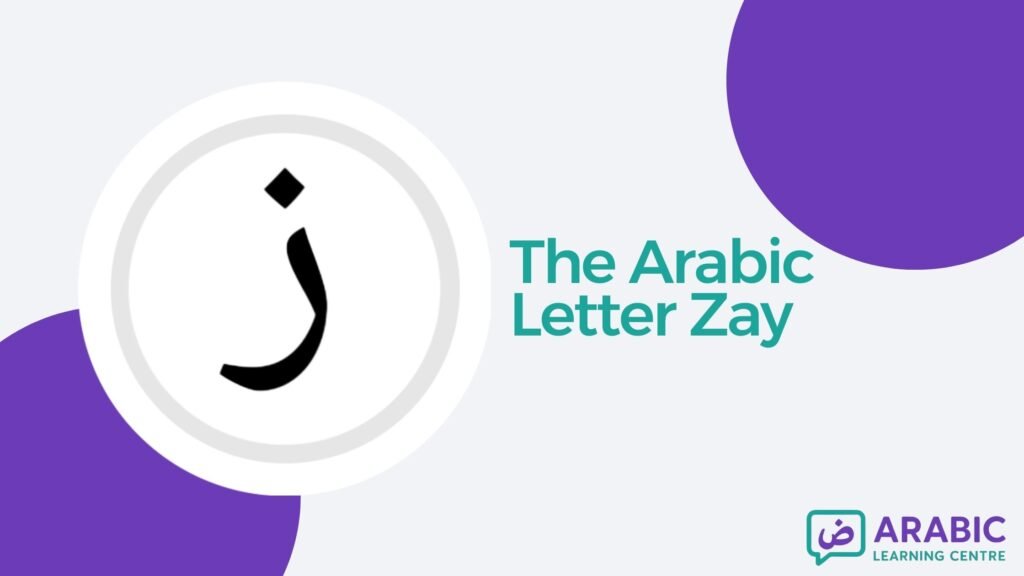
Learning the Arabic alphabet is the foundation for mastering the language, and among these letters is Zay (ز), a unique letter with a simple shape and clear sound. The letter Zay appears frequently in Arabic words, making it essential for beginners and children to recognize and practice. By learning how to read, write, and pronounce Zay correctly, students build a stronger foundation in reading and communication.
In this guide, we will explore the letter ز (Zay) in detail, covering its forms at the beginning, middle, and end of words, along with examples, exercises, and worksheets. Learners will also discover how to pronounce Zay with short vowels (Fatha, Dammah, Kasrah) and Sukoon, supported by practice activities, videos, and downloadable resources. This step-by-step approach ensures that children and beginners can easily master the letter Zay and use it confidently in reading and writing.
Letter Zay / ز

The letter Zay (ز) is the 11th letter of the Arabic alphabet. It is pronounced like the English “Z” in words such as zebra or zoo. Zay is a consonant letter and does not connect from the left side, which means that when it appears in the beginning or middle of a word, it is written separately from the next letter.
In Arabic, Zay is a simple and smooth letter without dots above or below, except for a single dot on top (ز). This makes it easy for children to identify and write. Because of its straightforward shape, learners often find Zay one of the easiest letters to recognize and practice.
How to Identify the letter Zay?
Identifying the letter ز (Zay) is simple because of its distinctive single dot above the letter and its smooth curve shape. Learners should pay attention to its form since it looks very similar to the letter Ra (ر), but the difference is the dot above Zay.
When practicing, students can circle or highlight Zay (ز) in words, listen carefully to its /z/ sound (like “z” in zebra), and repeat it aloud to strengthen recognition and pronunciation.

Letter Zay / ز Forms: At the Beginning, Middle, and End of the word
The letter Zay has a unique feature in Arabic: it does not connect to the next letter on its left side. This means that Zay’s shape stays nearly the same whether it comes at the beginning, middle, or end of a word. The only difference is how it connects (or doesn’t) to the letter before it.
– At the Beginning (في أول الكلمة): ز… (e.g., زيت – zayt / oil)
– In the Middle (في وسط الكلمة): …ز… (e.g., جزر – jazar / carrots)
– At the End (في آخر الكلمة): …ز (e.g., أرز – aruzz / rice)

At Arabic Learning Centre, we make learning Arabic letters simple and interactive, helping you practice these forms through guided lessons and exercises.
Letter Zay – ز With Fatha ( َ )
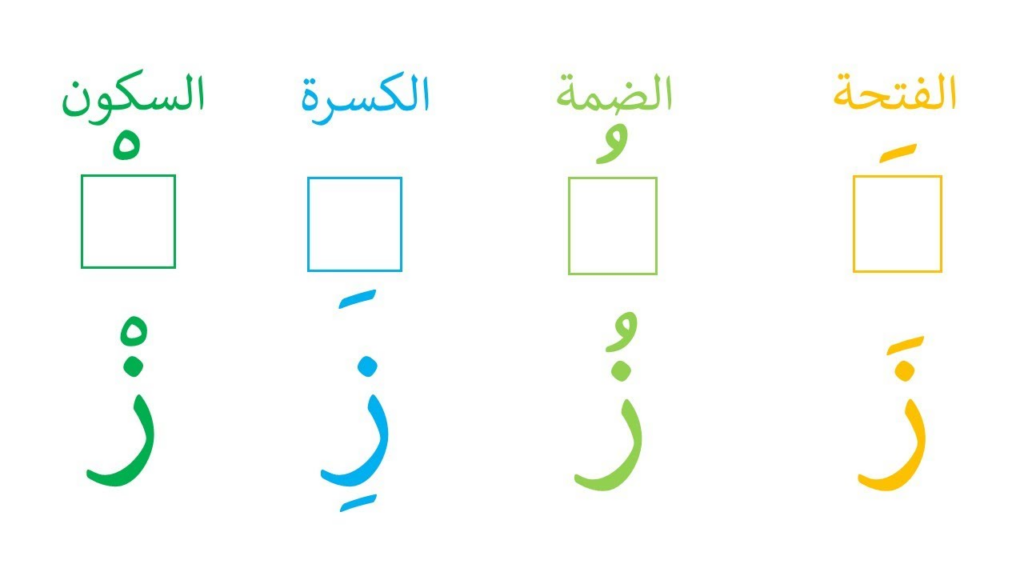
When the letter ز (Zay) is combined with a Fatha ( َ ), it is pronounced as “Za” – similar to the “za” sound in zebra. The Fatha is a small diagonal stroke placed above the letter to indicate the short vowel /a/ sound.
Examples of Zay with Fatha (زَ):
زَهر (zahr – blossom), زَرافة (zarāfa – giraffe), and زَمن (zaman – time)
Letter Zay – ز With Dammah ( ُ )
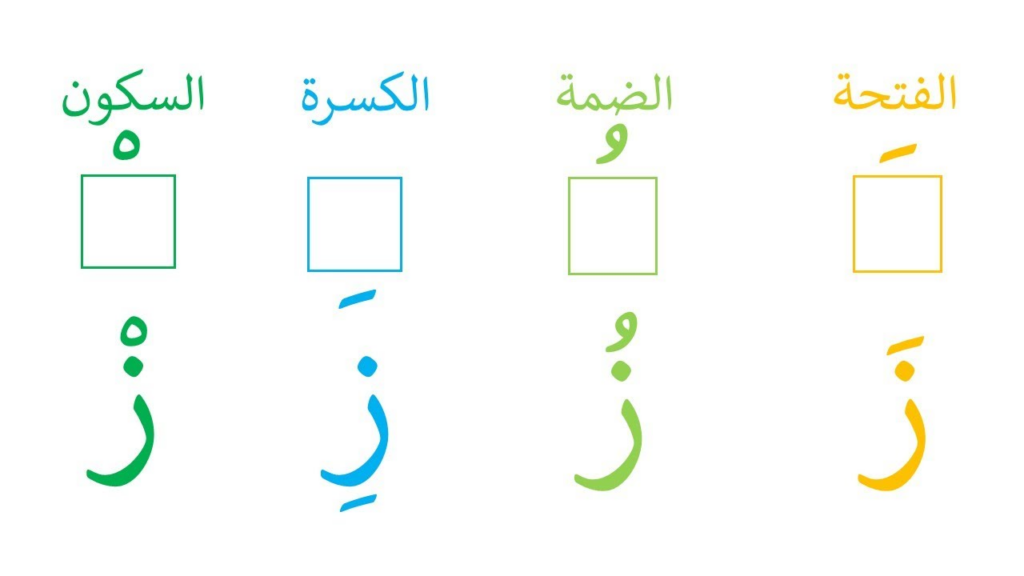
When the letter ز (Zay) is combined with a Dammah ( ُ ), it is pronounced as “Zu” – like the “zoo” sound in English. The Dammah is a small curved mark above the letter that gives the short vowel /u/ sound.
Examples of Zay with Dammah (زُ):
زُهور (zuhūr – flowers), زُجاج (zujāj – glass), and زُرع (zurʿ – planting)
Letter Zay – ز With Kasrah ( ِ )

When the letter ز (Zay) carries a Kasrah ( ِ ), it is pronounced as “Zi” – like the “zi” sound in zinc. The Kasrah is a small diagonal stroke placed below the letter, and it gives the short vowel /i/ sound.
Examples of Zay with Kasrah (زِ):
زِيت (zīt – oil), and زِر (zir – button)
Letter Zay – ز With sukoon ( ْ )
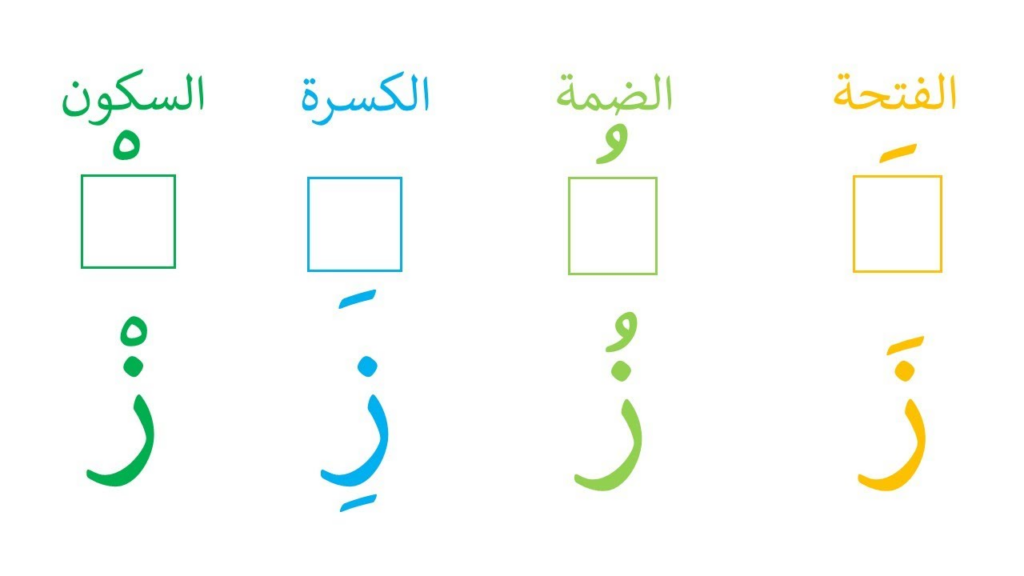
When the letter ز (Zay) is written with a Sukoon ( ْ ), it is pronounced as a pure “Z” sound without any following vowel. The Sukoon is a small circle placed above the letter to indicate the absence of a vowel.
Examples of Zay with Sukoon (زْ):
أرزْ (aruzz – rice), جَزْر (jazar – carrot), and حَزْم (hazm – firmness)
Examples of letter Zay – ز in Words
The letter Zay (ز) appears frequently in Arabic words. It can occur at the beginning, middle, or end of a word. Unlike many other Arabic letters, Zay has a consistent shape that does not change much depending on its position. Recognizing Zay in different word positions helps learners improve their reading accuracy and pronunciation.
Here are some examples:
| Position | Arabic Word | Pronunciation | English Meaning |
| At the Beginning | زَهر / زُجاج / زِيت | zahr / zujāj / zīt | flower / glass / oil |
| In the Middle | جَزَر / بَزْر / مِزاج | jazar / bazr / mizāj | carrot / seed / mood |
| At the End | أرز / حزْز / خبز | aruzz / hazz / khubz | rice / cut / bread |

Examples of letter Zay/ ز in Phrases and Sentences
After practicing individual words, it is important for learners to recognize the letter ز (Zay) in full phrases and sentences. Seeing Zay in context helps improve reading fluency, comprehension, and confidence. Zay may appear at the beginning, middle, or end of words within a sentence, but its shape always stays clear and easy to identify.
Here are some examples:
| Position | Arabic Sentence | Pronunciation | English Meaning |
| At the Beginning | زارَ زَيْدٌ المَدرَسة. | zāra Zaydun al-madrasa | Zayd visited the school. |
| In the Middle | أكَلْتُ جَزَرًا طازِجًا. | akaltu jazaran tāzijan | I ate fresh carrots. |
| At the End | هذا خُبزٌ ساخن. | hādhā khubzun sakhin | This is hot bread. |
How to write the Zay Letter?
Writing the letter ز (Zay) is simple because it has one smooth curve and a single dot above it. Unlike many Arabic letters, Zay does not change much in its different positions, which makes it easier for beginners to master.
Steps to Write Zay:
1- Start with a small curved stroke that looks similar to the English letter “r” but smoother.
2- Place one dot above the curve to complete the letter.
3- Practice writing Zay in different positions within words (beginning, middle, end).

Examples:
– Beginning: زَهر (zahr – flower)
– Middle: جَزَر (jazar – carrot)
– End: أرُز (aruzz – rice)
How to Pronounce the Letter Zay?
The pronunciation of Zay (ز) depends on the harakah (vowel mark) it carries. On its own, Zay represents the buzzing /z/ sound, like the “z” in zebra. When it carries a short vowel (Fatha, Dammah, Kasrah), the /z/ sound is followed by the corresponding vowel. With Sukoon, Zay produces a clear consonant sound without a vowel.
In Qur’anic recitation, the sound of ز comes from the tip of the tongue (طرف اللسان) touching close to the upper teeth while producing a voiced buzzing sound. It is classified as one of the “as-Safīr” (whistling sounds) in Tajweed due to its continuous airflow.

Basic Pronunciation Rules:
1- زَ (Zay with Fatha): Pronounced as “za”, a short /a/ sound after Zay.
Example: زَهر (zahr – blossom).
2- زُ (Zay with Dammah): Pronounced as “zu”, a short /u/ sound after Zay.
Example: زُهور (zuhūr – flowers).
3- زِ (Zay with Kasrah): Pronounced as “zi”, a short /i/ sound after Zay.
Example: زِيت (zīt – oil).
4- زْ (Zay with Sukoon): A pure buzzing /z/ sound with no vowel.
Example: خُبزْ (khubz – bread).
To pronounce correctly:
– Keep your tongue close to your upper teeth.
– Let the air pass smoothly with vibration of the vocal cords.
– Practice by saying words like: زَرافة (zarāfa – giraffe), زُجاج (zujāj – glass), and جَزْر (jazar – carrot).
Learn Zay through videos
Learning the letter Zay (ز) becomes easier and more engaging with the help of videos. Visual and audio resources allow learners to see how the letter is written, hear how it is pronounced, and practice it in real words. Videos are useful as they provide repetition, fun animations, and clear demonstrations that improve memory and understanding.
Here are some helpful video resources:
– How to Pronounce Zay (ز) – A simple guide to pronouncing the letter Zay clearly for beginners.
– Learn Zay with Short and Long Vowels – Focuses on Zay with Fatha, Dammah, Kasrah, and Madd (long vowels).
– Sounds and Shapes of the Letter Zay ز in Words – Teaches how Zay appears and sounds in different words.
How to Make the Most of These Videos
1- Listen carefully to the pronunciation at the start of the video, then repeat the examples out loud.
2- Follow the writing demonstration step-by-step, and practice writing alongside the video.
3- Combine the videos with written explanations, images, and exercises for maximum learning.
Learn Arabic with Arabic Learning Centre
If you want to master the Arabic alphabet step by step, including the letter Zay (ز) and all other letters, Arabic Learning Centre offers structured online Arabic classes for learners of all ages. With expert native teachers, interactive lessons, and personalized learning plans, you can improve your reading, writing, and speaking skills with confidence.
Exercises For Zay in Arabic
Practicing is the best way to master the Arabic letter Zay (ز). These exercises will help you recognize, write, and pronounce Zay correctly in different positions of a word.
1. Identify the Letter Zay
Circle the letter Zay (ز) in the words below:
– زرافة
– موز
– مزهرية
– زهر
2. Write Zay in Different Positions
Write the letter Zay in:
– Beginning position: ز
– Middle position: ـز
– End position: ـز
3. Match the Word to Its Picture
Draw a line between each word and the correct picture:
– زرافة 
– موز 
– زهرة 
4. Fill in the Missing Letter
Complete the words by adding the missing Zay (ز):
1- __رافة (Giraffe)
2- مو__ (Banana)
3- __هور (Flower)
5. Read Aloud
Read these words slowly, paying attention to the Zay pronunciation:
– زهر (Flower)
– موز (Banana)
– زرافة (Giraffe)
Repeat these exercises daily until you can easily spot Zay and write it from memory.
Read Also: The Letter Ayn ع In Arabic With Examples, Exercises, and Worksheets
Downloadable Worksheets for the Arabic letter Zay
Practicing the letter Zay (ز) with worksheets is an effective way for learners to reinforce reading, writing, and recognition skills. Worksheets provide hands-on activities such as tracing, coloring, connecting dots, and completing words, helping children and beginners master Zay in a fun and interactive way.
Free Printable Worksheets for Arabic Letter Zay (ز)
1- BelarabyApps – Arabic Letter Zay Worksheets
Offers engaging worksheets that teach how to write the letter Zay through coloring, connecting the dots, and practicing correct writing.
2- PajyKids – Zay with Short Vowel Worksheets
Provides worksheets for practicing Zay with Fatha, including writing practice, coloring activities, and vocabulary cards.
Read Also: The Letter Taa / ت In Arabic With Examples, Exercises, and Worksheets
Common Mistakes related to letter Zay
Even though the Arabic letter Zay (ز) is relatively easy to recognize and pronounce, many beginners make common mistakes when learning it. Understanding these mistakes will help learners avoid them and improve their Arabic reading and writing skills faster.
1. Confusing Zay (ز) with Ra (ر)
– Mistake: Writing Ra (ر) as if it were Zay (ز) or forgetting to place the dot above Zay.
– Correction: Zay has a single dot above the curve, while Ra has no dot. Always check for the dot to distinguish the two letters.

Read Also: The Letter Saad / ص in Arabic With Examples, Exercises, and Worksheets
2. Writing Zay Incorrectly in Words
– Mistake: Misplacing Zay in the beginning, middle, or end of words, or connecting it incorrectly to other letters.
– Correction: Remember that Zay does not connect to the next letter on the left. Its shape remains mostly consistent: Beginning: زَهر (zahr), Middle: جَزَر (jazar), and End: أرُز (aruzz)
3. Pronouncing Zay Incorrectly
– Mistake: Pronouncing Zay as Raa or another consonant, or adding extra vowel sounds when it carries Sukoon.
– Correction: Zay should be pronounced clearly as /z/. With Fatha, it becomes za; with Dammah, zu; with Kasrah, zi; and with Sukoon, just z.
Read Also: The Letter Seen / س in Arabic With Examples, Exercises, and Worksheets
4. Forgetting Harakat with Zay
– Mistake: Placing Fatha, Dammah, or Kasrah on Zay incorrectly, or skipping the vowel marks when needed.
– Correction: Make sure to place the correct short vowel above or below Zay when practicing reading:
– زَ – with Fatha
– زُ – with Dammah
– زِ – with Kasrah
5. Skipping Practice with Zay in Words and Sentences
– Mistake: Only practicing Zay in isolation.
– Correction: Practice Zay in full words and sentences to master its pronunciation and recognition in context, e.g., زارَ زَيْدٌ المَدرَسة (Zayd visited the school).
Read Also: The Letter Khaa / خ in Arabic With Examples, Exercises, and Worksheets
Learn Arabic with Arabic Learning Centre
Take your Arabic skills to the next level with Arabic Learning Centre, designed for learners of all ages and levels. From mastering the alphabet to reading, writing, grammar, listening, and conversation, Arabic Learning Centre provides structured lessons led by qualified native teachers. With flexible schedules and interactive lessons, you can learn at your own pace while gaining practical language skills and cultural understanding.
Whether you’re a beginner or looking to improve advanced skills, the Arabic Learning Centre helps you:
– Read and write Arabic confidently
– Understand Arab culture and literature
– Hold conversations with native speakers
– Work or travel in Arabic-speaking countries
– Teach Arabic reading professionally, including Quranic reading
Start your journey today with a free trial and personalized online Arabic classes, and master Arabic efficiently and effectively.
Courses We Offer:
- Learn to Read Arabic Course
- Arabic Grammar Course
- Arabic Speaking Course
- Arabic Script writing course
- Arabic Vocabulary Course
- Arabic Pronunciation Course
Conclusion
The Arabic letter Zay (ز) is an essential consonant in the Arabic alphabet, appearing in many words and phrases across the language. Understanding its shape, pronunciation, and different forms in the beginning, middle, and end of words is crucial for learners who want to read and write Arabic accurately. Practicing Zay with short vowels like Fatha, Dammah, and Kasrah, as well as Sukoon, helps improve both reading fluency and proper articulation.
Using exercises, worksheets, and video resources reinforces recognition and writing skills, making the learning process interactive and effective. By consistently practicing the letter Zay in words, phrases, and sentences, learners develop confidence in reading, writing, and pronunciation. Mastery of Zay lays a strong foundation for tackling other Arabic letters, enabling learners to gradually build comprehensive Arabic literacy skills.
Related Articles
Arabic Alphabet & Writing



Leave a Reply