 Arabic Alphabet & Writing
Learning the Arabic alphabet is the foundation for mastering the Arabic language, whether for reading the Qur’an, daily communication, or academic study. The Arabic script consists of 28 unique letters, each with its own sound and multiple forms depending on its position in a word. Understanding these letters step by step helps learners progress from recognizing sounds to building words and complete sentences with confidence.
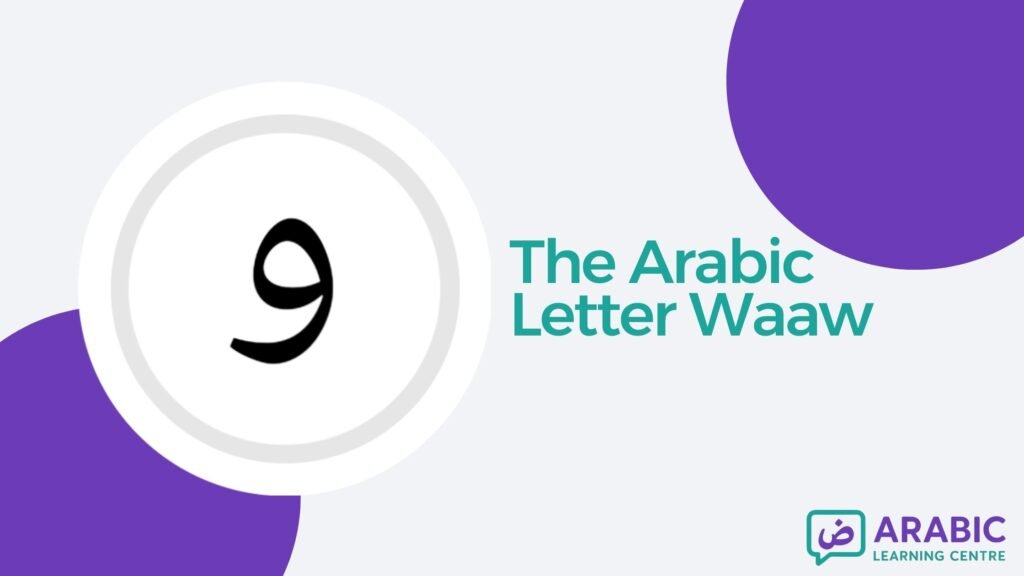
Among these letters, the Arabic letter Waaw (و) stands out as both a consonant and a long vowel, making it an essential letter in the language. It can represent the consonant sound “w” (like in “water”) or the long vowel “oo” (like in “moon”). Due to this dual role, mastering Waaw is crucial for learners, as it enhances both their reading fluency and pronunciation accuracy.
Letter Waaw – و
The letter Waaw (و) is the twenty-seventh letter of the Arabic alphabet. It is a rounded letter pronounced as a soft “w” sound, or as the long vowel “oo.” Waaw is unique because it only connects to the letter before it, but never to the letter after it. This makes it similar to Alif (ا) and Daal (د) in its connecting behavior.
In written Arabic, Waaw keeps the same rounded form whether it appears in the beginning, middle, or end of words. This consistency makes it one of the easier letters to recognize and write. Waaw is found in countless everyday Arabic words, and its role as both a consonant and a vowel makes it indispensable in mastering the Arabic language.
How to Identify The letter Waaw – و

Recognizing the letter Waaw is simple once you learn its rounded shape. Waaw looks like a small circular loop with a short tail extending downwards to the left. Unlike many Arabic letters, it does not change its form much, making it easy to spot in any word.
A key feature of Waaw is that it never connects to the letter after it, but it can connect to the letter before it. This makes its form consistent across the beginning, middle, and end of words.
Example
– Beginning of the word: وَرد (Ward – rose)
– Middle of the word: نور (Noor – light)
– End of the word: أبو (Abu – father of)
Tip for learners: When you see a rounded loop with a small tail that does not connect forward, you are most likely looking at the letter Waaw (و).
Letter Waaw and و Forms: At the Beginning, Middle, and End of the word
The letter Waaw (و) is one of the easiest letters in Arabic to recognize because its shape remains nearly the same in all positions. Like Alif, Waaw does not connect to the letter that comes after it, but it does connect to the letter before it when it appears in the middle or at the end of a word.
Here’s how Waaw looks in different positions:
1- At the beginning: Appears as a small loop with a short tail, e.g., ورد (ward – rose), وقت (waqt – time).
2- In the middle: Connects only to the letter before it but remains open at the front, e.g., نور (noor – light), سور (soor – wall).
3- At the end: Appears after the last letter and is written as the same circular loop with a tail, e.g., أبو (abu – father of), هو (huwa – he).
Since Waaw never connects forward, you can easily identify it as the round loop with a tail, whether it’s in the middle or at the end of a word.

Arabic Learning Centre helps you learn Arabic, Quran, and Islamic studies with expert native teachers. Our online classes are flexible, interactive, and designed for all ages and levels. Join today and start your journey towards mastering the Arabic language and the Quran!
Letter Waaw/ و With Fatha ( َ )

When the letter Waaw (و) carries a fatha (ـَ), it produces the short sound “wa”, similar to the “wa” in the English word water. This makes the sound quick and light, not a long vowel.
– At the beginning: The fatha is placed above the Waaw to show the “wa” sound, e.g., وَردة (warda – flower).
– In the middle: Waaw with fatha connects to the letter before it but does not connect to the letter after, e.g., ألوَان (alwan – colors).
– At the end: Waaw rarely appears with fatha at the very end, but it can in some words, e.g., عَدوَ (ʿaduwā – enemy).
The fatha always sits above the Waaw, slightly slanted, and signals a quick “wa” sound—not a long “wā”.
Letter Waaw / و With Dammah ( ُ )
When the letter Waaw (و) carries a dammah (ـُ), it produces a short “u” sound, similar to the “oo” in the English word book. This sound is quick and rounded, not as long as the “oo” in moon.
– At the beginning: The dammah is placed above the Waaw in the form of a small curl or loop, e.g., وُرود (wurūd – roses).
– In the middle: Waaw with dammah connects to the letter before it but does not connect to the letter after, e.g., فُوطة (fuota – towel).
– At the end: Waaw with dammah can appear at the end when it carries a short vowel sound, e.g., يَدعُو (yad‘uo – he calls).
The dammah always sits above the letter and looks like a small Arabic “9”. It gives a short, rounded “u” sound that should be pronounced quickly without lengthening.
Letter Waaw/ و With Kasrah ( ِ )
When the letter Waaw (و) carries a kasrah (ـِ), it produces a short “i” sound, similar to the “i” in the English word sit. The kasrah is a small diagonal stroke placed below the letter, and it gives the sound a lighter, sharper tone compared to fatha or dammah.
– At the beginning: The kasrah is placed under the Waaw, e.g., وِسام (wisām – medal).
– In the middle: Waaw with kasrah connects to the letter before it but not to the one after, e.g., أدوِية (adwiya – medicine).
– At the end: It can appear at the end of some words, e.g., يرتو (yartawi – quench your thirst).
The kasrah always appears under the letter, so whenever you see a small slanted stroke below Waaw, it signals a quick “i” sound.
Letter Waaw/ و With sukoon ( ْ )
The sukoon (ـْ) is a small circular mark placed above a letter to indicate the absence of a vowel sound. When placed on Waaw (و), it means the Waaw is silent; it does not carry a vowel of its own but is pronounced immediately after the preceding vowel sound.
– At the beginning: Waaw never comes with sukoon at the beginning of a word, since Arabic words cannot start with a consonant without a vowel.
– In the middle: Waaw with sukoon acts like a consonant joining two sounds together, e.g., صوْم (swūm – fasting).
– At the end: Waaw with sukoon can appear at the end of a word, e.g., هُوْ (huwa – he).
Sukoon on Waaw is very common in Arabic, especially in Qur’anic recitation and everyday words. It tells you to “pause” the Waaw without giving it any vowel, smoothly connecting the sound before it to the letter after.
Examples of letter Waaw/ و in Words
The letter Waaw (و) is one of the most common and important letters in Arabic. It can occur at the beginning, middle, or end of a word. Waaw is easy to recognize because of its rounded shape, and unlike many other letters, it does not connect to the letter after it. Recognizing Waaw in different positions will help learners read more fluently and accurately.
Here are some examples:
| Position | Arabic Word | Pronunciation | English Meaning |
| At the beginning | ولد / ورد / وسام | walad / ward / wisām | boy / rose / medal |
| In the middle | سورة / جوهر / نور | sūrah / jawhar / nūr | chapter / jewel / light |
| At the end | هو / يدعو / يرو | huwa / yad‘ū / yarw | he / he calls / he narrates |
Tip for learners: Always pay attention to how Waaw looks in different positions. Practice by circling or highlighting و in words to train your eyes to spot it quickly.

Examples of letter Waaw/ و in Phrases and Sentences
Seeing the letter Waaw (و) in full phrases and sentences helps learners understand how it works naturally in context. By practicing with connected text, you can spot Waaw at the beginning, middle, or end of words, while also improving your Arabic fluency.
Here are some examples:
| Position of Waaw | Arabic Example | English Meaning |
| At the beginning | وَصلتُ إلى البيت مُبكرًا | I arrived home early |
| وَردة جميلة في الحديقة | A beautiful rose in the garden | |
| In the middle | أزور جدتي كل أسبوع | I visit my grandmother every week |
| هذا جوهر الكلام | This is the essence of the speech | |
| At the end | هو صديقي المفضل | He is my best friend |
| يدعو المسلم ربه دائمًا | The Muslim always calls upon his Lord |
Try reading these sentences aloud and underline every و you see. This will train your eyes to quickly recognize Waaw in real text.
How to write the Waaw Letter?
The letter Waaw (و) is one of the rounded letters in the Arabic alphabet. It has a smooth, circular shape and is written in a single flowing motion. Unlike many letters, Waaw does not connect to the letter after it, but it does connect to the one before it.
Steps to Write Waaw (و):
1- Starting point: Place your pen slightly above the writing line.
2- Curve downward: Begin with a small rightward hook that curves down and left.
3- Loop shape: Continue the stroke into a circular loop, like a small “9” shape resting on the line.
4- Tail end: Finish with a slight upward flick at the baseline.

Important Notes:
– Consistency: Waaw keeps the same rounded shape whether it appears at the beginning, middle, or end of a word.
– Direction: Always write it in one smooth motion from right to left.
– Size: Keep Waaw proportionate to other letters; it should not be too large or too small.
Practice writing Waaw several times on lined paper, making sure the loop touches the baseline neatly.
How to Pronounce the Letter Waaw?
The pronunciation of Waaw (و) depends on whether it is used as a consonant or as a long vowel (madd letter).
Its sound comes from Al-Jawf (الجوف) — the empty space in the mouth and throat. Waaw is also one of the three Madd letters (letters of elongation) along with Alif (ا) and Yaa (ي).

Basic Pronunciation Rules:
1- Waaw as a consonant (وُ / وَ / وِ):
– With Dammah (وُ): makes a short “w” sound combined with “u” (like woo in “wood”). Example: وُجوه (wujooh – faces).
– With Fatha (وَ): makes a “wa” sound. Example: وَرد (ward – rose).
– With Kasrah (وِ): makes a “wi” sound. Example: وِصال (wisaal – connection).
2- Waaw as a long vowel (ـو):
– Pronounced as a stretched “oo” sound, similar to the “oo” in moon.
– It only works as a long vowel when preceded by a letter carrying a Dammah. Example: نور (noor – light).
3- Waaw with Sukoon (وْ):
Produces a pure “w” sound without an added vowel. Example: قول (qawl – saying).
Tips for Learners:
– Lips shape: Round your lips gently when pronouncing Waaw, especially for the “oo” sound.
– Short vs. long sounds: Keep the consonant Waaw short and crisp, but stretch the sound when Waaw functions as a Madd letter.
– Practice aloud: Repeat examples in front of a mirror to check lip rounding and airflow.
Learn Waaw through videos
Using educational videos makes learning the Arabic letter Waaw more effective and fun. You’ll see how the letter is written, hear its pronunciation, and observe how it functions both as a consonant and a long vowel—boosting your memory and speaking confidence.
Featured videos:
1- Learn Letter Waaw (و) in Arabic | Arabic Alphabet for Kids
A recent and engaging lesson that walks through reading, writing, and pronouncing Waaw, accompanied by fun example words. Perfect for visual learners!
2- Arabic Writing for Beginners _ Waw Wonders: Exploring short Vowels and different shapes of waaw و
A video showing vowels and different shapes of waaw.
How to make the most of these videos:
1- Listen intently: Focus on the pronunciation—distinguish Waaw as a consonant and as a long “oo” sound.
2- Pause and practice: Stop the video during writing demonstrations and try writing Waaw yourself to reinforce its shape.
3- Combine resources: Use these videos alongside written explanations, coloring activities, and worksheets to reinforce learning.
Master Arabic step by step with Arabic Learning Centre!
Learn reading, writing, and speaking with native teachers, interactive lessons, and flexible schedules.
Start your Arabic journey today—fun, engaging, and effective for all ages!
Exercises for letter Waaw in Arabic
Practicing is the best way to master the Arabic letter Waaw (و). These exercises will help you recognize, write, and pronounce Waaw correctly in different positions of a word.
1. Identify the Letter Waaw
Circle the letter و in the words below:
– وادي
– نور
– ورقة
– وردة
2. Write Waaw in Different Positions
Write the letter Waaw in:
– Beginning position: و
– Middle position: ـوـ
– End position: ـو
3. Match the Word to Its Picture
Draw a line between each word and the correct picture:
– وادي 
– نور 
– وردة 
4. Fill in the Missing Letter
Complete the words by adding the missing Waaw (و):
1- __ادي (Valley)
2- ن__ر (Light)
3- ____ردة (flower)
Read Also: The Letter Jeem / ج in Arabic With Examples, Exercises, and Worksheets
5. Read Aloud
Read these words slowly, paying attention to the soft “w” sound of Waaw:
– وادي (Wadi – Valley)
– نور (Noor – Light)
– وردة (Warda – Flower)
Repeat these exercises daily until you can spot Waaw instantly and write it in all positions with ease.
Read Also: The Letter Dhaal / ذ in Arabic With Examples, Exercises, and Worksheets
Downloadable Worksheets for the Arabic letter Waaw
To make learning fun and effective, we’ve created printable worksheets for the Arabic letter Waaw (و). These worksheets will help students practice recognizing, writing, and using the letter in words and sentences through interactive activities. Perfect for both classroom and home learning.
Download the worksheets here:
– My Resourse Station: Waaw Worksheet – Colour, Trace, and Write a printable PDF to practice writing and recognizing Waaw.
– Arabic Seeds (Islamic-themed): Provides coloring and tracing worksheets for each letter, including Waaw, along with pronunciation audio files for memorization and enhanced learning.
Read Also: The Letter Faa’ ف In Arabic With Examples, Exercises, and Worksheets
Common Mistakes related to the letter Waaw
Even though the Arabic letter Waaw (و) is simple in shape and pronunciation, beginners often make common mistakes when learning it. Recognizing these mistakes will help improve reading, writing, and pronunciation skills faster.
1- Confusing Waaw (و) with Dammah carrier ( ُ ) or Hamzah on Waw (ؤ)
Mistake: Mixing Waaw (و) with the letter carrying a Hamzah above (ؤ) or confusing it with a vowel sound.
Correction: Waaw (و) is a single curved stroke without any dots, while Hamzah on Waw (ؤ) has a small glottal stop above.
| Feature | Waaw (و) | Hamzah on Waw (ؤ) |
| Type | Letter in the Arabic alphabet | Letter with glottal stop |
| Shape | Small loop or curve, never carries a dot | Waw shape with Hamzah on top |
| Function | Consonant “w” or long vowel “oo” | Represents a glottal stop plus vowel |
| Examples | ورد (ward – rose), نور (noor – light) | مسؤول (mas’ool – responsible) |
| Connection | Connects to the previous letter, never after | Same connection rules, but includes the Hamzah sound |
Read Also: The Letter Baa / ب in Arabic With Examples, Exercises, and Worksheets
2- Forgetting Waaw’s Role as a Long Vowel
Mistake: Pronouncing Waaw (و) as a consonant “w” when it acts as the long vowel “oo”.
Correction: Context matters:
– Consonant: وَلَد (walad – boy)
– Long vowel: نُور (noor – light)
Read Also: The Letter Yaa ي In Arabic With Examples, Exercises, and Worksheets
3- Writing Waaw Incorrectly in Different Positions
Mistake: Altering its simple curved shape when it appears at the beginning, middle, or end of words.
Correction:
– Beginning: وِلاد (wilad)
– Middle: مـوـسـى (Moosaa)
– End: يدعو (calling)
4- Misplacing Harakat on Waaw
Mistake: Adding Fatha, Dammah, or Kasrah incorrectly or confusing short and long vowels.
Correction:
– وَ (wa) – Fatha, short “a” sound
– وُ (wu) – Dammah, short “u” sound
– وَو (waw as long vowel) – acts as “oo”
Focusing on these common mistakes helps learners distinguish Waaw from similar letters and ensures proper pronunciation and writing.
Read Also: The Letter Haa هـ In Arabic With Examples, Exercises, and Worksheets
Start Your Arabic Learning Journey with Expert Teachers Today
Ready to truly understand Arabic and use it with confidence? At The Arabic Learning Centre, you’ll learn with expert Arabic language teachers, including qualified female Arabic teachers, in a supportive and professional environment designed for real progress. Whether you’re learning Arabic for the Quran, studies, career, or daily conversation, we have the right course for you.
Take the next step today and join thousands of students learning Arabic the right way.
Courses We Offer:
- Learn to Read Arabic Course
- Arabic Grammar Course
- Arabic Speaking Course
- Arabic Script writing course
- Arabic Vocabulary Course
- Arabic Pronunciation Course
Conclusion
The Arabic letter Waaw (و) is both a consonant and a long vowel, representing the sounds “w” as in “water” and “oo” as in “moon.” Its rounded shape with a small tail is easy to recognize, and it only connects to the letter before it, making it consistent in the beginning, middle, or end of words. Learning Waaw helps improve reading fluency, pronunciation, and understanding of everyday Arabic words.
Waaw can carry short vowels—fatha (َ), dammah (ُ), kasrah (ِ)—or a sukoon (ْ) to change its sound. Practicing its different forms in words, phrases, and sentences allows learners to read and write accurately while avoiding common mistakes, such as confusing Waaw with Hamzah on Waw (ؤ) or misplacing vowels. Regular practice ensures mastery of this important Arabic letter.
Related Articles
Arabic Alphabet & Writing


Leave a Reply