 Arabic Resources & Courses
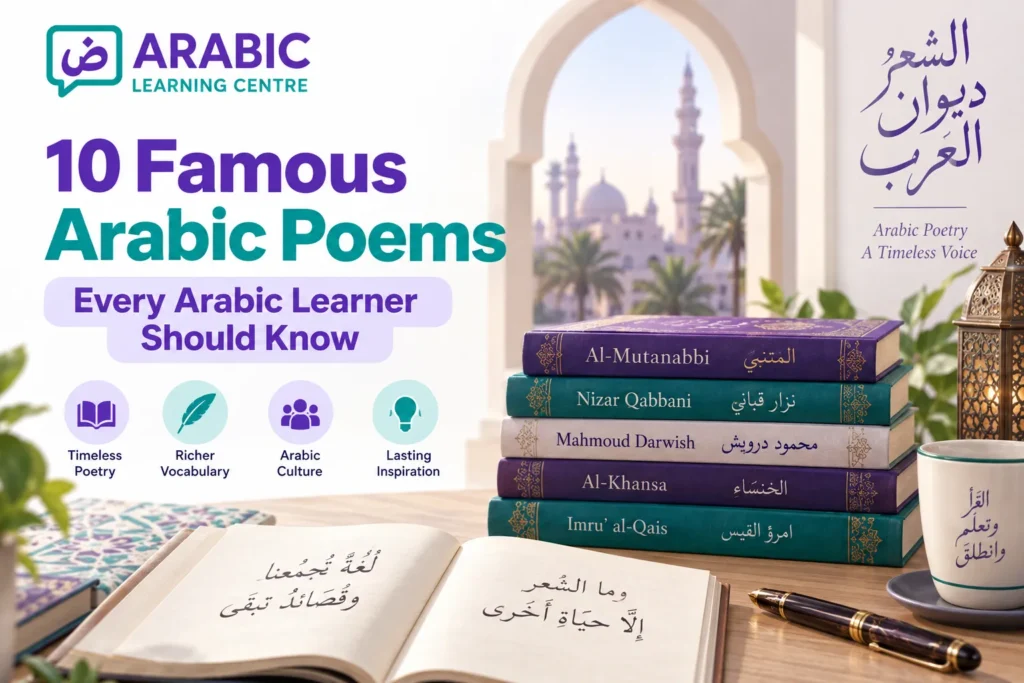
Arabic poetry is one of the richest literary traditions in the world. For more than fifteen centuries, Arab poets have used verse to express love, pride, grief, courage, exile, identity, wisdom, and longing.
From the elaborate odes of pre-Islamic Arabia to the emotionally direct poetry of Mahmoud Darwish and Nizar Qabbani, poems have played an important role in preserving both the Arabic language and Arab cultural memory.
For Arabic learners, however, entering the world of poetry can seem intimidating. Classical Arabic poetry is closely connected to ʿarūḍ (Arabic prosody), a sophisticated system of poetic meters, rhythms, and structures.
Early poets competed in their command of language and their ability to create memorable verses while remaining within established poetic conventions.
Modern Arabic poetry changed many of these traditions. Beginning especially in the twentieth century, poets increasingly experimented with free verse and prose poetry, giving writers greater freedom in rhythm, structure, and vocabulary. This makes some modern poems particularly approachable for intermediate Arabic learners.
1. قفا نبك (Stop, Let Us Weep) – Imru’ al-Qais
The Mu‘allaqa of Imru’ al-Qais is one of the most famous examples of the classical Arabic qasidah.
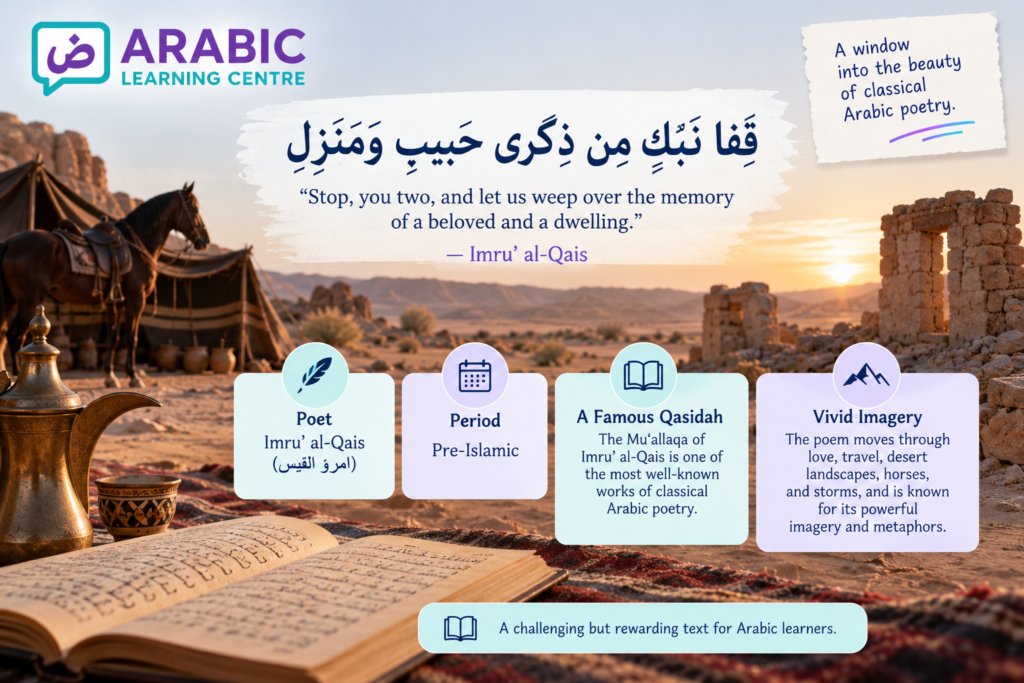
It begins with the poet stopping at the remains of an abandoned campsite and remembering his beloved before moving through scenes of love, travel, desert landscapes, horses, and storms.
Poet: Imru’ al-Qais (امرؤ القيس)
Period: Pre-Islamic
قِفا نَبكِ مِن ذِكرى حَبيبٍ وَمَنزِلِ
“Stop, you two, and let us weep over the memory of a beloved and a dwelling.”
Imru’ al-Qais is especially known for his vivid imagery and metaphors, which had a lasting influence on Arabic poetry.
For Arabic learners, the poem is challenging because of its classical vocabulary and grammatical structures, but studying even a few lines offers a valuable introduction to the language and imagery of early Arabic poetry.
2. رثاء صخر (Elegy for Sakhr) – Al-Khansa
Al-Khansa, whose name was Tamadir bint Amr, became one of the most celebrated female poets in Arabic literary history. She is particularly remembered for her elegies for her brother Sakhr.
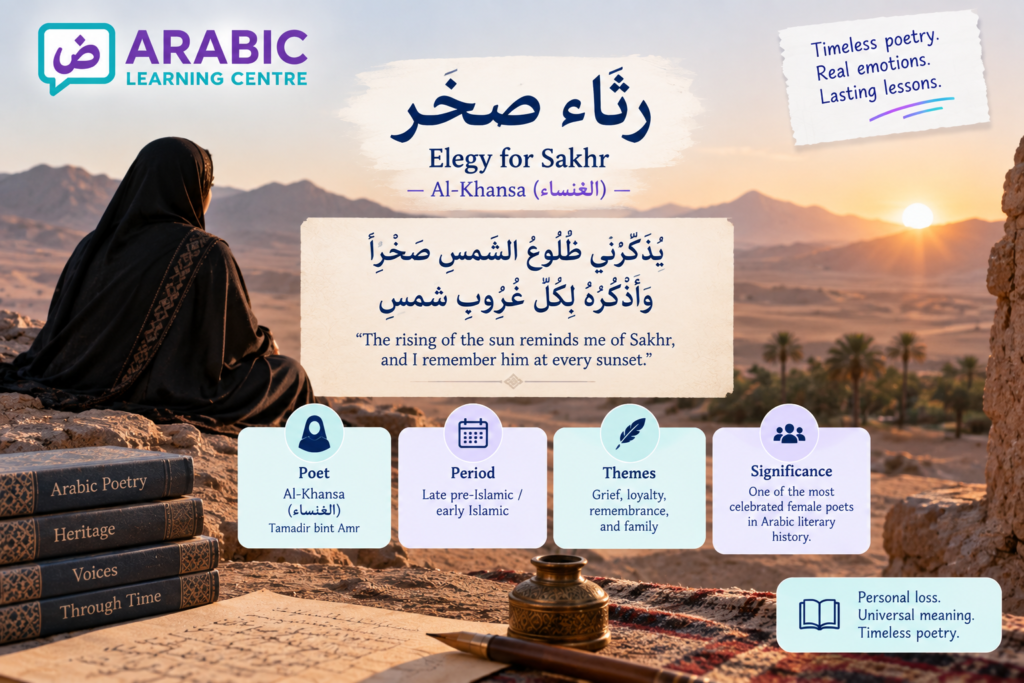
Arabic: رثاء صخر
Poet: Al-Khansa (الخنساء)
Period: Late pre-Islamic / early Islamic
Her poetry transforms personal grief into memorable Arabic verse. Rather than simply stating that she misses her brother, Al-Khansa repeatedly describes his character, courage, generosity, and the emptiness his death created.
One of her famous verses begins:
يُذَكِّرُني طُلوعُ الشَمسِ صَخراً
وَأَذكُرُهُ لِكُلِّ غُروبِ شَمسِ
“The rising of the sun reminds me of Sakhr,
and I remember him at every sunset.”
The simplicity of the central image makes these lines particularly memorable: morning and evening both become reminders of someone who has been lost.
Al-Khansa’s work is valuable for learners who want to see how classical Arabic expresses grief, loyalty, remembrance, and family relationships through relatively concise images.
3. معلقة عنترة (The Mu‘allaqa of Antarah) – Antarah ibn Shaddad
Antarah ibn Shaddad occupies a special place in Arabic cultural history as both a poet and a warrior. His famous Mu‘allaqa combines descriptions of battle, courage, hardship, love, and his beloved Abla.
Arabic: معلقة عنترة بن شداد
Poet: Antarah ibn Shaddad (عنترة بن شداد)
Period: Pre-Islamic
One of its best-known passages is:
وَلَقَد ذَكَرتُكِ وَالرِماحُ نَواهِلٌ
مِنّي وَبيضُ الهِندِ تَقطُرُ مِن دَمي
فَوَدِدتُ تَقبيلَ السُيوفِ لِأَنَّها
لَمَعَت كَبارِقِ ثَغرِكِ المُتَبَسِّمِ
The poet remembers his beloved even while surrounded by spears and swords in battle. The flash of the swords reminds him of the brightness of her smile.
This striking combination of romance and warfare is one reason Antarah’s poetry has remained memorable for generations.
For Arabic learners, his work is also an opportunity to encounter classical descriptions, similes, battle vocabulary, and the highly compressed sentence structures characteristic of early Arabic poetry.
4. على قدر أهل العزم (According to the Measure of Determination) – Al-Mutanabbi
Al-Mutanabbi is one of the towering figures of classical Arabic literature. His poetry explores pride, ambition, courage, wisdom, travel, conflict, and human character, and many individual lines from his poems are still quoted like proverbs.
Poet: Al-Mutanabbi (المتنبي)
Period: Abbasid era
Famous opening: على قدر أهل العزم تأتي العزائم
English meaning: “Great resolutions come according to the greatness of those who make them.”
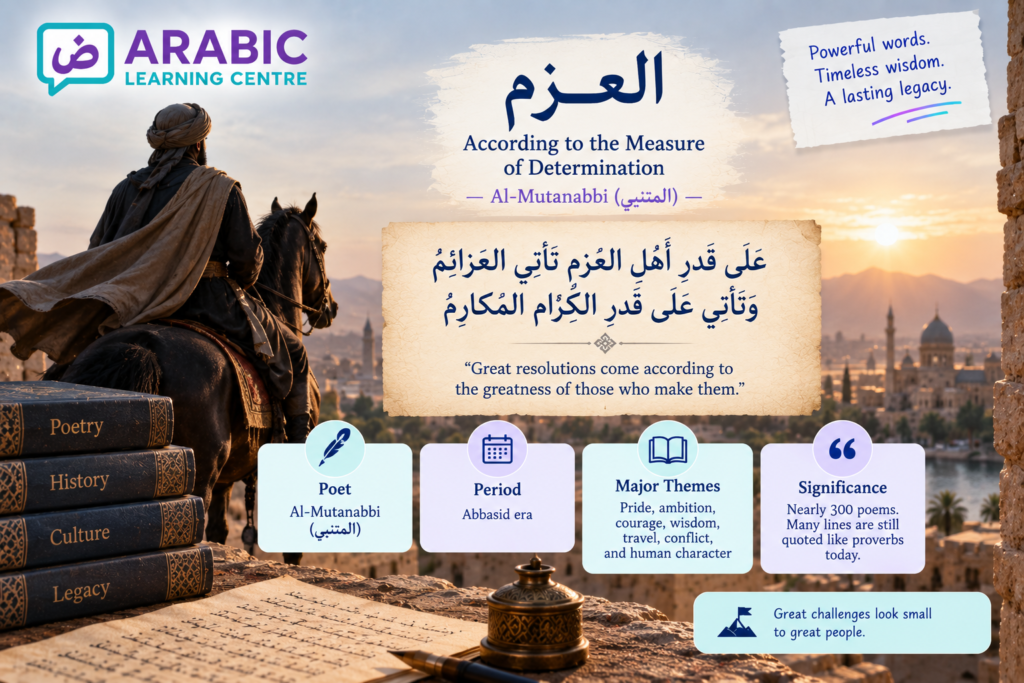
Among his most famous poems is the ode beginning:
عَلى قَدرِ أَهلِ العَزمِ تَأتي العَزائِمُ
وَتَأتي عَلى قَدرِ الكِرامِ المَكارِمُ
وَتَعظُمُ في عَينِ الصَغيرِ صِغارُها
وَتَصغُرُ في عَينِ العَظيمِ العَظائِمُ
The passage expresses a central idea in Al-Mutanabbi’s poetry: great people regard enormous challenges as manageable, while smaller challenges may appear enormous to those without the same determination.
Al-Mutanabbi’s nearly 300 poems helped establish his reputation as a master of Arabic verse. His work addressed themes ranging from courage and pride to friendship, separation, war, and death.
Students who want to appreciate poetry of this period will benefit greatly from a strong foundation in Arabic grammar, since classical poets frequently use sophisticated sentence structures, unusual word order, and grammatical constructions that may initially be difficult to recognize.

5. أراك عصي الدمع (I See You Refuse to Shed Tears) – Abu Firas al-Hamdani
The poem explores love, longing, pride, emotional restraint, and separation. The speaker appears outwardly strong and patient, but the poem gradually reveals the intensity of the emotion beneath that self-control.
English title: I See You Refuse to Shed Tears
Poet: Abu Firas al-Hamdani (أبو فراس الحمداني)
Period: Abbasid era
أَراكَ عَصِيَّ الدَمعِ شيمَتُكَ الصَبرُ
أَما لِلهَوى نَهيٌ عَلَيكَ وَلا أَمرُ
These opening words belong to one of the most recognizable poems of Abu Firas al-Hamdani.
This tension between dignity and vulnerability gives the poem much of its appeal. The poet is not simply describing romantic longing; he is struggling with the question of how much emotion a proud person should reveal.
For learners, أراك عصي الدمع offers an excellent example of how Arabic poetry can express complex emotional states through relatively short and carefully constructed lines.
Don’t Just Take Our Word For It
Take a look inside our vibrant classes and see our students and teachers in action. Click below to watch our classroom experience:
6. إرادة الحياة (The Will to Live) – Abu al-Qasim al-Shabbi
The poem centers on determination, freedom, hope, and the human desire to overcome oppression and despair. Images of night disappearing and chains breaking transform abstract ideas into vivid, easily remembered pictures.
English title: The Will to Live
Poet: Abu al-Qasim al-Shabbi (أبو القاسم الشابي)
Period: Modern
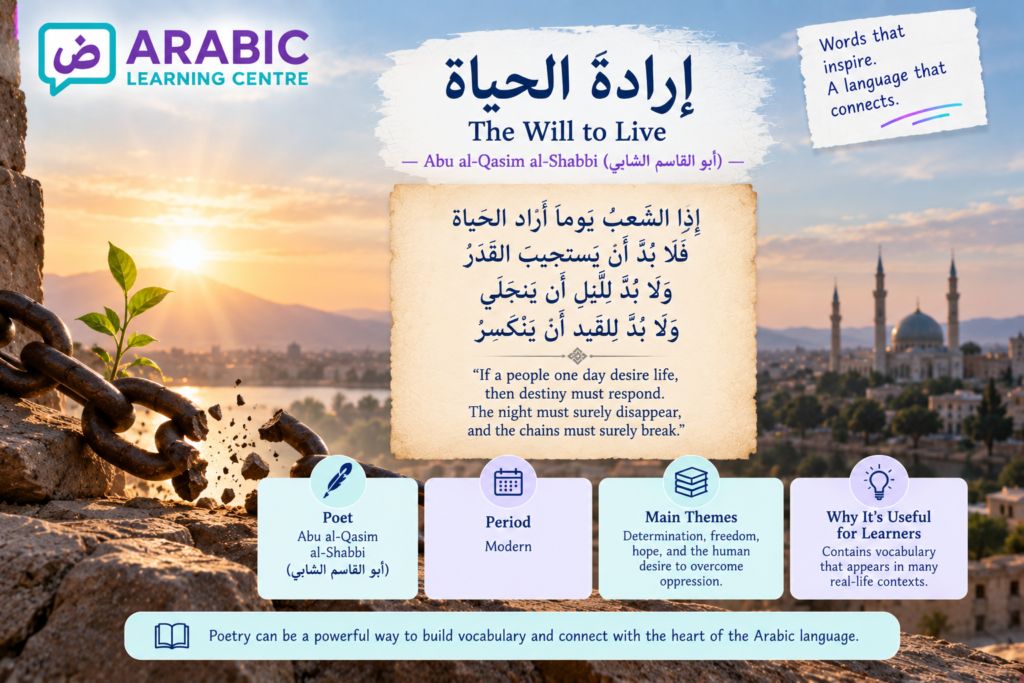
Few modern Arabic verses are as instantly recognizable as the opening of Al-Shabbi’s إرادة الحياة:
إِذا الشَعبُ يَوماً أَرادَ الحَياةَ
فَلا بُدَّ أَن يَستَجيبَ القَدَرْ
وَلا بُدَّ لِلَّيلِ أَن يَنجَلي
وَلا بُدَّ لِلقَيدِ أَن يَنكَسِرْ
This is one reason the poem is particularly useful for Arabic learners. Its best-known lines contain vocabulary that students can encounter in many other contexts, including الشعب (the people), الحياة (life), القدر (destiny), الليل (night), and القيد (chain or restraint).
Reading poetry can therefore become a form of vocabulary study rather than a separate literary exercise.
7. أحن إلى خبز أمي (I Long for My Mother’s Bread) – Mahmoud Darwish
Mahmoud Darwish is among the most internationally recognized modern Arabic poets. His work combines deeply personal experiences with larger themes of homeland, exile, memory, displacement, identity, and belonging.
English title: I Long for My Mother’s Bread
Poet: Mahmoud Darwish (محمود درويش)
Period: Modern
One of his most beloved poems begins:
أحنُّ إلى خبز أمي
وقهوة أمي
ولمسة أمي
The language is remarkably simple compared with much classical poetry. Yet ordinary things—bread, coffee, and a mother’s touch—become symbols of home, childhood, belonging, and emotional security.
That simplicity makes أحن إلى خبز أمي particularly suitable for Arabic learners. Students can recognize everyday vocabulary while observing how familiar words gain deeper meanings through context and repetition.
Darwish’s poetry often combines modern forms with elements of Arabic rhythm, and his themes frequently address Palestinian experience, exile, memory, and displacement.
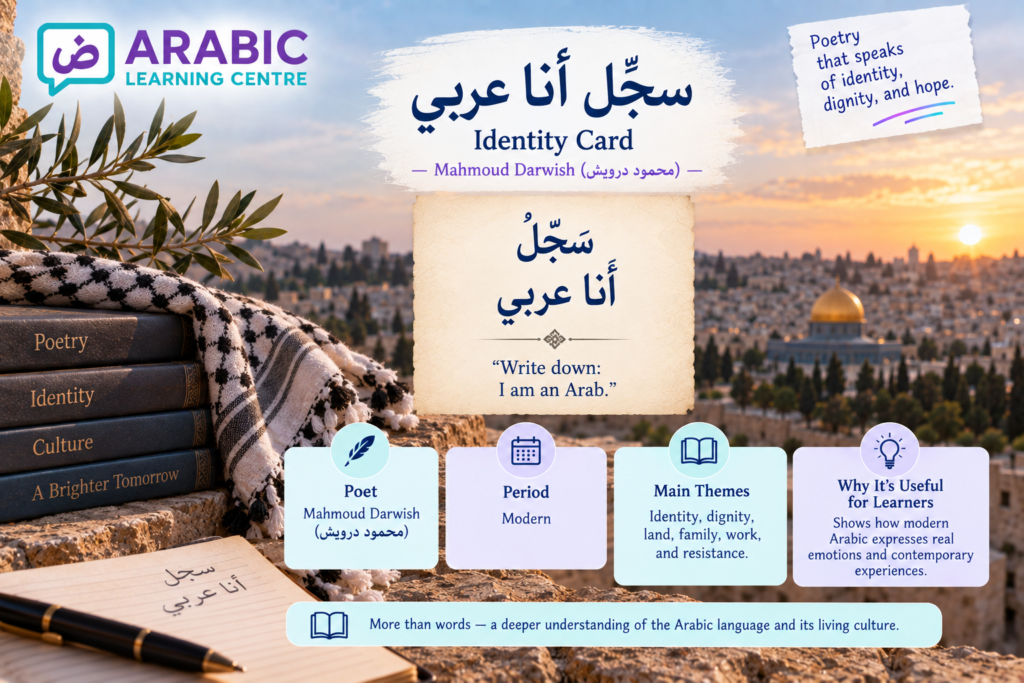
8. سجّل أنا عربي – Mahmoud Darwish
The poem develops around identity, dignity, land, family, work, and resistance. Its repeated imperative سجل—“write down” or “record”—gives the poem a direct, forceful voice.
English title: Identity Card / Write Down: I Am an Arab
Poet: Mahmoud Darwish (محمود درويش)
Period: Modern
Another of Darwish’s most famous Arabic poems is widely known by its repeated declaration:
سَجِّلْ
أنا عربي
The language also offers learners a useful example of how repetition can create rhythm without depending entirely on the structures associated with the traditional qasidah.
Darwish’s work demonstrates the enormous transformation Arabic poetry experienced during the modern period. Poetry could retain the musical qualities and imagery of Arabic while using new structures to respond to contemporary political and personal experiences.
For learners moving beyond textbook passages, reading poems like this can reveal how Arabic functions as a living language of identity and emotion rather than merely a collection of grammatical rules.
9. أحبك جدًا (I Love You So Much) – Nizar Qabbani
Throughout the poem, Qabbani uses recognizable natural images—wind, clouds, lightning, thunder, snow, fire, trees, rain, and the sea—to describe the distance and emotional intensity between two lovers.
English title: I Love You So Much
Poet: Nizar Qabbani (نزار قباني)
Period: Modern
Nizar Qabbani is one of the best-known modern Arabic poets, particularly for poetry about love, women, longing, intimacy, and relationships.
In أحبك جدًا, the repeated declaration of love becomes the emotional center of the poem:
أحبك جدًا
وأعرف أن الطريق إلى المستحيل طويل
Meaning:
“I love you so much,
and I know that the road to the impossible is long.”
For Arabic learners, Qabbani can provide a more accessible entry into poetry than many early classical poets. The sentences often resemble recognizable Modern Standard Arabic structures, while repetition helps readers follow the emotional development of the poem.
Learners can also copy a short passage and rewrite its ideas in their own words. Practising this way alongside an Arabic writing course can help students move from simply recognizing vocabulary to actively producing sentences and expressing ideas in Arabic.

10. أنشودة المطر (Rain Song) – Badr Shakir al-Sayyab
Badr Shakir al-Sayyab was one of the central figures in the development of modern Arabic free verse. His famous أنشودة المطر (Rain Song) shows just how far twentieth-century Arabic poetry had moved from the traditional structure of the classical qasidah.
English title: Rain Song
Poet: Badr Shakir al-Sayyab (بدر شاكر السياب)
Period: Modern
Rain becomes the poem’s central symbol. Rather than serving as simple background scenery, it is connected with sorrow, fertility, death, rebirth, homeland, poverty, and hope.
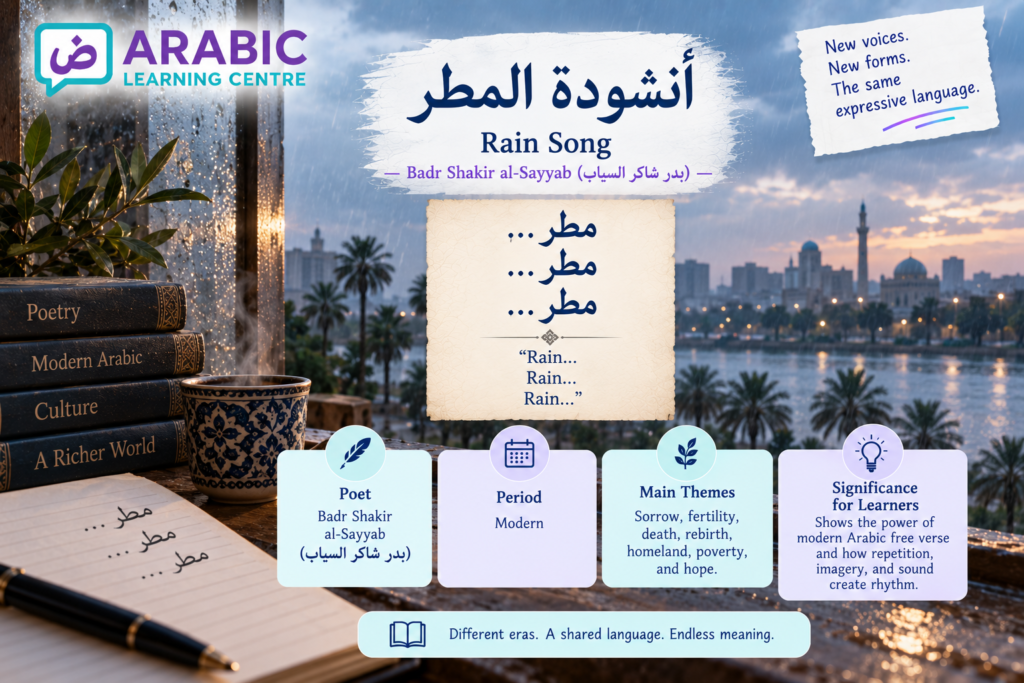
The repeated word:
مطر…
مطر…
مطر…
creates a powerful rhythm of its own.
For students, Rain Song is especially useful because it demonstrates that Arabic poetic musicality does not depend solely on the strict structure associated with older poems. Repetition, sound, imagery, and the arrangement of words can also establish rhythm.
Studying Al-Sayyab alongside poets such as Imru’ al-Qais and Al-Mutanabbi allows learners to see how dramatically Arabic poetry changed while continuing to draw strength from the same extraordinarily expressive language.
The Difference Between Classical and Modern Arabic Poetry
The main difference between classical and modern Arabic poetry lies in form, language, and style.
Classical Arabic Poetry
Classical poets such as Imru’ al-Qais, Antarah, Al-Khansa, and Al-Mutanabbi generally followed established meters and rhyme patterns.
Their poetry often uses older vocabulary, complex grammar, and dense imagery, which can make it challenging for Arabic learners.
Modern Arabic Poetry
Modern poets experimented more freely with poetic form. Some continued using traditional meter, while others adopted shi‘r al-taf‘ila (شعر التفعيلة) or prose poetry. The language can be closer to contemporary Arabic, although symbolism and metaphor may still make the poems challenging.
Which Is Better for Arabic Learners?
Both are valuable. Classical poetry introduces learners to the historical depth, vocabulary, and traditional structures of Arabic, while modern poetry offers exposure to more contemporary language and literary styles.
How Can Arabic Learners Study Famous Arabic Poetry?
Arabic learners do not need to understand every word on the first reading. Studying a poem gradually makes it easier to understand while turning it into useful language practice.
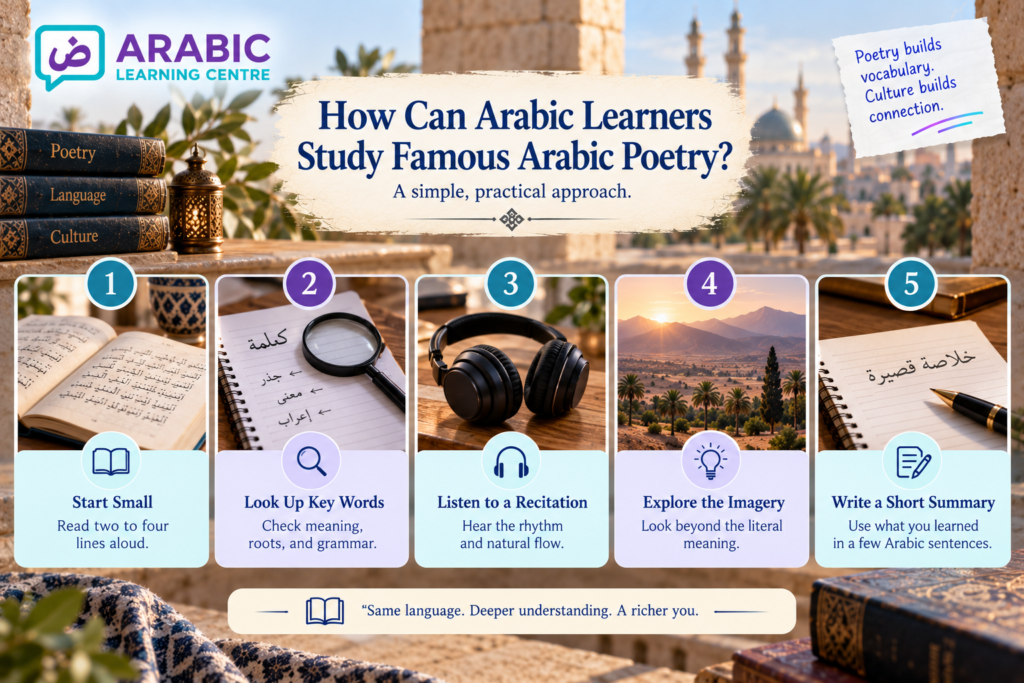
1. Start With Two to Four Lines Instead of Reading the Whole Poem
Choose a short passage and read it aloud several times. Identify the words you already recognize before looking up unfamiliar vocabulary.
2. Check Unfamiliar Vocabulary, Roots, and Grammar
Look at unfamiliar words, their roots, verb forms, pronouns, and grammatical relationships. Understand the literal meaning first before moving to the poem’s deeper imagery.
3. Listen to a Native Arabic Recitation to Hear the Poem’s Rhythm
Hearing the poem aloud makes rhyme, repetition, stress, and rhythm easier to recognize than reading it silently.
4. Look Beyond the Literal Meaning to Understand the Poet’s Imagery
Once the words are clear, consider why the poet chose particular expressions, comparisons, or images. Poetry often communicates more than its literal translation suggests.
5. Write a Short Arabic Summary to Practice What You Learned
Summarize the passage in three or four Arabic sentences. This turns passive reading into active practice and reinforces new vocabulary and grammatical structures.
Inside Our Classrooms
See how we make learning interactive and engaging! Watch a quick snippet of our live, conversational classes in action:
Learn Arabic Beyond the Poems With Arabic Learning Centre
Reading famous Arabic poems can introduce you to powerful vocabulary, grammar, imagery, and expressions, but understanding them becomes much easier when you have a strong foundation in the language itself.
At Arabic Learning Centre, learners can develop their Arabic reading, grammar, writing, vocabulary, and communication skills through structured lessons with experienced teachers.
As your Arabic improves, you can move beyond translations and begin understanding poems such as those of Al-Mutanabbi, Al-Shabbi, Darwish, and Qabbani directly in Arabic.
If your goal is to experience Arabic literature rather than simply read it in translation, start learning Arabic with Arabic Learning Centre and build the language skills you need to explore Arabic poetry with greater confidence.
Courses We Offer:
- Business Arabic Course
- Learn Arabic from Zero
- Medical Arabic Course
- Learning Arabic for Non Arabic Speakers
- Learn Arabic in Saudi Arabia
- Learn to Read Arabic Course

Conclusion
Famous Arabic poems offer much more than examples of beautiful writing. From the classical verse of Imru’ al-Qais, Antarah, Al-Khansa, and Al-Mutanabbi to the modern poetry of Mahmoud Darwish, Nizar Qabbani, Al-Shabbi, and Al-Sayyab, they show how Arabic has been used across centuries to express love, grief, courage, identity, hope, and belonging.
Arabic learners do not need to understand an entire poem at once. Start with a few lines, study the vocabulary and grammar, listen to the rhythm, and gradually move toward more challenging texts. With stronger Arabic skills, these poems become more than translated literary works—they become texts you can read, hear, and appreciate in their original language.
FAQs About Famous Arabic Poems
What Are Some of the Most Famous Arabic Poems?
Some famous Arabic poems include قفا نبك by Imru’ al-Qais, معلقة عنترة by Antarah ibn Shaddad, على قدر أهل العزم by Al-Mutanabbi, إرادة الحياة by Abu al-Qasim al-Shabbi, and أنشودة المطر by Badr Shakir al-Sayyab. Modern poetry by Mahmoud Darwish and Nizar Qabbani is also widely read.
What Is the Most Famous Classical Arabic Poem?
The Mu‘allaqa of Imru’ al-Qais is one of the best-known works of classical Arabic poetry. Its famous opening, قِفا نَبكِ مِن ذِكرى حَبيبٍ وَمَنزِلِ, is among the most recognizable lines in the Arabic poetic tradition.
Is Arabic Poetry Good for Learning Arabic?
Yes. Arabic poetry can help learners expand their vocabulary, recognize grammatical structures, improve pronunciation, and understand how words create rhythm and imagery. Beginners should start with short and relatively accessible passages rather than trying to understand complete classical poems immediately.
Is Classical or Modern Arabic Poetry Easier for Learners?
Modern Arabic poetry can sometimes be easier because its vocabulary and sentence structures may be closer to contemporary Arabic. Classical poetry often contains older vocabulary, unusual word order, and complex grammatical constructions. However, modern poems can still be challenging because of symbolism and metaphor.
Which Arabic Poets Should Beginners Read?
Learners may find selected works by Mahmoud Darwish, Nizar Qabbani, and Abu al-Qasim al-Shabbi more approachable than many pre-Islamic poems. The best starting point depends on the learner’s Arabic level, so beginning with a few lines rather than an entire poem is usually more effective.
How Can I Understand Arabic Poetry Without Translation?
Build your Arabic reading, vocabulary, and grammar skills first, then study poems in short sections. Identify familiar words, analyze unfamiliar vocabulary and roots, listen to native recitations, and compare your understanding with a reliable explanation. As your Arabic improves, you can rely less on English translation and engage more directly with the original poem.
Related Articles
Arabic Resources & Courses