 Learn Arabic
The kitchen table has always been where language comes alive. A steaming plate of كُسْكُسِي (kuskusi) or a simple loaf of خُبْز (khubz) carries stories, family history, and daily ritual long before it carries flavor for a learner encountering Arabic for the first time.
Understanding food in the Arabic language opens a direct path into everyday conversation, hospitality customs, and the root and pattern system that underlies so much of Arabic vocabulary. This article breaks down essential food terms, correct pronunciation, grammatical gender, morphology, and practical phrases for ordering and discussing meals.
Essential Arabic Food Vocabulary Every Beginner Learner Should Master
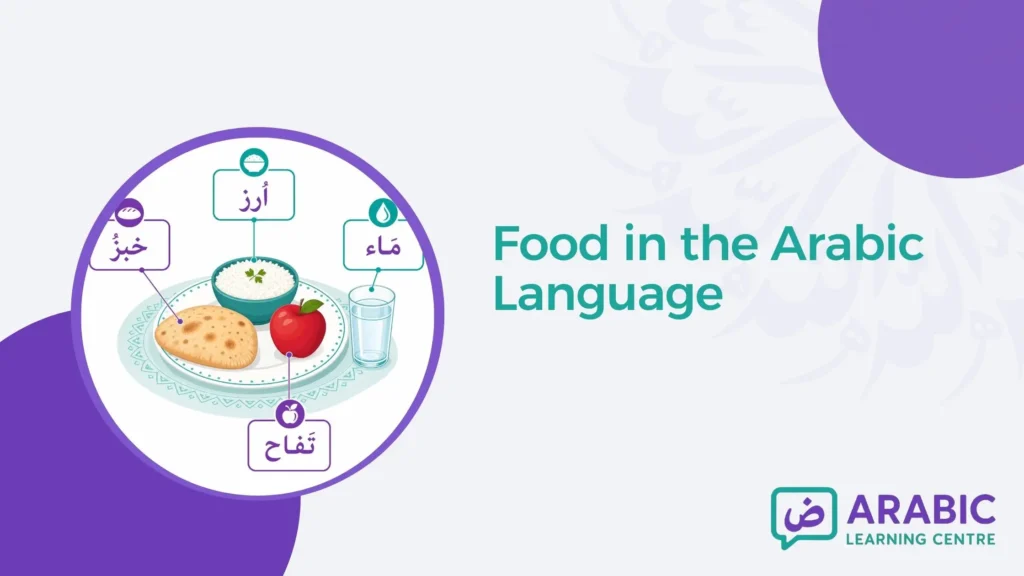
The single most useful category of food in Arabic language study is the set of everyday staple words used in nearly every household and restaurant across the Arab world. These words appear constantly in beginner textbooks and daily speech.
Bread, rice, and water form the backbone of most meals discussed in Modern Standard Arabic and colloquial dialects alike. Mastering these first gives learners immediate conversational traction.
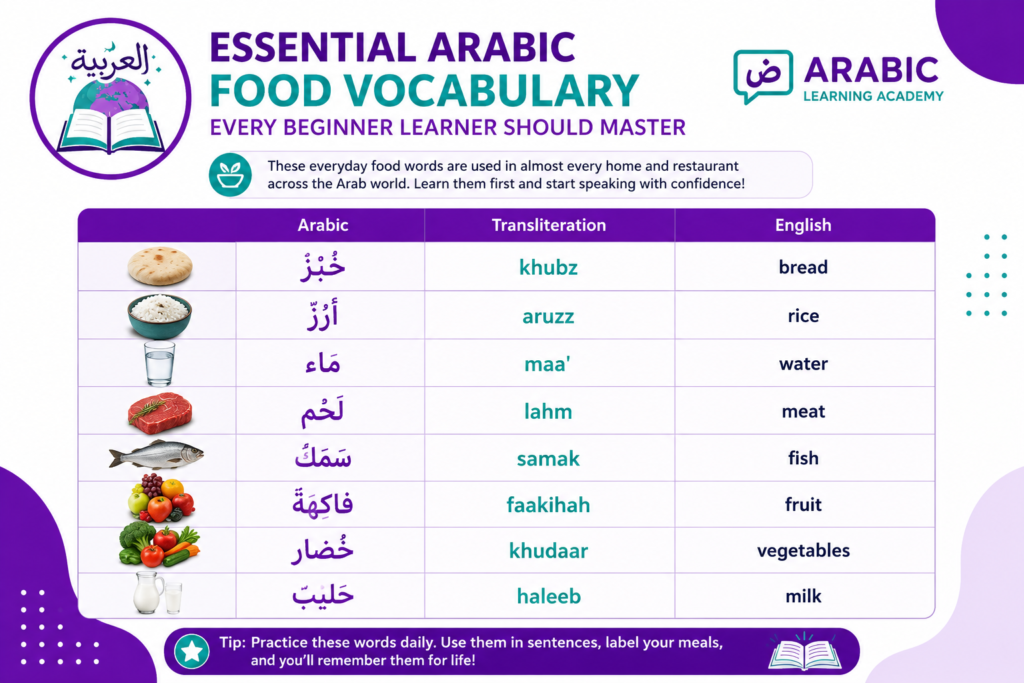
Beginners often try to memorize these words in isolation, without a system, which slows retention. The Arabic Learning Centre’s Arabic Vocabulary Course groups food terms by theme and root family, so learners build lasting recall rather than short-term memorization.
Book Your Free Trial for Arabic Vocabulary Course Now!
Common Beginner Mistakes With Basic Food Terms
New learners frequently confuse سَمَك (samak, fish) with سَمِيك (sameek, thick), since the words differ only by a short vowel and a doubled consonant. Careful attention to harakat prevents this error.
Another frequent slip is pronouncing لَحْم (lahm, meat) without the guttural quality of the letter ح, softening it into an English “h” sound that changes the word’s identity entirely.
Inside Our Classrooms
See how we make learning interactive and engaging! Watch a quick snippet of our live, conversational classes in action:
Correct Pronunciation of Arabic Food Words for Non-Native Speakers
Accurate pronunciation of Arabic food vocabulary hinges on mastering three sounds absent from English: ح (ha), ع (ain), and ق (qaf). These appear constantly in food-related terms and shape meaning precisely.
The letter ع, found in words like عَصِير (aseer, juice), is a voiced pharyngeal sound produced by constricting the throat. English speakers often substitute a glottal stop, which native listeners immediately notice.
Phonetic Comparisons for English Speakers
Consider قَهْوَة (qahwah, coffee). The ق is a uvular stop, articulated further back in the throat than the English “k.” Substituting a standard “k” sound produces كَهْوَة, which is not a recognized word but sounds distractingly foreign to native ears.
Similarly, عَسَل (asal, honey) requires the pharyngeal ع at the start. Learners who replace it with a simple vowel sound produce أَسَل, altering the word beyond recognition for native listeners.
Consistent, guided pronunciation drilling closes this gap far faster than self-study alone. The Arabic Learning Centre’s Arabic Speaking Course pairs learners with native tutors who correct these throat-based sounds in real time, using food vocabulary as practical drilling material.
Book Your Free Trial for Arabic Speaking Course Now!

Grammatical Gender Rules for Arabic Food Nouns and Common Learner Mistakes
Every Arabic noun carries grammatical gender, and food vocabulary is no exception. Most food nouns ending in ة (taa marbuta) are feminine, while nouns without this ending default to masculine unless otherwise specified.
تُفَّاحَة (tuffahah, an apple) is feminine due to its ة ending, while خُبْز (khubz, bread) is masculine with no visible marker. This distinction affects every adjective and verb agreement attached to the noun.
Gender Agreement Errors Learners Commonly Make
A frequent mistake is pairing a feminine food noun with a masculine adjective, producing phrases like تُفَّاحَة كَبِير instead of the correct تُفَّاحَة كَبِيرَة (a large apple). The adjective must mirror the noun’s gender exactly.
| Arabic Noun | Gender | Correct Adjective Form | Meaning |
| تُفَّاحَة | Feminine | كَبِيرَة | a large apple |
| خُبْز | Masculine | كَبِير | large bread |
| بَيْضَة | Feminine | صَغِيرَة | a small egg |
| رُزّ | Masculine | لَذِيذ | delicious rice |
This kind of agreement error is one of the most common issues instructors correct in early lessons. The Arabic Grammar Course at The Arabic Learning Centre dedicates focused practice to noun-adjective agreement, using familiar food vocabulary as low-pressure, high-repetition drilling material.
Book Your Free Trial for Arabic Grammar Course Now!

Root and Pattern System Behind Common Arabic Food Terms
Arabic morphology organizes almost every word around a three-letter root that carries core meaning, then applies patterns to generate related words. Food vocabulary offers some of the clearest, most memorable examples of this system.
The root ط-ب-خ relates to cooking. From it comes طَبَخَ (tabakha, he cooked), طَبَّاخ (tabbaakh, a cook), and مَطْبَخ (matbakh, a kitchen), each sharing the same three consonants in a different pattern.
Applying Root Recognition to Expand Vocabulary Quickly
Once a learner recognizes the root ح-ل-و, related to sweetness, words like حَلْوَى (halwa, sweets), حُلْو (hulw, sweet), and حَلَاوَة (halaawah, sweetness) become predictable rather than isolated items to memorize separately.
This pattern recognition dramatically accelerates vocabulary acquisition once learners internalize it. Instead of memorizing hundreds of unrelated words, students learn root families and predict new vocabulary confidently.
The Arabic Vocabulary Course structures lessons explicitly around root families, so students studying food in Arabic language contexts also gain transferable skills for cooking, agriculture, and hospitality vocabulary.
Everyday Phrases for Ordering and Discussing Food in Arabic
Practical, conversational fluency around food requires more than vocabulary lists. Learners need functional phrases for ordering, expressing preference, and describing taste in real situations at markets, restaurants, and family gatherings.
A foundational phrase every learner should master is أُرِيدُ أَكْلَ الطَّعَامِ (ureedu akla at-ta’aam), meaning “I want to eat food,” useful as a flexible sentence frame for building more specific requests.
Useful Restaurant and Market Phrases
- مَا هَذَا الطَّبَق؟ (maa hadha at-tabaq?) — “What is this dish?”
- أَنَا جَائِع (ana jaa’i’) — “I am hungry”
- هَلْ يُوجَد لَحْم فِي هَذَا؟ (hal yujad lahm fi hadha?) — “Is there meat in this?”
- هَذَا لَذِيذ جِدًّا (hadha ladheedh jiddan) — “This is very delicious”
These phrases give learners immediate, usable tools for real hospitality settings, whether traveling, dining with Arabic-speaking friends, or studying abroad. Building confidence with functional phrases like these is precisely what the Arabic Speaking Course at The Arabic Learning Centre targets, moving students from memorized vocabulary to natural conversation.
Regional Variations in Arabic Food Vocabulary Across the Arab World
Modern Standard Arabic provides a shared foundation, but everyday food vocabulary varies meaningfully across regional dialects. A learner prepared only with Fusha vocabulary may encounter unfamiliar terms in casual settings.
طَمَاطِم (tamaatim, tomatoes) in Modern Standard Arabic becomes بَنَدُورَة (banadoura) in Levantine dialects and مَطِيشَة (matisha) in some Maghrebi dialects, despite referring to the same vegetable.
Why Fusha Vocabulary Remains the Right Foundation
Despite dialectal variation, Modern Standard Arabic vocabulary remains understood across the entire Arabic-speaking world, making it the correct starting point for structured, transferable learning. Dialect exposure builds naturally afterward through real conversation.
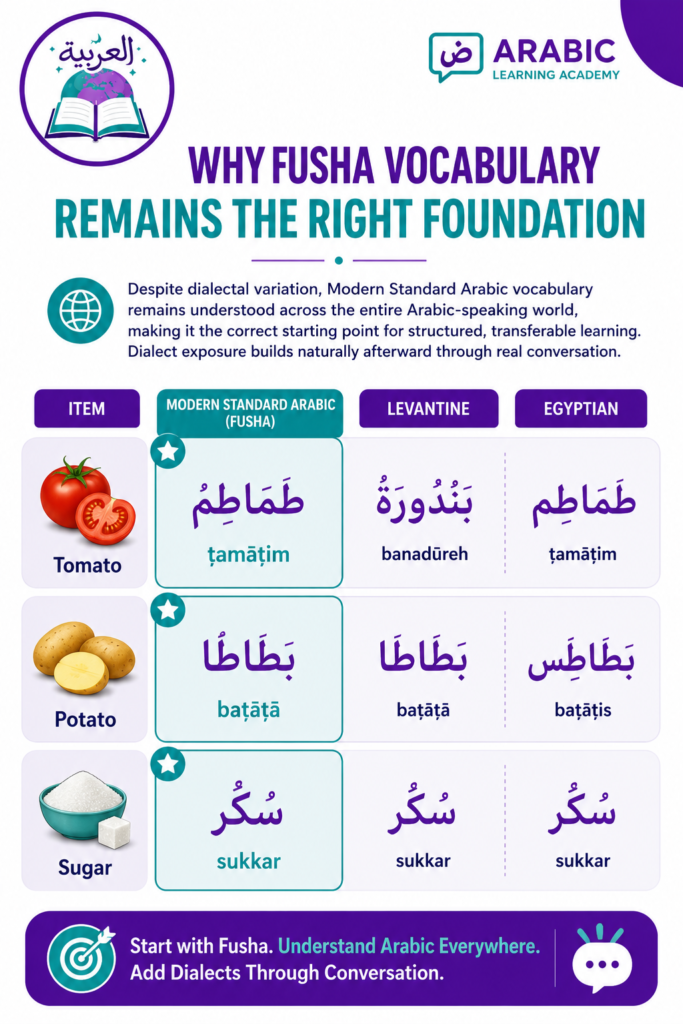
The Fusha Arabic Course builds this exact foundation first, giving learners a stable base of standard vocabulary before dialect exposure adds regional color and nuance to their spoken Arabic.
Book Your Free Trial for Fusha Arabic Course Now!

Structured Practice Routine for Mastering Arabic Food Vocabulary
Retention of food vocabulary, like all Arabic vocabulary, depends heavily on spaced repetition and active recall rather than passive reading. A structured weekly routine produces measurably better results than sporadic study sessions.
Effective learners review new food terms daily for the first week, then space reviews to every three days, then weekly, reinforcing each word through writing, speaking, and listening exercises rather than reading alone.
A Sample Weekly Practice Schedule
Dedicate ten minutes daily to flashcard review, followed by writing five sentences using new food vocabulary in context. Speaking the sentences aloud reinforces pronunciation and cements the connection between script, sound, and meaning.
| Day | Activity | Focus |
| Monday | Flashcard review | New vocabulary |
| Wednesday | Sentence writing | Grammar application |
| Friday | Speaking practice | Pronunciation |
| Sunday | Root family review | Morphology |
This kind of structured, cumulative routine mirrors what students receive inside The Arabic Learning Centre’s live sessions, where native tutors reinforce each week’s vocabulary through spoken review before introducing new material.
Don’t Just Take Our Word For It
Take a look inside our vibrant classes and see our students and teachers in action. Click below to watch our classroom experience:
Begin Your Arabic Language Journey With Expert Guidance at The Arabic Learning Centre
Mastering food in Arabic, from vocabulary and pronunciation to grammar and root families, becomes far more achievable with structured, expert guidance rather than scattered self-study alone.
The Arabic Learning Centre offers:
- Native Arabic tutors guiding pronunciation and grammar from day one
- A structured curriculum spanning beginner to advanced levels
- Live sessions combined with recorded materials for flexible review
- Scheduling across global time zones at accessible pricing
Courses We Offer:
- Business Arabic Course
- Learn Arabic from Zero
- Medical Arabic Course
- Learning Arabic for Non Arabic Speakers
- Learn Arabic in Saudi Arabia
- Learn to Read Arabic Course
- Arabic Grammar Course
- Arabic Speaking Course
- Arabic Script writing course
- Arabic Vocabulary Course
- Arabic Pronunciation Course
Book your free trial today and start speaking with confidence.
Book your free trial lesson today!

Conclusion
Food in Arabic connects learners to daily life, hospitality, and morphology all at once. Vocabulary, gender rules, and pronunciation each shape confident, accurate communication.
Root and pattern recognition transforms isolated food words into predictable families. Regional dialect variation adds richness once a strong Modern Standard Arabic foundation exists.
Structured, guided practice consistently outperforms unstructured self-study for lasting retention. Expert instruction accelerates every stage of this rewarding language journey.
Frequently Asked Questions
What is the general word for food in Arabic?
The general word for food in Arabic is طَعَام (ta’aam), used across Modern Standard Arabic and most dialects. It functions as a broad, uncountable noun covering meals, dishes, and edible items collectively.
طَعَام appears constantly in daily speech, from restaurant menus to casual conversation. A related, more specific term, أَكْل (akl), refers to the act of eating or food more informally, and the two are often used interchangeably in spoken Arabic.
Is bread masculine or feminine in Arabic?
خُبْز (khubz, bread) is grammatically masculine in Arabic, since it lacks the taa marbuta ة ending that typically signals feminine nouns. Adjectives and verbs describing bread must agree in the masculine form.
This matters directly for sentence accuracy: خُبْز طَازَج (khubz taazaj, fresh bread) uses the masculine adjective form, while the same adjective applied to a feminine noun like خُبْزَة would require طَازَجَة instead.
How many words exist for meat in Arabic dialects?
Modern Standard Arabic uses لَحْم (lahm) as the standard word for meat, understood across every Arabic-speaking region. Regional dialects rarely replace this term, though pronunciation and surrounding vocabulary can shift noticeably.
Compound terms built from لَحْم specify type, such as لَحْم بَقَر (lahm baqar, beef) and لَحْم غَنَم (lahm ghanam, lamb), following a consistent noun-plus-noun construction pattern.
Why does Arabic food vocabulary vary so much between dialects?
Arabic food vocabulary varies because dialects absorbed local, Ottoman, French, and Berber influences differently across regions over centuries, while Modern Standard Arabic preserved a shared, standardized layer used in writing, media, and education everywhere.
Learners who master Modern Standard Arabic first gain a stable reference point, making dialect variations easier to recognize as regional substitutions rather than confusing, unrelated new vocabulary.