 Arabic Alphabet & Writing
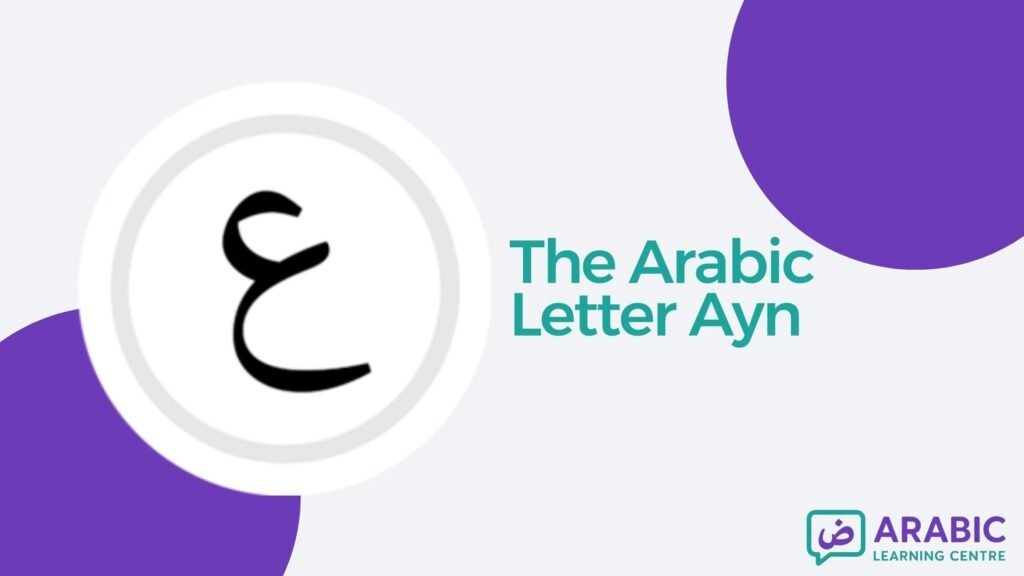
The Arabic alphabet is one of the richest writing systems in the world, and each letter carries its own beauty, sound, and meaning. Among these letters is the letter ʿAyn (ع), which is the 18th letter of the Arabic alphabet. It has a unique sound that does not exist in English and can be challenging for beginners to pronounce, but with practice, it becomes an essential part of mastering Arabic reading, writing, and speaking.
Learning the letter Ayn (ع) is very important for students of Arabic, as it appears frequently in the Qur’an, daily speech, and modern texts. In this article, we will explore the definition, forms, pronunciation, and usage of the letter ع, along with examples, exercises, and worksheets that will make learning both effective and enjoyable.
Letter Ayn – ع
The letter ʿAyn (ع) is the 18th letter of the Arabic alphabet. It represents a voiced pharyngeal sound that is unique to Arabic and some other Semitic languages. Unlike many letters, the sound of ع does not have a direct equivalent in English, which makes it a special and distinctive feature of Arabic pronunciation.
In terms of its characteristics, the letter ع is:
– Consonant (حرف ساكن).
– Voiced (مجهور).
– Pharyngeal (يُخرج من الحلق الأوسط).
It can carry all Arabic short vowels (Fatha, Dammah, Kasrah, Sukoon) and can also appear with Tanween or Shaddah.
This letter holds a significant role in Arabic words, as it often appears in the beginning, middle, and end of words, giving flexibility to the structure of Arabic vocabulary.
How to Identify The letter Ayn – ع

The letter ʿAyn (ع) can be identified easily once you become familiar with its unique shape and sound. It has two main written forms: ع (when it comes alone or at the end of a word without connection) and عـ / ـعـ / ـع (when it is connected to other letters at the beginning, middle, or end).
Key points to help you identify ع:
1- Shape:
It looks like a small curved “hook” or a rounded open curve, which changes slightly depending on its position in the word.
2- Dot:
Unlike similar letters such as غ (Ghayn), the letter ع has no dot above or below it.
3- Sound:
The sound of ع is produced from the middle of the throat, with a voiced deep tone that is distinct from any English sound.
4- Position Flexibility:
It can appear at the beginning, in the middle, or at the end of words, always adapting its shape while keeping its identity clear.
By paying attention to these features, learners can easily recognize ع in texts and distinguish it from similar letters.
Letter Ayn and ع Forms: At the Beginning, Middle, and End of the word
The letter ʿAyn (ع) changes its written form depending on where it appears in the word. Like many Arabic letters, it has four shapes: isolated, initial, medial, and final. Understanding these forms is essential for reading and writing Arabic correctly.
1- Isolated (منفصل): ع
2- Initial (في أول الكلمة): ,عـ Example: عَسل (honey)
3- Medial (في وسط الكلمة):ـعـ, Example: مَعرِفة (knowledge)
4- Final (في آخر الكلمة): ـع, Example: شَمع (candle)
The basic curve of the letter remains the same, but the connections before or after it change how it looks. With practice, learners will quickly recognize how ع blends smoothly with other letters in different word positions.

Start your Arabic journey today with Arabic Learning Centre! Flexible online classes, step-by-step guidance, and fun lessons tailored to your needs.
Shots Videos from Our Courses
Letter Ayn/ ع With Fatha ( َ )

When the letter ʿAyn (ع) carries a Fatha ( َ ), it is pronounced as “ʿA” with a short “a” sound, similar to the a in apple, but starting from the throat because of the special sound of ع.
Form and Pronunciation:
– عَ = ʿA
– Example sound: ʿA
Examples:
1- عَسل (ʿasal – honey) → here the letter comes at the beginning.
2- مَعَ (maʿa – with) → here the letter is in the middle.
3- وَداعَ (wadaʿa – farewell) → here the letter is at the end.
Open your mouth slightly and let the sound come from the middle of your throat while keeping it short and clear.
Letter Ayn / ع With Dammah ( ُ )

When the letter ʿAyn (ع) carries a Dammah ( ُ ), it is pronounced as “ʿU” with a short “u” sound, similar to the “oo” in book, but beginning from the throat.
Form and Pronunciation:
– عُ = ʿU
– Example sound: ʿU
Examples:
1- عُمر (ʿUmar – a common Arabic name) → beginning.
2- مَعُونة (maʿūnah – assistance) → middle.
3- رُكوعُ (rukūʿu – bowing in prayer) → end.
To pronounce it correctly, round your lips slightly while producing the voiced sound deep from the throat.
Letter Ayn/ ع With Kasrah ( ِ )
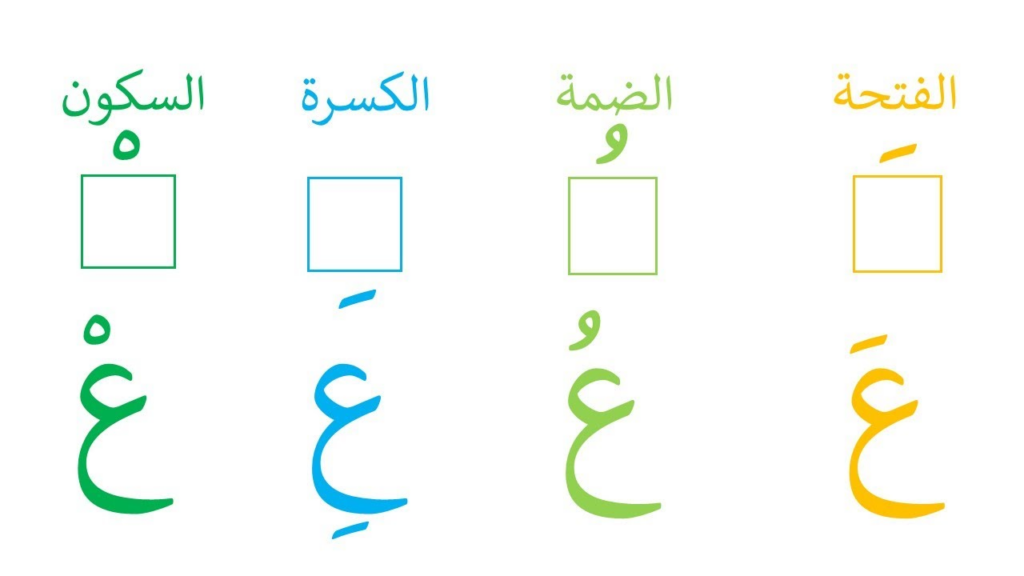
When the letter ʿAyn (ع) carries a Kasrah ( ِ ), it is pronounced as “ʿI” with a short “i” sound, similar to the “i” in sit, but the sound starts deep from the throat.
Form and Pronunciation:
– عِ = ʿI
– Example sound: ʿI
Examples:
1- عِلم (ʿilm – knowledge) → beginning.
2- مَعِدة (maʿidah – stomach) → middle.
3- أوجاعِ (awjāʿi – pains) → end.
Keep your mouth slightly closed, smile gently, and produce the “i” sound clearly from the throat without making it long.
Letter Ayn/ ع With sukoon ( ْ )

When the letter ʿAyn (ع) carries a Sukoon ( ْ ), it becomes silent and joins smoothly with the letter before it, without any vowel sound. This form is important in Arabic because it helps create natural pauses and proper word flow.
Form and Pronunciation:
– عْ = ʿ (no vowel sound, just the throat consonant)
– The sound stops quickly in the throat without adding a, u, or i.
Examples:
1- يَسمَعْ (yasmaʿ – he listens) → end.
2- مَعْنى (maʿnā – meaning) → middle.
3- اِقطَعْ (iqṭaʿ – cut!) → end with command.
When pronouncing عْ, stop the sound suddenly in your throat. Make sure not to add any extra vowel.
Examples of letter Ayn/ ع in Words
The letter ʿAyn (ع) appears very frequently in Arabic words. It can occur at the beginning, middle, or end of a word. Each position has a slightly different shape, but the sound remains the same: a voiced pharyngeal sound from the throat. Recognizing ع in different positions helps learners improve both reading fluency and pronunciation.
Here are some examples:
| Position | Arabic Word | Pronunciation | English Meaning |
| At the beginning | عَين / عُمر / عِلم | ʿAyn / ʿUmar / ʿIlm | Eye / Omar (name) / Knowledge |
| In the middle | مَعَ / مَعُونة / مَعِدة | Maʿa / Maʿūnah / Maʿidah | With / Assistance / Stomach |
| At the end | شَمع / وداعَ / سَمِعْ | Shamaʿ / Wadaʿa / Samiʿ | Candle / Farewell / He heard |
Tip for learners: When practicing, highlight ع in different words to train your eyes to spot it quickly and your ears to pronounce it correctly, no matter where it appears in the word.

Examples of letter Ayn/ ع in Phrases and Sentences
After practicing ʿAyn (ع) in single words, it is very important to see it in full phrases and sentences. This helps learners understand how the letter flows naturally in speech and connects with other letters. The sound of ع often adds depth to the meaning and is very common in both classical and modern Arabic.
Here are some examples:
| Position | Arabic Phrase / Sentence | English Meaning |
| At the beginning | عَلى الطاولة | On the table |
| In the middle | هو مَعَه أصدقائه | He is with his friends |
| At the end | استمِعْ جيّدًا | Listen carefully |
Tip for learners: Practice reading these sentences aloud. Notice how ع blends smoothly with surrounding words and strengthens your pronunciation when used in connected speech.
How to write the Ayn Letter?
The ʿAyn (ع) is a unique Arabic letter that changes its shape depending on its position in the word (beginning, middle, or end). Unlike Alif, it has a curved shape that opens and flows smoothly into the letters before or after it. Writing ع requires careful attention to the curves so it remains clear and distinct from similar letters like غ (Ghayn).
Steps to Write Ayn (ع):
1- Starting point: Begin slightly above the baseline with a small curved stroke.
2- Curve downward: Draw a half-circle or hook shape that opens upward.
3- Connect (if needed): Extend the line smoothly to connect with the following or previous letter.
4- Final stroke: If it is isolated or final, extend the curve downward to rest on the baseline.

Important notes:
– Shape variation: The letter ع changes shape depending on whether it is isolated, initial, medial, or final.
– No dots: Unlike غ, the letter ع has no dot above or below.
– Flow: Always write the letter in a smooth, continuous motion to keep it connected naturally within words.
How to Pronounce the Letter Ayn?
The pronunciation of ʿAyn (ع) is one of the most distinctive and unique features of the Arabic language. Its sound does not exist in English, which makes it challenging for learners, but with practice, it becomes natural. The articulation point of ع is from the middle of the throat (وسط الحلق), and it is a voiced pharyngeal sound that resonates deeply.
In Qur’anic recitation and Arabic speech, ع is always pronounced clearly, whether it carries a short vowel (Fatha, Dammah, Kasrah) or a Sukoon. It never acts as a long vowel by itself, but rather as a consonant that joins with vowels to create the correct syllable.

Basic pronunciation rules:
1- ʿAyn with Fatha (عَ):
Pronounced as ʿA, a short “a” sound with throat emphasis.
Example: عَلم (ʿalam – flag).
2- ʿAyn with Dammah (عُ):
Pronounced as ʿU, a short “u” sound with rounded lips.
Example: عُمر (ʿUmar – name).
3- ʿAyn with Kasrah (عِ):
Pronounced as ʿI, a short “i” sound with the mouth slightly smiling.
Example: عِلم (ʿilm – knowledge).
4- ʿAyn with Sukoon (عْ):
The sound stops suddenly in the throat without a vowel.
Example: يَسمَعْ (yasmaʿ – he listens).
Tips for learners:
– Practice in front of a mirror to notice how your throat tightens slightly when pronouncing ع.
– Record yourself and compare with native speakers.
– Don’t confuse ع with ء (Hamzah) — the Hamzah comes from the lowest throat area, while ʿAyn comes from the middle throat.
Learn Ayn through videos
Learning the Arabic letter ʿAyn (ع) through videos can significantly boost your understanding and retention. Videos offer a multi-sensory learning experience—you can see the shape, hear the pronunciation, and watch how the letter is written step by step.
Here are two excellent YouTube videos that explain the letter ʿAyn (ع) clearly and effectively:
1- How To Pronounce Arabic Alphabet Correctly | Ayn & Ghayn | Arabic Alphabet Lesson 7 | Ismail Alqadi This video offers a deep and detailed explanation of how to pronounce ʿAyn, including practical examples and pronunciation exercises. It’s great for mastering the throat articulation.
2- Ayn (ع) & Ghayn (غ) | Learn How To Read Quran – Lesson 7 This lesson not only introduces the pronunciation of ʿAyn, but also compares it to the similar letter Ghayn (غ), helping learners distinguish between the two both visually and phonetically.
Exercises for the letter Ayn in Arabic
Practicing is the best way to master the Arabic letter ʿAyn (ع). These exercises will help you recognize, write, and pronounce ʿAyn correctly in different positions of a word.
1. Identify the Letter Ayn
Circle the letter ʿAyn (ع) in the words below:
– عنب
– معرض
– معلم
– ساعة
2. Write Ayn in Different Positions
Write the letter ʿAyn in:
– Beginning position: عـ
– Middle position: ـعـ
– End position: ـع
– Isolated form: ع
3. Match the Word to Its Picture
Draw a line between each word and the correct picture:
– عنب 
– عين 
– ساعة 
4. Fill in the Missing Letter
Complete the words by adding the missing ʿAyn (ع):
1- __نب (Grapes)
2- سا__ة (Clock)
3- م__لم (Teacher)
4- ___ين (Eye)
5. Read Aloud
Read these words slowly, paying attention to the deep sound of ʿAyn:
– علم (Knowledge)
– عسل (Honey)
– شارع (Street)
– طمع (Greed)
Repeat these exercises daily until you can spot ʿAyn instantly, write it in all its forms, and pronounce it clearly.
Downloadable Worksheets for the Arabic letter Ayn
To make learning fun and effective, we’ve created printable worksheets for the Arabic letter ʿAyn (ع). These worksheets will help students practice recognizing, writing, and using the letter in words and sentences through interactive activities. Perfect for classroom and home learning.
Download the worksheets here:
– My Resource Station: ʿAyn Worksheet – Colour, Trace, and Write → a printable PDF to practice writing and recognizing the letter ʿAyn in different positions.
– Arabic Seeds (Islamic-themed): Provides coloring and tracing worksheets for each letter, including ʿAyn, along with pronunciation audio files for memorization and enhanced learning.
Read Also: The Letter Zay / ز in Arabic With Examples, Exercises, and Worksheets
Common Mistakes related to the letter Ayn
Even though the Arabic letter ʿAyn (ع) is one of the most important and frequently used letters, many beginners struggle with it. Understanding these mistakes will help you avoid them and improve your Arabic skills faster.
1. Confusing ʿAyn (ع) with Ghayn (غ)
Mistake: Writing ع with a dot above it or confusing its sound with غ.
Correction: Remember that ʿAyn (ع) has no dot, while Ghayn (غ) has one dot above.
| Feature | ʿAyn (ع) | Ghayn (غ) |
| Dot | None | One dot above |
| Sound | Voiced from the middle throat | Voiced from the upper throat, with a buzzing sound |
| Examples | علم (ʿilm – knowledge) | غيم (ghaym – cloud) |
Read Also: The Letter Taa / ت In Arabic With Examples, Exercises, and Worksheets
2. Mispronouncing ʿAyn as Hamzah (ء)
Mistake: Many learners replace ع with a glottal stop like ء because they can’t produce the throat sound.
Correction: Hamzah (ء) comes from the bottom of the throat, while ʿAyn (ع) is produced from the middle throat with a voiced sound.
Read Also: The Letter Haa هـ In Arabic With Examples, Exercises, and Worksheets
3. Forgetting the Different Forms of ʿAyn in Words
Mistake: Writing the same form of ع everywhere instead of adapting it to beginning, middle, or end positions.
Correction:
– Beginning: عـ → عَسل (ʿasal – honey)
– Middle: ـعـ → مَعِدة (maʿidah – stomach)
– End: ـع → شَمع (shamaʿ – candle)
Read Also: The Letter Saad / ص in Arabic With Examples, Exercises, and Worksheets
4. Weak Pronunciation of ʿAyn
Mistake: Pronouncing ع too lightly, making it sound like a normal vowel without throat emphasis.
Correction: Practice pressing your throat slightly when pronouncing ع, especially in words like عَين (ʿayn – eye).
Read Also: The Letter Seen / س in Arabic With Examples, Exercises, and Worksheets
5. Adding Extra Vowels to Sukoon (عْ)
Mistake: Beginners sometimes add an unintended vowel after عْ.
Correction: With Sukoon, the sound must stop immediately. Example: يَسمَعْ (yasmaʿ – he listens).
Tip for learners: Always practice ع in front of a mirror or record your voice. Compare your sound with native speakers until you can feel the throat vibration clearly.
Read Also: The Letter Khaa / خ in Arabic With Examples, Exercises, and Worksheets
Our Students Reviews
Start Your Arabic Learning Journey with Expert Teachers Today
Ready to truly understand Arabic and use it with confidence? At The Arabic Learning Centre, you’ll learn with expert Arabic language teachers, including qualified female Arabic teachers, in a supportive and professional environment designed for real progress. Whether you’re learning Arabic for the Quran, studies, career, or daily conversation, we have the right course for you.
Take the next step today and join thousands of students learning Arabic the right way.
Courses We Offer:
- Learn to Read Arabic Course
- Arabic Grammar Course
- Arabic Speaking Course
- Arabic Script writing course
- Arabic Vocabulary Course
- Arabic Pronunciation Course
Conclusion
The Arabic letter ʿAyn (ع) is the 18th letter of the alphabet and has a distinct, deep sound that does not exist in English. It is written in different shapes depending on where it appears in a word. At the beginning, it looks like a small loop with an open top (عـ), while in the middle, it connects smoothly to both sides (ـعـ). At the end, it has two forms: either open and curved (ـع) or closed with a tail, depending on the handwriting style. Recognizing these forms helps learners read Arabic words more easily.
For example, the letter ʿAyn can be seen in words like عنب (ʿinab – grapes), where it comes at the beginning, مَعَلِّم (muʿallim – teacher), where it is in the middle, and مَسجِع (masjiʿ – rhyme,) where it comes at the end. Practicing with these examples shows how the shape of the letter change,s but the sound remains the same. This understanding is key to reading and writing Arabic correctly.
Related Articles
Arabic Alphabet & Writing